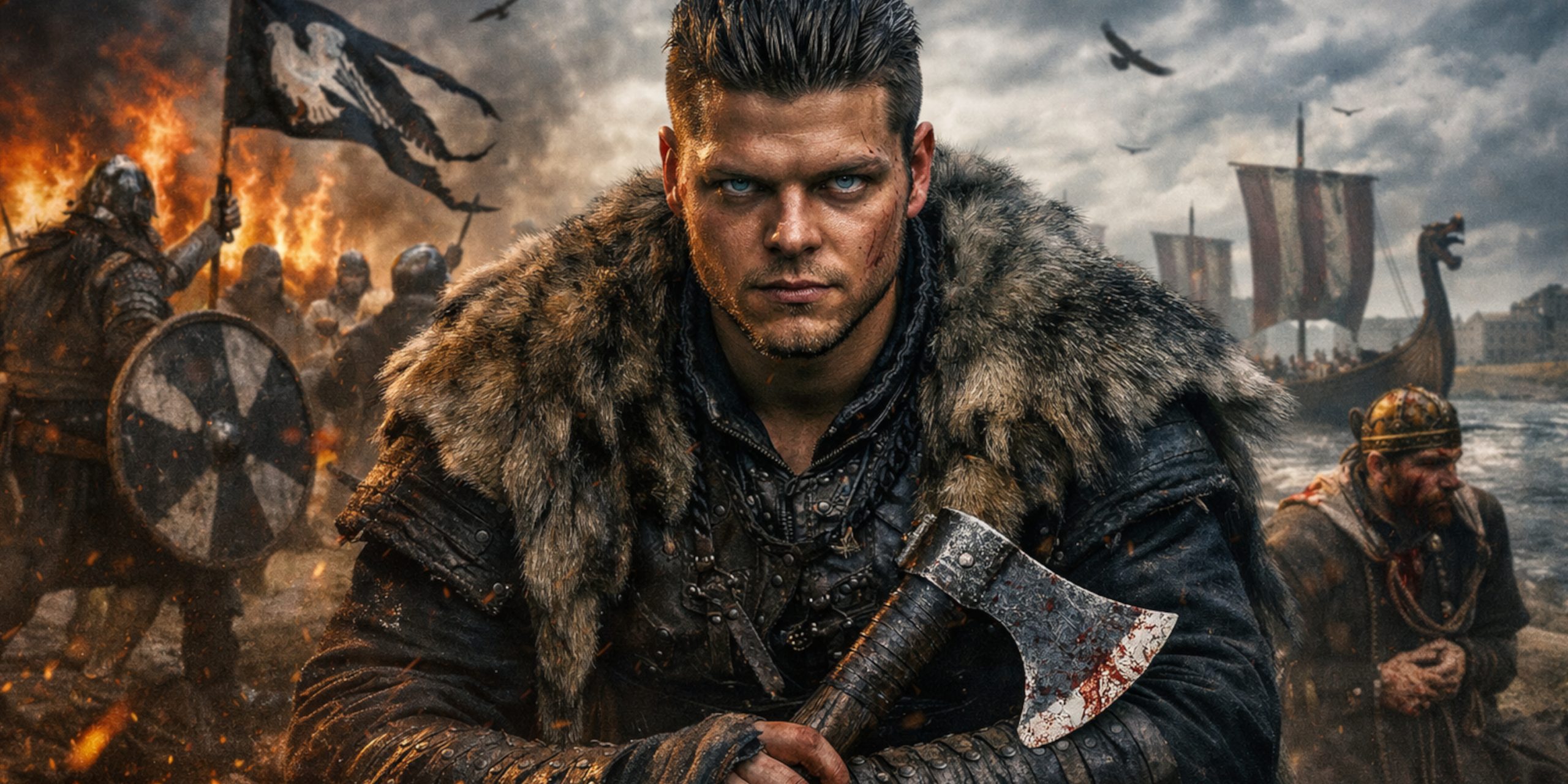
Few historical figures have had such a dramatic second life on television as Ivar the Boneless. In the History Channel’s Vikings, he is a ruthless tactician with burning blue eyes and a talent for psychological warfare. In medieval sources, he is something both stranger and harder to pin down.
So who was he really. A disabled warlord. A saga invention. A political mastermind. Or a little bit of all three.
Let’s separate what we know from what makes good television.
Who Was Ivar the Boneless
Ivar the Boneless was a Viking leader active in the mid to late ninth century. He is most strongly associated with the Great Heathen Army, the large Scandinavian force that invaded Anglo Saxon England in 865.
The main narrative sources come from later medieval texts, including the Icelandic sagas and the Anglo Saxon Chronicle. That means we are dealing with stories written generations after the events. Think memory filtered through myth.
What is fairly secure:
- He was one of the leaders of the Great Heathen Army.
- He operated in England and Ireland.
- He likely died around 873.
- He may have ruled in Dublin.
The “Boneless” nickname remains debated. Some historians suggest it refers to a medical condition such as osteogenesis imperfecta. Others argue it could be a metaphor for flexibility or even a mistranslation. Medieval nicknames were rarely subtle.
The Great Heathen Army
In 865, a large Viking force landed in East Anglia. The Anglo Saxon Chronicle describes it as a “micel here,” meaning a great army. Modern historians still debate its size, but it was clearly more organised and sustained than earlier hit and run raids.
Key campaigns linked to Ivar:
- Capture of York in 866
- Defeat of Northumbrian kings Ælla and Osberht
- Campaigns against Mercia
- Possible involvement in the martyrdom of King Edmund of East Anglia
The saga tradition claims Ivar killed King Ælla in revenge for the death of Ragnar. The famous blood eagle scene belongs to legend, not solid history. The Chronicle simply records Ælla’s death in battle. It does not describe theatrical execution methods.
Archaeology adds weight to the story of a substantial Viking presence. The mass burial at Repton in Derbyshire has been linked to the overwintering army of 873 to 874. That is real earth, real bones, not just saga drama.
Ivar in the Sagas
In texts like the Saga of Ragnar’s Sons, Ivar is presented as the son of Ragnar Lothbrok. He is clever, strategic and physically impaired from birth. The sagas describe him as being carried on a shield and unable to walk.
That does not mean he was weak. Quite the opposite. Saga Ivar compensates with intelligence and ruthlessness. He is the brain of the operation while his brothers handle brute force.
It is worth remembering that sagas are literary works, shaped by oral tradition. They reflect how later Scandinavians wanted to remember their past. That memory favoured dramatic lineage and poetic revenge.
Ivar in Vikings
In Vikings, Ivar is portrayed by Alex Høgh Andersen. The series leans heavily into his disability, presenting him as unable to walk without braces or crawling.
The show amplifies several traits:
- Extreme volatility
- Messianic self image
- Elaborate executions
- A near mythic aura
It also places him at the centre of events that in reality involved multiple leaders over several decades. Television thrives on focus. History is messier and rarely gives us a single villain or hero.
One clever aspect of the show is its emphasis on psychological warfare. While the details are fictionalised, Viking leaders did rely on intimidation and reputation. Fear was a weapon.
Still, the series compresses timelines, merges characters and invents motivations. Ragnar’s death at Ælla’s hands is itself uncertain. The neat revenge arc works brilliantly on screen. Historically, it is speculative at best.
Was Ivar Really Disabled
This is the question that refuses to go away.
Some historians have suggested osteogenesis imperfecta, a brittle bone disease. Others argue that a man with severe skeletal fragility would have struggled to lead sustained campaigns across England and Ireland.
Another theory suggests “boneless” could mean impotent, snake like, or even simply flexible in battle. Old Norse nicknames were often metaphorical and occasionally insulting.
The archaeological record does not give us a skeleton labelled “Ivar.” We do not have a medical file. What we have is ambiguity. Personally, I find the idea of a physically impaired war leader in the ninth century both plausible and compelling. Medieval warfare was not a weightlifting contest. Strategy mattered.
History vs Television: The Key Differences
Historically grounded elements:
- Ivar was real
- He led or co led a major invasion force
- He operated in both England and Ireland
- He was remembered as formidable
Television inventions or exaggerations:
- Clear revenge narrative tied to Ragnar
- Detailed blood eagle execution scenes
- Divine self proclamation
- Simplified political landscape
The real ninth century world was a web of shifting alliances, rival kings and practical objectives. Land, tribute and power drove events more than operatic revenge.
Why Ivar Still Fascinates
I think part of the appeal lies in contradiction. A figure described as physically limited who commands armies. A man who straddles the line between history and legend. A name that appears in chronicles yet feels half mythical.
For a generation raised on streaming epics, Ivar fits perfectly. He is complex, morally unstable and visually distinctive. But even without television, he would still matter. The Great Heathen Army reshaped Anglo Saxon England and helped pave the way for the Danelaw.
That is not just drama. That is structural change in the history of Britain.
Takeaway
The television version of Ivar the Boneless is compelling, intense and occasionally unhinged. The historical figure is harder to define but arguably more interesting. He stands at the intersection of saga, archaeology and political transformation.
If you strip away the cinematic lighting and slow motion executions, you are left with a ninth century war leader who helped alter the course of English history. That is impressive enough.
And frankly, it does not need special effects.