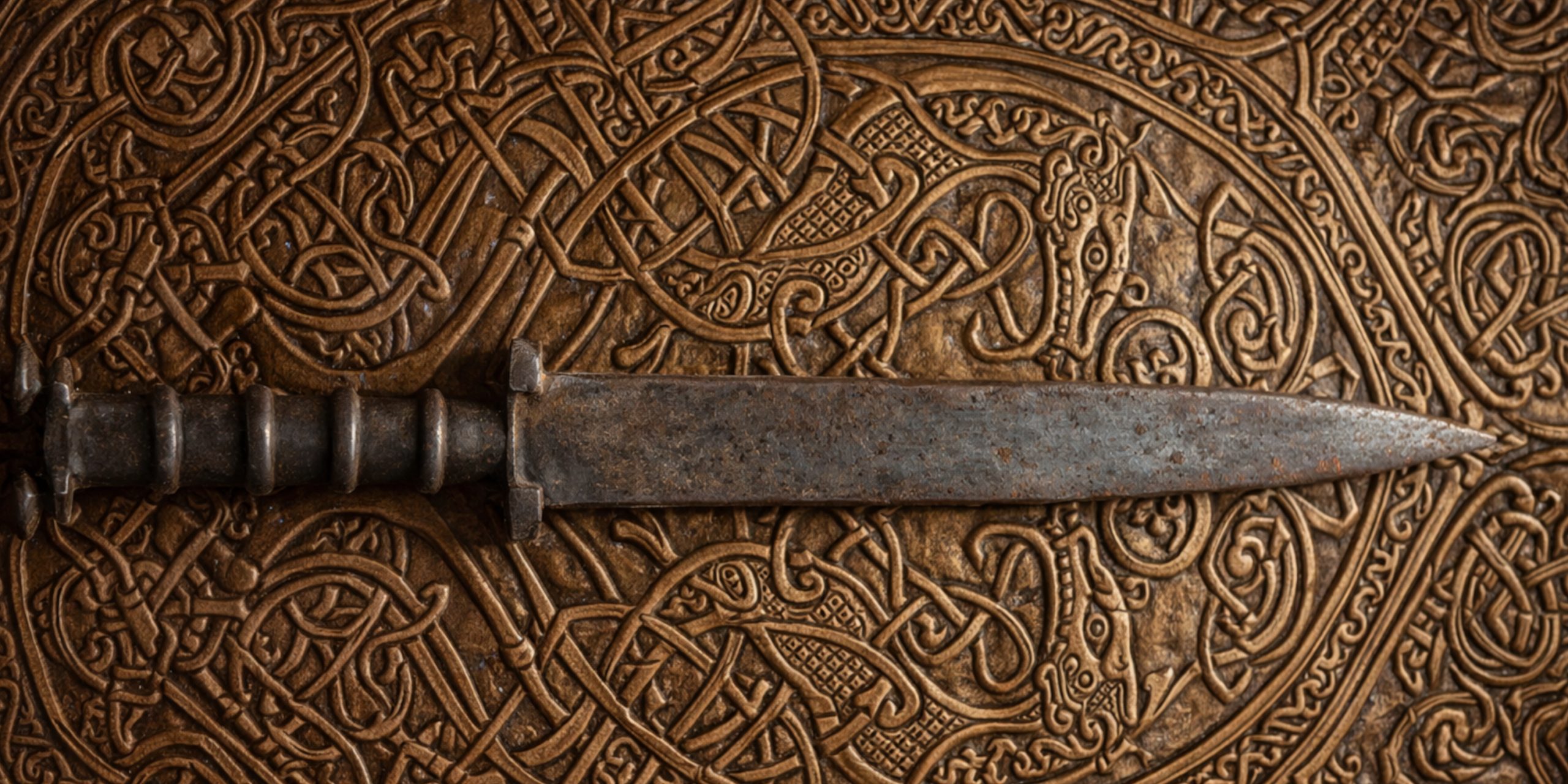
In pre Roman Spain, the leaf bladed sword belongs to a complex and regional story rather than a single “Spanish” type. The Iberian Peninsula sat at a crossroads between Atlantic Europe, the Mediterranean, and North Africa. As a result, early Iron Age swords show a blend of older leaf shaped cutting traditions and newer forms that would eventually lead to the famous Iberian falcata.
Iron leaf bladed swords appear most clearly in early Iron Age and Celtiberian contexts, particularly in central and eastern Spain, before narrowing profiles and curved single edged blades take over in the later pre Roman period.
Specifications
The figures below reflect Spanish and Celtiberian finds rather than continental averages.
| Feature | Common range in Iberia | Notes |
|---|---|---|
| Date band | c. 800 BCE to 300 BCE | Leaf profiles fade earlier than in northern Europe |
| Overall length | 60 to 80 cm | Generally shorter than later La Tène swords |
| Blade length | 55 to 70 cm | Compact, authority focused blades |
| Blade form | Double edged, leaf shaped or gently waisted | Strong cutting belly |
| Construction | Forged iron blade, organic hilt | Wood and bone dominate |
| Scabbard | Organic core with iron fittings | Decoration more restrained than later types |
Spanish examples tend to favour practical proportions suited to rugged terrain and mobile fighting, rather than extreme reach.
History and evolution in Spain
Early Iron Age foundations
- Leaf bladed swords in Iberia emerge from late Bronze Age traditions combined with early iron forging.
- These weapons are associated with local warrior elites rather than massed infantry.
Celtiberian context
- Among Celtiberian groups, double edged leaf shaped blades coexist with straight edged swords and daggers.
- Burial finds suggest swords were personal weapons, often deposited with the individual rather than recycled.
Transition to distinctive Iberian forms
- By the fourth to third centuries BCE, leaf bladed swords give way to more regionally distinctive designs.
- The curved falcata becomes dominant in eastern and southern Iberia, while straight swords persist inland.
- Roman authors later comment on Iberian blade quality, suggesting local ironworking had reached a high level by the time Rome arrived.
Advantages and disadvantages
| Category | Advantages | Disadvantages |
|---|---|---|
| Cutting power | Excellent against lightly armoured opponents | Less effective versus mail or heavy shields |
| Handling | Compact, decisive, good for uneven terrain | Shorter reach than northern Iron Age swords |
| Versatility | Works well with shield based fighting | Limited thrusting efficiency |
| Durability | Simple forged construction | Surviving examples often heavily corroded |
In Iberian warfare, where skirmishing and aggressive shield use mattered, the leaf blade’s cutting authority made sense.
Comparison with similar Iberian weapons
| Weapon | Key differences | Role |
|---|---|---|
| Bronze leaf sword | Earlier, cast bronze | Prestige and cutting |
| Celtiberian straight sword | Narrower profile | Improved reach and thrust |
| Iberian falcata | Single edged, curved | Powerful chopping blows |
| Roman gladius | Short, rigid, thrust focused | Formation fighting |
The leaf bladed sword represents a transitional stage, sitting between older Bronze Age styles and the later, highly specialised Iberian blades.
Legacy in the Iberian Peninsula
- Leaf bladed swords helped establish local iron forging traditions that later produced some of Rome’s most feared opponents.
- Their decline marks a shift toward more specialised regional weapons rather than a simple technological failure.
- Spanish archaeology shows fewer ritual water deposits than Britain, with more emphasis on burial and settlement contexts.
Where to see examples in Spain
Notable examples and related material can be seen in major Spanish collections:
- Museo Arqueológico Nacional
Holds Iberian and Celtiberian weapons, including early Iron Age swords and scabbard fittings. - Museu d’Arqueologia de Catalunya
Strong material from eastern Iberia, useful for understanding the transition toward the falcata. - Museo Arqueológico Provincial de Alicante
Regional context for Iberian arms and armour.
Gallery displays are useful for form, but study collections and catalogues are far better for measurements and construction details.
Collector’s guide, authenticity, and auction prices
Provenance and legality
- Spanish material requires careful documentation, especially for export.
- Claims of Iberian origin without paperwork should be treated cautiously.
Condition realities
- Most iron blades survive in mineralised condition.
- Hilts are often reconstructed, sometimes imaginatively.
Typical market ranges
| Tier | Description | Common price range |
|---|---|---|
| Entry | Blade fragments or incomplete swords | Hundreds to low thousands |
| Mid | Mostly complete sword, limited decoration | Low thousands |
| High | Sword with associated scabbard fittings and strong provenance | Several thousand pounds |
True Iberian leaf bladed swords appear less frequently on the market than falcatas, which increases competition for well documented examples.
Buying checklist
- Demand clear provenance and export documentation
- Examine corrosion patterns for consistency
- Be wary of blades that look overly cleaned or symmetrical
- Ask about stabilisation and conservation history
Storage and care
- Keep humidity stable
- Avoid oils or polishing
- Support the blade evenly if displayed