The reputation of the Huscarl still stirs something in me. They come across as the sort of soldiers who stepped onto a battlefield knowing exactly what they were about to do and refusing to flinch. Part household guard, part status symbol, part terrifying line breaker, they shaped Anglo Scandinavian warfare with a professionalism that feels almost modern in a world that was anything but.
They were not superhuman, despite what later romantic writers insisted. They were simply paid, trained and expected to hold. Most did. Some broke. All were part of a military culture that left a surprisingly rich trail in text, metal and bone.
Origins And Social Role
The term Huscarl comes from Old Norse húskarl meaning house man. These were retainers who owed loyalty to a lord in return for pay, food and a place within the household. Scandinavian warbands brought the concept into England, where it was refined into a standing corps under King Cnut and his successors.
By the mid eleventh century the English king relied heavily on them. They guarded the royal household, formed the core of field armies and acted as tax enforcers when needed. They were, in simple terms, the men you sent when you wanted something to stay safe or someone to behave.
They also cost a small fortune to maintain. Their pay helped cultivate a sense of discipline that the fyrd militia could not match. You can almost feel the tension between professional soldiers and part time farmers whenever chroniclers throw a subtle jab about the reliability of one over the other.
Arms And Armour
This part of their story is often blown out of proportion, yet their kit really was better than average. Plenty of finds and written accounts help us pin things down with a reasonable degree of confidence.
Weapons typically associated with Huscarls
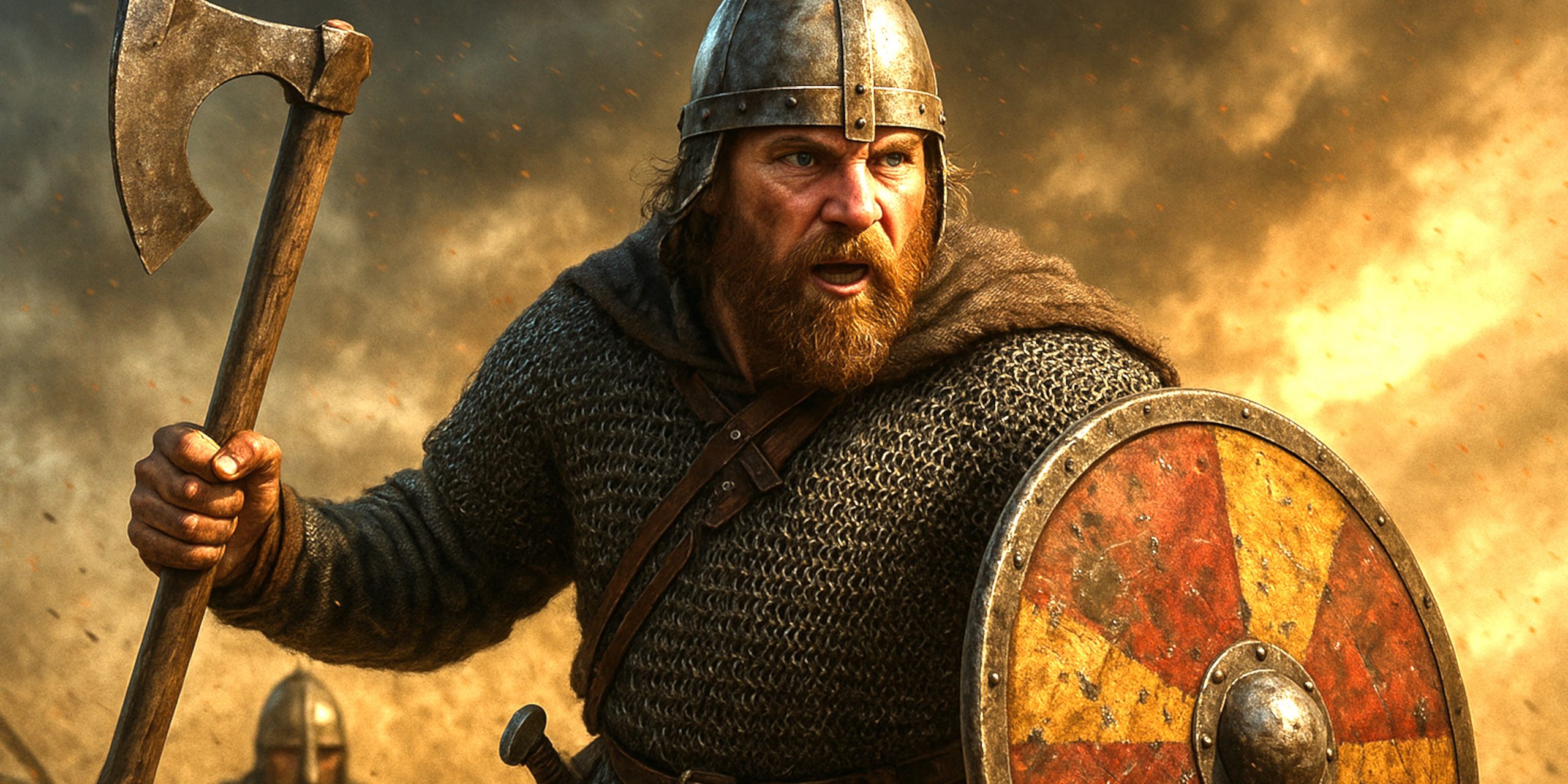
- Long handled Dane axe, the iconic bearded two handed axe used for hacking shields, cutting limbs and creating space in tight shield formations.
- Single handed axes of Scandinavian form, often used as secondary weapons.
- Swords of high status. Patterns vary, but many were late Viking Age types such as Petersen Type X, XI or XII blades. Straight, double edged and intended for decisive cuts rather than elaborate techniques.
- Spears, sometimes long thrusting spears for use in the shieldwall.
- Seaxes as utility blades, though not usually prestige pieces by this period.
Armour typically associated with Huscarls
- Mail hauberks reaching mid thigh. Sometimes with longer sleeves depending on wealth and era.
- Conical helmets with nasal guards. A few might have had spectacle masks, though these are less common in England.
- Round shields early on, slowly replaced or supplemented by kite shields as Norman influence grew.
- Gambesons or padded under armour layers to absorb shock, though preservation makes this harder to confirm.
There is a lingering idea that Huscarls always wielded two handed axes. In truth many fought with spears and shields. Axemen tended to operate in the front rank where their reach mattered most.
Battlefield Role And Tactics
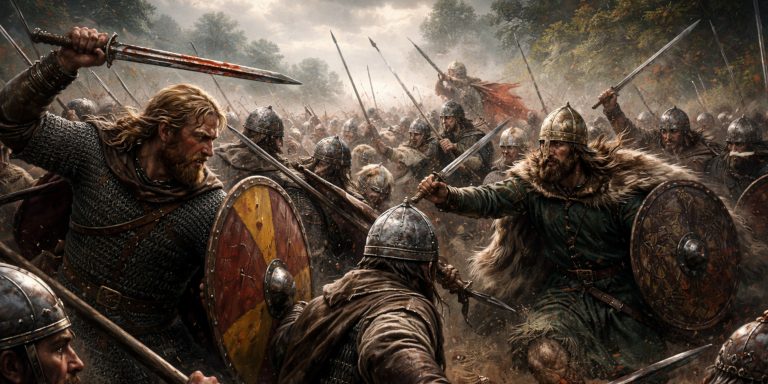
They formed the reliable spine of an English army. In shieldwall combat they stood in front, middle or rear depending on their weapons. Chroniclers often marked them out as the men who held the king’s banner, which is both an honour and a great way to get killed first.
Their discipline is what made them dangerous. Shieldwall fighting was an exhausting exercise in timing, patience and aggression. A gap meant death. A slip in footing meant death. The Huscarl was paid to make fewer mistakes than the men beside him.
At Hastings they fought with the stubborn focus of professionals who understood exactly what was at stake. Watching from eleven centuries away, it is hard not to admire the sheer misery of their task.
Archaeology
Archaeology gives us fragments of the world they inhabited. Graves in England and Scandinavia reveal axe heads with long sockets, sword hilts of Anglo Scandinavian style and the occasional helmet fragment that helps tighten our dates.
The Staffordshire Hoard, although earlier, offers a sense of the wealth and craftsmanship surrounding high status warriors who lived within royal or noble retinues. Later finds at various Anglo Scandinavian sites show weapon marks on bones, particularly heavy chopping injuries consistent with axes of the type they carried.
Excavations at sites like York, Winchester and rural manor complexes show a blend of elite and everyday martial items. Metal detectors continue to turn up axe heads of types associated with professional retainers. None of this paints the full picture, but each piece adds confidence that the textual accounts did not exaggerate everything.
Contemporary Voices
A few medieval writers left remarks that help sketch their character. Some admired them, others feared them, and at least one sounded slightly irritated at how much the treasury had to pay them.
- The Encomium Emmae speaks of the king’s household troops as valiant men who feared nothing in battle.
- The Anglo Saxon Chronicle describes the king’s hearth troops standing fast even when militia units faltered.
- A later Norman writer commented that the English axemen were fearsome in the first clash, which feels like grudging respect.
There is always bias in these sources, but the general mood is clear. These men were held to a higher standard and usually lived up to it.
After The Norman Conquest
The corps collapsed with the defeat of Harold Godwinson. Some Huscarls died at Hastings, some entered Norman service, and others drifted into exile. A number are believed to have travelled east to join the Varangian Guard in Byzantium. It is strangely poetic that warriors once shaped by Scandinavian influence found themselves serving a Mediterranean emperor.
The term survives in various forms, but the English Huscarl as a military institution ended in 1066.
Legacy
The Huscarl occupies a place somewhere between historical reality and popular imagination. They were not an unbeatable super troop, yet they were skilled and impressively equipped for their time. Whenever the English crown could afford them, they became the closest thing the kingdom had to a standing army.
Their legacy survives in the romantic image of the great axe swinging warrior at Hastings, cutting through Norman shields with grim determination. As a historian, I admit there is something satisfying in knowing that even the most disciplined medieval force depended on a handful of well paid, slightly irritable professionals trying not to get killed before lunch.
Watch the documentary: