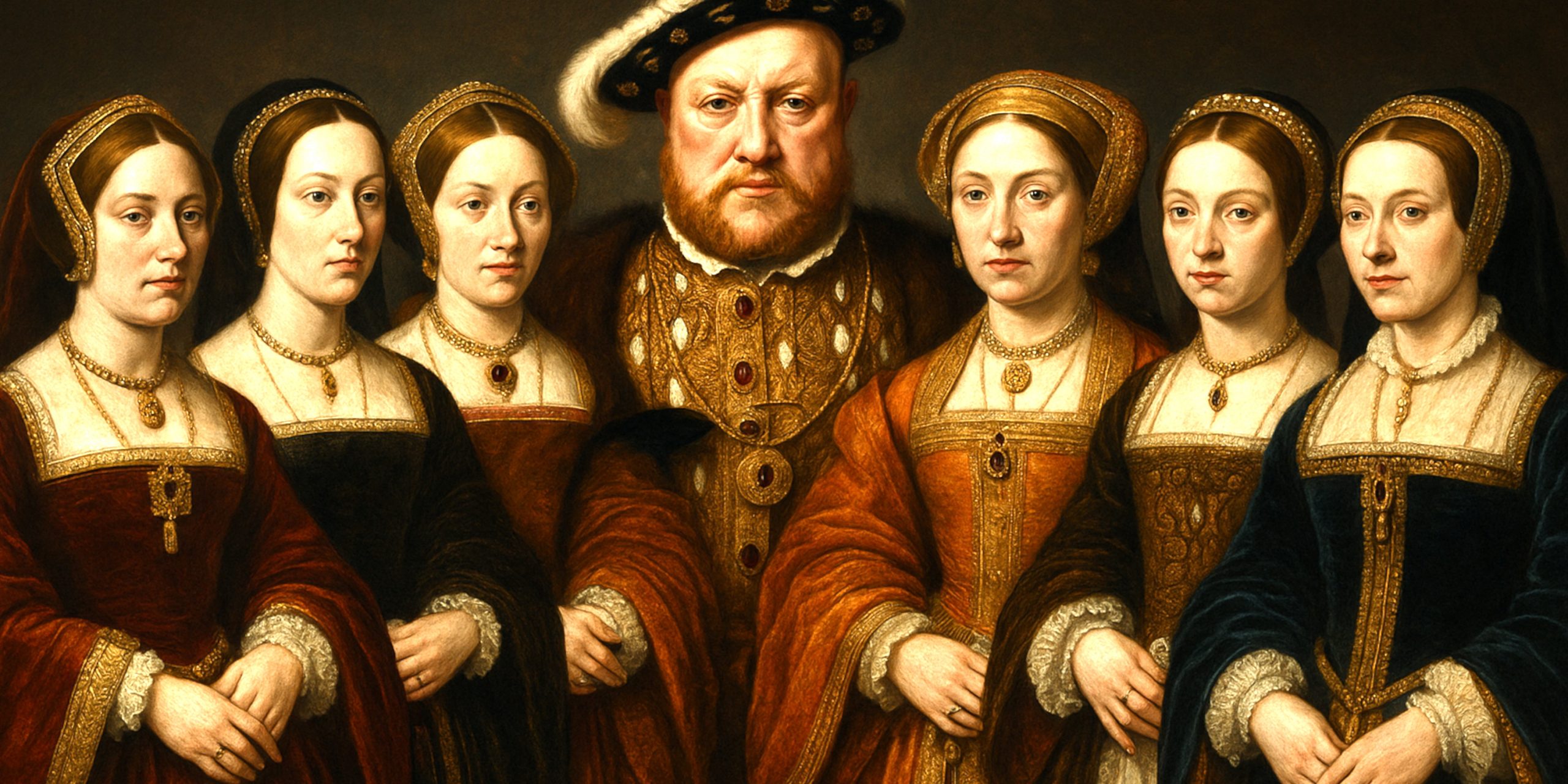
When discussing Henry VIII’s wives, the historian quickly discovers that Tudor England was never short of opinions. Fortunately, a fair number of those opinions were written down at the time, so we can let a few voices from the sixteenth century wander into the room and comment for themselves.
What follows is the longer feature, now supported by contemporary observations that help sharpen the picture.
Catherine of Aragon
A Life Shaped by Europe
Catherine’s political instincts were evident to those around her. When Henry fought in France in 1513, she acted as regent. After the English victory at Flodden, she wrote proudly to Henry:
“This day we have taken the King of Scots slain in battle, which news I thought to bring you myself.”
Letter from Catherine to Henry, 1513.
Her courage and clarity were noted by foreign ambassadors. The Venetian diarist Giustinian wrote:
“She is a most distinguished woman, more learned than any lady in England.”
Myths and the voices behind them
The myth of Catherine as meek contradicts the image painted by those who met her. Even Henry admitted her strength, once remarking privately that she was “as obstinate as she is clever.”
The contested question of her marriage to Arthur is wrapped in political fog. Catherine insisted firmly:
“I was a true maid without touch of man.”
Deposition to papal legates, 1529.
Anne Boleyn
A Woman at the Heart of Reform
Anne impressed and unnerved observers in equal measure. The French poet Lancelot de Carles described her intelligence with a mixture of admiration and caution:
“She had eyes always alert, her mind most quick and her wit incomparable.”
Her interest in religious reform was genuine. She gifted Henry a copy of Tyndale’s works, and the reformist scholar William Latimer later reflected:
“The Queen’s Grace favoured the promotion of God’s word.”
Myths and their sources
Anne’s enemies sharpened their knives before her fall. The imperial ambassador Eustace Chapuys, hardly her greatest admirer, nevertheless conceded:
“I cannot deny that she is very intelligent.”
The posthumous stories about deformities came not from medical examinations but from hostile chronicles. Lancelot de Carles again tried to steady the tale, writing shortly after her execution:
“She was reputed beautiful, and certainly she was graceful.”
Jane Seymour
Poise, Caution and Legacy
Jane’s brief queenship is quieter in the sources, yet the Spanish ambassador Eustace Chapuys offered a revealing snapshot:
“The new Queen is of middle stature and very pale. She is of gentle character.”
Her efforts to restore Princess Mary to favour earned praise from contemporary observers. The humanist Roger Ascham later noted the calming change in the court’s atmosphere, crediting Jane’s influence.
Myths and testimonies
Jane is often painted as timid, yet Chapuys hinted at more nuance:
“She may appear meek, but she is not without spirit.”
Henry’s later praise of her as his “best beloved wife” is often taken at face value. It is worth remembering that the remark was made after her death when nostalgia did most of the work.
Anne of Cleves
Politics, Portraits, and Pragmatism
Holbein’s portrait of Anne was admired at the time. The chronicler Edward Hall wrote of her arrival:
“She showed herself to be of good countenance and cheerful behaviour.”
Chapuys, usually keen to criticise when possible, conceded:
“She is tall and of goodly presence.”
Myths challenged by contemporary voices
The myth of Anne’s unattractiveness grows weaker the closer we get to Tudor observers. Even Henry’s own account of their first meeting sounds more like wounded pride than honest appraisal.
After the annulment, Anne wrote graciously to Henry:
“I take your Majesty’s friendship to be more than a marriage.”
This is what political survival looks like in letter form.
Catherine Howard
Youth in a Predatory Court
Catherine’s downfall was narrated by others, which is part of the tragedy. Archbishop Cranmer reported her confession with striking sympathy:
“She wept sore, desiring God to forgive her offences.”
The French ambassador Marillac described her vulnerability rather than malice:
“She is young and without great judgement.”
The myths that stripped away her humanity
Later writers tried to reduce her to a foolish flirt. Yet even Henry’s councillors admitted privately that she had been poorly guided. One court observer wrote in 1541:
“The Queen had not been well instructed in her youth.”
Such understatement borders on brutal honesty.
Catherine Parr
A Scholar on the Throne
Catherine published her own devotional works, giving us her voice directly. In her preface to Prayers or Meditations she wrote:
“I have followed the counsel of Saint Paul to edify the congregation.”
Contemporary scholars admired her intellect. The reformist John Foxe later praised her:
“A woman of singular learning, wise and discreet.”
Myths corrected by the record
Catherine as nursemaid is a myth that collapses the moment you read Henry’s commission making her regent in 1544. The document grants her authority to act in all matters concerning the kingdom.
Even the story of her near arrest is softened by her own quick wit. She told Henry:
“I only disputed to learn from your Majesty’s greater wisdom.”
A sentence that probably saved her life.
Why Tudor Myths Endure
Contemporary voices offer texture that later stories smooth away. Ambassadors, poets, clerics, and the queens themselves speak with their own agendas, but even through the bias you can see authentic glimpses of character.
These six women were not lessons in a rhyme. They were political actors navigating one of the most volatile courts in Europe. The myths survive because they are tidy. The truth survives because it is stubborn.
Watch the documentary: