The Thorakitai occupa fascinating corner of Hellenistic warfare. They are not the immovable wall of the phalanx nor the elusive skirmishers darting about its edges. Instead, they sit somewhere in between, which is precisely why historians keep circling back to them.
The name itself comes from thorax, meaning cuirass. It suggests protection first, flexibility second. That alone hints at their purpose. These were soldiers expected to move, adapt, and hold their own in places where a dense phalanx would struggle. If the Macedonian system was a carefully arranged machine, the Thorakitai were the parts that could still function when that machine started to creak.
Origins and Development
The Thorakitai emerge in the 3rd century BC, during the long and often messy aftermath of Wars of the Diadochi. The great successor kingdoms inherited the Macedonian military model, but they also inherited its limitations.
The phalanx remained dominant, but it was increasingly clear that it lacked flexibility. Campaigns across Asia Minor, Syria, and Greece brought armies into rough terrain, cities, and irregular engagements. Commanders needed troops who could fight in looser formations without abandoning discipline altogether.
That gap produced the Thorakitai.
They likely evolved from earlier peltasts, particularly the heavily equipped variants that had already begun to blur the line between light and medium infantry. By the time we see them clearly in sources, they are equipped for close combat and capable of operating independently or alongside heavier troops.
Polybius, writing in the 2nd century BC, provides one of the clearer glimpses. He describes troops who are not quite phalangites, not quite skirmishers, but something deliberately hybrid. One suspects he understood their value, even if he preferred the tidy logic of the Roman legion.
Role on the Battlefield
Thorakitai were versatile by design. They could:
- Support the flanks of a phalanx
- Engage in broken or uneven terrain
- Conduct assaults on fortified positions
- Skirmish when necessary, though not as lightly as traditional peltasts
Their flexibility made them particularly useful in the increasingly complex warfare of the Hellenistic period. Armies were no longer meeting on conveniently flat plains out of mutual courtesy. Sieges, ambushes, and manoeuvre warfare demanded troops who could think on their feet.
In practical terms, Thorakitai often acted as a bridge between rigid and fluid tactics. If the phalanx was the anvil, these men were sometimes the hammer, or at least the part of the army that could reach the fight without tripping over its own formation.
Arms and Armour
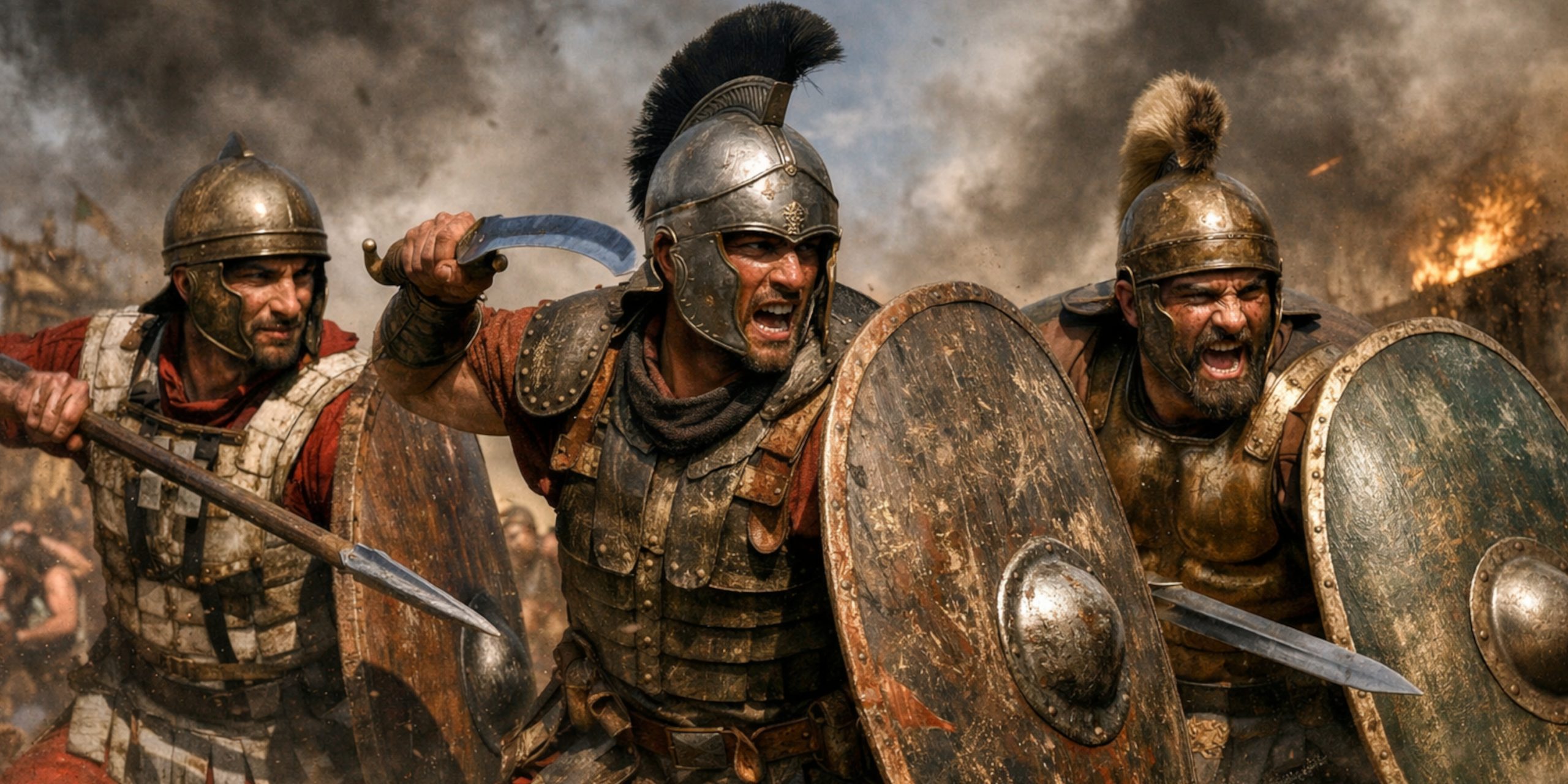
The defining feature of the Thorakitai is their equipment, which reflects their hybrid role.
Armour
- Linothorax or muscle cuirass
The name Thorakitai implies the use of a thorax. This could be a layered linen cuirass or, for wealthier soldiers, a bronze muscle cuirass. Protection mattered, but weight had to be manageable. - Helmet
Common types included Hellenistic variations of the Phrygian or Montefortino helmets. These offered good visibility, which suggests an expectation of active, mobile combat. - Greaves
Not universal, but often present. Again, a balance between protection and mobility.
Shield
- Thureos
The large oval shield is central to their identity. Derived from Celtic designs, it provided more coverage than the traditional Greek hoplon while remaining lighter and easier to handle on the move.
Weapons
- Spear or javelin
Likely carried both thrusting spears and lighter throwing weapons, allowing them to engage at multiple ranges. - Sword types
Thorakitai would have used several Hellenistic sword forms:- Xiphos
A straight, double-edged blade suited for thrusting in close quarters. - Kopis
A forward-curving blade designed for powerful cuts. Particularly effective against lightly armoured opponents. - Machaira
Similar to the kopis, often used interchangeably in sources, though sometimes with subtle differences in curvature.
- Xiphos
The mix of equipment suggests a soldier prepared for unpredictability. If a Thorakitai found himself in a tight melee, he was equipped for it. If the fight required movement and missile use, he could manage that too.
Organisation and Tactics
Thorakitai were not a uniform troop type across all Hellenistic kingdoms. Their organisation likely varied between the Seleucid, Antigonid, and Ptolemaic armies.
In the Seleucid Empire, they appear as a recognised infantry class, sometimes grouped with other flexible units. In the Ptolemaic Kingdom, similar troops existed, though the terminology and equipment could differ slightly.
They fought in looser formations than the phalanx, allowing for:
- Rapid redeployment
- Independent action in smaller units
- Adaptation to terrain and changing battlefield conditions
There is a quiet practicality to this. While generals still adored the visual and psychological impact of the phalanx, they increasingly relied on troops like the Thorakitai to make that system actually work in the real world.
Archaeology
Direct archaeological evidence for Thorakitai as a distinct unit is limited, which is both frustrating and entirely typical.
What we do have includes:
- Shield remains and depictions
The thureos appears in reliefs, frescoes, and some surviving fragments. Its widespread depiction supports the idea of a distinct troop type associated with it. - Weapons finds
Swords such as the xiphos and kopis are well attested across the Hellenistic world. While not exclusive to Thorakitai, their presence aligns with the expected equipment. - Helmets and armour
Montefortino and similar helmets are common finds, reinforcing the broader pattern of adaptable infantry equipment.
Experimental archaeology has been particularly helpful. Reconstructions of the linothorax and thureos show that these items offer a practical compromise between protection and mobility. In other words, the Thorakitai were not just a theoretical solution. Their kit actually works.
Contemporary Sources and Quotes
Ancient authors rarely pause to give us neat definitions, which is inconvenient but honest.
Polybius provides one of the more useful perspectives. While he does not romanticise Hellenistic armies, he acknowledges the presence of more flexible infantry types alongside the phalanx.
“The phalanx is irresistible so long as it maintains its proper formation…”
It is the unspoken second half of that thought which matters. Once that formation breaks, troops like the Thorakitai become essential.
Livy, writing about conflicts involving Hellenistic armies, also hints at varied infantry roles, even if he does not always use consistent terminology.
“The nature of the ground itself often decides the battle…”
A line that might as well be addressed directly to the Thorakitai. They existed precisely because the ground refused to cooperate.
Strengths and Limitations
Thorakitai were effective because they were adaptable, but that adaptability came with trade-offs.
Strengths
- Flexibility in varied terrain
- Capability in both missile and close combat
- Better mobility than heavily armoured infantry
Limitations
- Less cohesion and shock power than a phalanx
- Not as specialised in skirmishing as lighter troops
- Equipment and training likely varied in quality
They were, in essence, a compromise. A useful one, but still a compromise. Ancient armies, like modern ones, rarely get everything they want in a single unit.
Legacy
The Thorakitai represent a broader shift in Hellenistic warfare. Armies were becoming more complex, more layered, and more realistic in their expectations.
Their influence can be seen in the gradual move toward more flexible infantry systems, culminating in the success of the Roman legion. It would be too neat to say the Romans simply replaced them, but the comparison is hard to ignore.
Where the Hellenistic world experimented with hybrid troops, Rome refined the concept into a system that could function consistently across varied conditions. The Thorakitai feel like an important step along that road.
Takeaway
There is something quietly appealing about the Thorakitai. They lack the grandeur of the phalanx and the romantic image of elite cavalry, yet they may have done more to keep Hellenistic armies functioning than either.
They are the soldiers of uneven ground, awkward encounters, and battles that refused to follow a script. History rarely celebrates that sort of reliability, but it tends to depend on it.