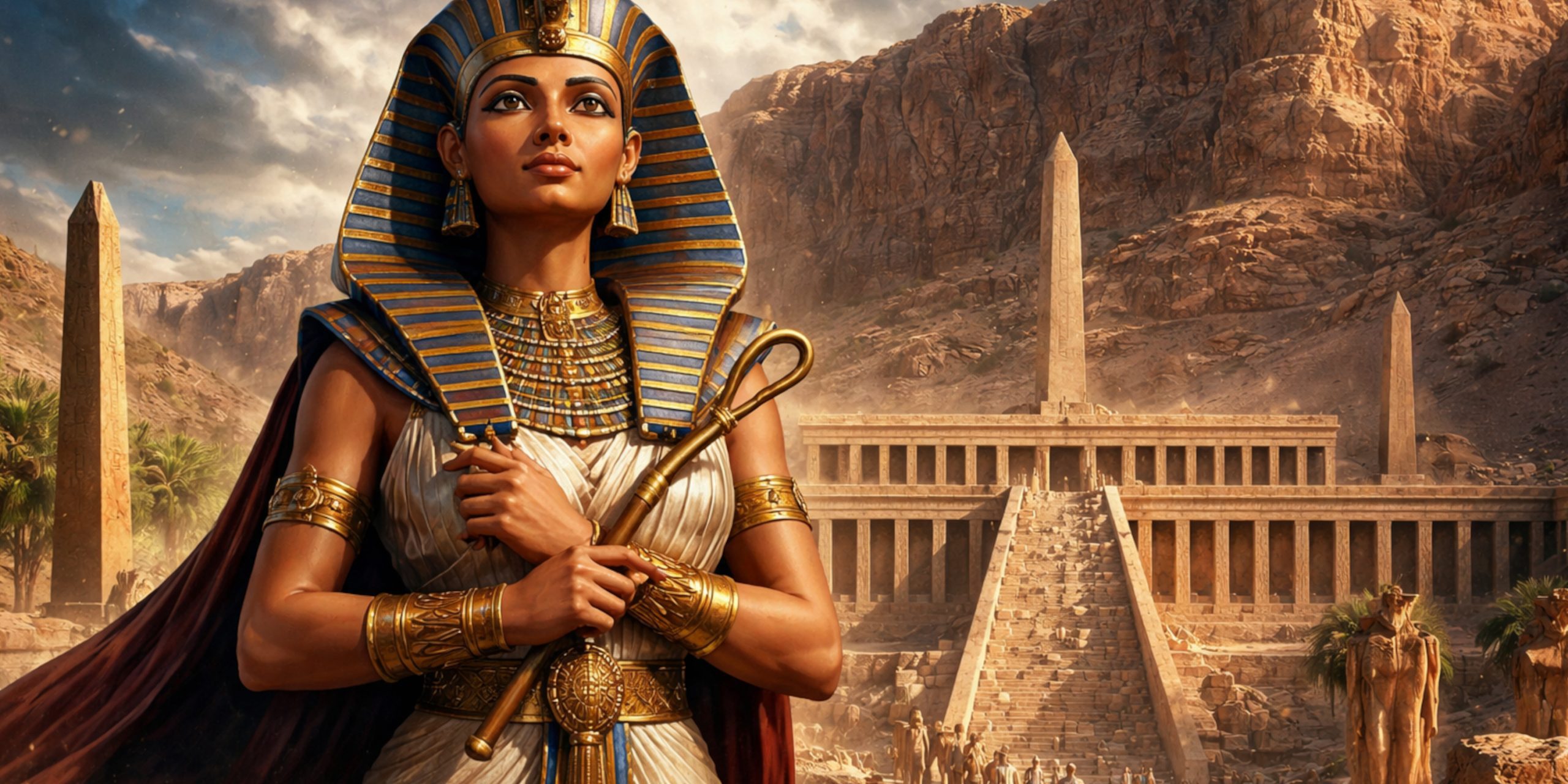
Few rulers of ancient Egypt have been so carefully edited out of history and yet refused to disappear. Hatshepsut ruled during the Eighteenth Dynasty, around 1479 to 1458 BC, and did so not as queen consort or regent but as pharaoh in her own right.
She adopted full royal titulary, wore the false beard, and commissioned statues showing herself in the idealised male form of kingship. It was not theatrical eccentricity. It was political clarity. Egypt expected a king, so she became one.
Her reign stands out not for reckless conquest but for consolidation, statecraft, and a building programme so ambitious that later rulers struggled to ignore it. As a historian, I find her reign quietly formidable. She understood that legitimacy rests as much on stone and ceremony as it does on swords.
Early Life and Path to Power
Hatshepsut was the daughter of Thutmose I and became Great Royal Wife to her half brother Thutmose II. When he died, the heir Thutmose III was still a child.
Initially she ruled as regent. Within a few years she assumed full pharaonic titles. Reliefs depict a carefully staged coronation narrative, complete with divine endorsement from Amun. Egypt did not collapse in protest. Administration continued, temples functioned, and trade flourished. Stability can be more persuasive than ideology.
Royal Ideology and Representation
Hatshepsut’s monuments reveal an acute awareness of image. Early statues show her in feminine form. Later examples present her in the standard male royal body, kilted and broad shouldered, yet still bearing inscriptions using feminine grammar.
The message was subtle but firm. Kingship was an office, not a gender. The regalia mattered more than biology.
Her mortuary temple at Deir el Bahri remains the clearest architectural statement of her authority.
The Mortuary Temple at Deir el Bahri
The temple at Mortuary Temple of Hatshepsut is one of the masterpieces of New Kingdom architecture. Its terraced colonnades rise against the cliffs of western Thebes with an austere confidence that still commands attention.
Reliefs within depict her divine birth and the celebrated expedition to Punt. The artistic programme is deliberate. It anchors her rule in theology, prosperity, and international prestige.
When I first saw the site, what struck me was not grandeur but balance. It is architectural persuasion in limestone.
Arms and Armour of the Hatshepsut Era
Egypt in the mid fifteenth century BC was a military state in formation. The campaigns of earlier and later rulers framed her reign, and the army remained central to royal authority.
Typical equipment of Egyptian forces during her time included:
Offensive Weapons
- Composite bows with horn and sinew reinforcement
- Bronze tipped arrows
- Bronze spears and thrusting lances
- Daggers with cast bronze blades
- Early sickle swords, or khopesh, increasingly adopted from Near Eastern forms
Defensive Equipment
- Leather or linen corselets
- Wooden shields covered with hide
- Helmets were rare, though some leather head protection existed
Chariots had been introduced into Egypt shortly before her dynasty and were becoming integral to elite warfare. Though not yet deployed in the grand mass formations of later reigns, they symbolised royal power and mobility.
Weapons from this period can be seen today in institutions such as the Egyptian Museum and the British Museum, where bronze daggers and decorated axes illustrate the craftsmanship of the era.
Battles and Military Acumen
Hatshepsut is often portrayed as purely peaceful. The record is more nuanced.
Inscriptions refer to campaigns in Nubia and possible action in the Levant. These were likely continuations of existing imperial policy rather than grand new conquests. Nubia in particular was economically vital, providing gold and manpower.
Her strategy appears conservative but effective:
- Maintain Egyptian dominance in Nubia
- Preserve trade routes to the Levant
- Project authority without exhausting resources
Her most famous foreign enterprise was the expedition to Punt, usually identified with the Red Sea or Horn of Africa region. Though not a battle, it required logistical organisation and maritime capability. The reliefs show ships laden with incense trees, ebony, ivory, and exotic animals. It was economic statecraft in action.
Military command in the field likely rested with senior officials and, in time, the young Thutmose III. She governed at the centre, keeping the machine steady.
Administration and Prosperity
Her reign coincided with internal stability and wealth. Tribute flowed from subject territories. Temple endowments increased. Large scale quarrying and obelisk erection demonstrated logistical confidence.
The obelisks she raised at Karnak, carved from single blocks of granite, remain among the tallest ever erected in Egypt. They are less about decoration and more about proclamation.
Artefacts and Where to See Them
Objects from Hatshepsut’s reign survive across major collections.
- The seated and kneeling statues from Deir el Bahri, many reconstructed after ancient damage, are displayed in the Metropolitan Museum of Art and Cairo
- Fragments of relief from her temple remain in situ at Deir el Bahri
- Obelisks at Karnak still stand within the precinct of Amun
- Small finds including scarabs and inscribed blocks appear in European and American museums
The dispersal of her monuments tells its own story. Many were deliberately defaced after her death, likely during the later reign of Thutmose III or his successor. The damage was systematic, targeting names and royal images. It was political memory control in stone.
Latest Archaeological Findings
Recent conservation work at Deir el Bahri has refined our understanding of the temple’s original colour scheme. Traces of pigment confirm that the pale limestone façade was once vividly painted.
Ongoing excavations in the Theban necropolis continue to uncover administrative ostraca and minor officials’ tombs dating to her reign, providing insight into the bureaucratic world that sustained her rule.
Scholarly reassessment of inscriptions also suggests that the erasure of her memory was selective rather than immediate, complicating earlier assumptions about a swift and total damnatio memoriae.
Death and Legacy
Hatshepsut likely died in her early fifties. A mummy identified through dental analysis is widely believed to be hers, though debates persist.
After her death, Thutmose III emerged as one of Egypt’s greatest military conquerors. His campaigns overshadowed her measured governance. Yet it is worth remembering that he inherited a stable and wealthy kingdom.
Her legacy rests not on battlefield glory but on statecraft, architecture, and resilience. She proved that kingship in Egypt could be embodied in different forms without fracturing the state.
As a historian, I find that more impressive than a dozen campaigns carved in triumphal relief.
Takeaway
Hatshepsut’s reign challenges easy narratives. She was neither a pacifist anomaly nor a mere caretaker. She was a political strategist who understood symbolism, administration, and controlled power.
Her monuments still rise above the Nile valley. Attempts to erase her name have only sharpened modern curiosity. In the end, stone endures longer than rivalry.