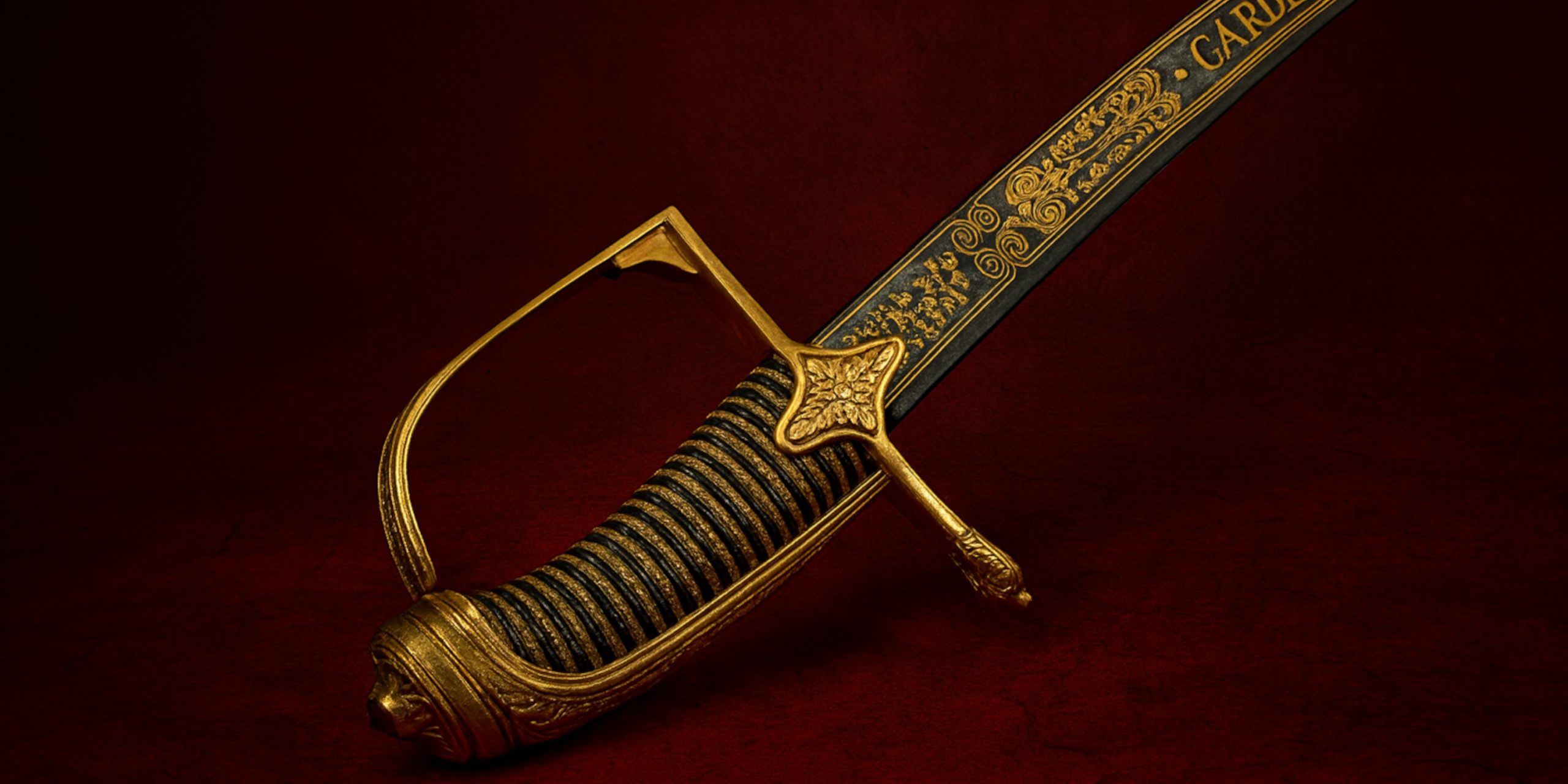
The French Empire Guard Officer’s Sword sits among the most recognisable symbols of Napoleonic military culture. It blends ceremony with battlefield practicality, and although it carries the flourish of an elite officer’s badge of rank, it was also designed to be used in earnest. The ornate examples made for the Imperial Guard reveal how Napoleon’s government fused classical taste, neoclassical lines, and martial bravado into a single weapon. The best surviving pieces feel almost theatrical, yet they speak clearly about the ambitions of the Empire and the men who served it.
Specifications
| Feature | Details |
|---|---|
| Classification | Curved sabre for officers of the French Imperial Guard |
| Blade length | Commonly 80 to 90 cm |
| Blade type | Single edged, curved sabre blade with blue and gilt decoration on ceremonial examples |
| Hilt | Brass or gilt brass with wire bound grip, typically black leather beneath |
| Guard | Half basket or stirrup guard with neoclassical motifs |
| Scabbard | Brass mounted leather or all brass for parade versions |
| Weight | Usually between 900 g and 1.1 kg |
| Primary use | Cavalry and mounted officers, with status display in formal settings |
History and Evolution
The sword developed in the years following the reforms of the Revolutionary and Napoleonic armies. Officers needed weapons that could function on campaign but also support the increasingly elaborate visual language of the Empire. By the founding of the Imperial Guard, the design had settled into a refined sabre that combined practical French cavalry heritage with the gilded splendour expected around the Emperor.
The curved blade drew heavily from earlier French light cavalry patterns. Ornamental versions rose in prominence during the Empire’s later years, when appearances at court and on parade became almost as important as battlefield activity. After the fall of Napoleon, the weapon continued to influence French sabre design, although without the same imperial flourish.
Advantages and Disadvantages
Advantages
- Light and responsive in the hand which made it suitable for mounted officers.
- Strong cutting ability thanks to the curved blade.
- Highly visible on parade, reinforcing status and identity within the Imperial Guard.
- Solid brass hilts improved durability and resisted corrosion.
Disadvantages
- Ornamental pieces were not ideal for heavy combat.
- The curve limited the effectiveness of thrusting compared with straight blades.
- Decoration added cost which restricted ownership to higher ranked or wealthier officers.
- All brass scabbards could dent easily when used in the field.
Comparison with Similar Weapons
| Sword Type | Key Differences |
|---|---|
| British 1796 Light Cavalry Sabre | More aggressive curve and broader blade, designed chiefly for cutting rather than a balance of form and ceremony. Less ornate in standard issue form. |
| Austrian 1798 Heavy Cavalry Pallasch | Straight, heavy and built for powerful thrusts. A battlefield tool with none of the decorative focus found on elite French officer swords. |
| Prussian M1811 Blucher Sabre | Influenced by the British 1796 but used widely across Prussian forces. Strong and practical, though far more utilitarian than the French Imperial Guard officer sabre. |
| French Line Officer Sabres (early nineteenth century) | Similar in form but with less elaborate gilt work and without the prestige attached to the Imperial Guard. |
Legacy
The French Empire Guard Officer’s Sword became a visual shorthand for the Napoleonic era. Artists, museums, and collectors continue to value it for the way it captures the intersection of warfare and pageantry. Its decorative motifs speak of imperial confidence while its blade shape links directly to the cavalry traditions that shaped European warfare for centuries.
Many military sabres produced in continental Europe throughout the nineteenth century echoed its patterns. Even today the neoclassical styling and blue and gilt blades remain defining hallmarks of Napoleonic military art.
Where to See Examples
- Musée de l’Armée, Paris which holds several Imperial Guard sabres in excellent condition.
- Château de Malmaison where collections include officer equipment from the Napoleonic courts.
- Private collections exhibited in temporary displays across Europe.
- The Royal Armouries often features comparative displays of Napoleonic swords.
Collector’s Guide
What Collectors Look For
- Original blue and gilt finish on the blade.
- Clear Imperial motifs such as eagles, laurel wreaths, and inscriptions to the Garde Imperiale.
- Untouched patina on brass hilts and mounts.
- Provenance linked to documented officers of the Guard.
- Complete sets including scabbards and belts.
Condition Considerations
- Gilt loss is common and accepted if even.
- Blade polish should avoid aggressive modern cleaning.
- Replaced wire bindings reduce value.
- Cracks in leather grips are typical but should not be structural.
Auction Prices
| Condition | Typical Range |
|---|---|
| Museum grade with full blue and gilt | 8,000 to 15,000 GBP |
| Very good with strong decoration | 4,000 to 7,000 GBP |
| Average examples with wear | 2,000 to 3,500 GBP |
| Atypical pieces or later reproductions | 500 to 1,500 GBP |
Exceptional pieces linked to high ranking officers can exceed these ranges by a considerable margin.