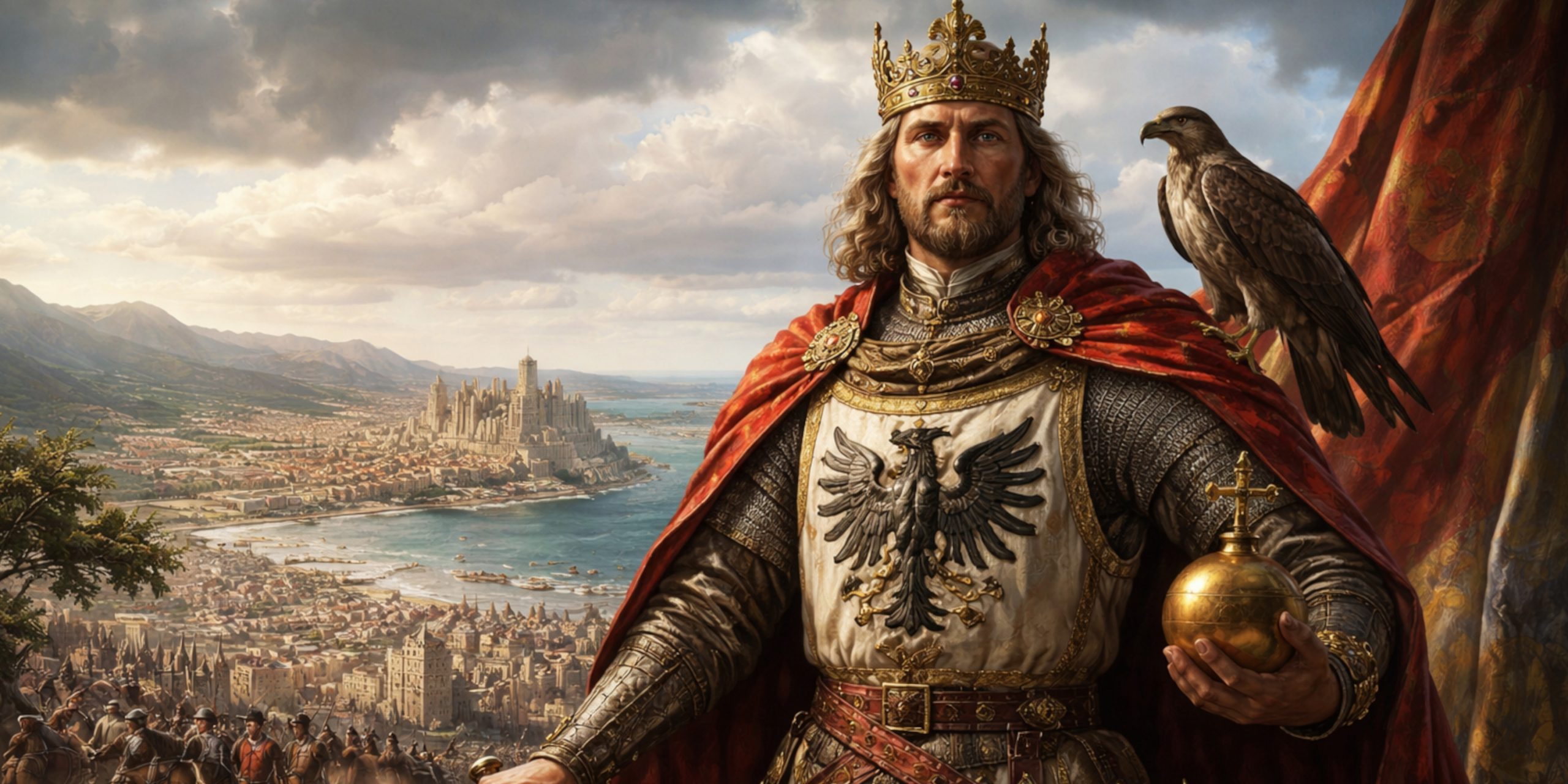
Frederick II does not sit comfortably alongside other medieval rulers. He feels slightly out of place, as if someone dropped a Renaissance prince into the thirteenth century and told him to improvise. Born in 1194, King of Sicily as a child, Holy Roman Emperor as an adult, he ruled a realm that stretched from Germany to southern Italy, yet never quite behaved like a conventional emperor.
Contemporaries called him Stupor Mundi, the wonder of the world. His enemies preferred less flattering descriptions, usually involving accusations of heresy. Both sides had a point.
Early Life and Rise to Power
Frederick was born in Jesi, in what is now Italy, the son of Emperor Henry VI and Constance of Sicily. Orphaned young, he grew up in Palermo under papal guardianship, which sounds reassuring until one remembers the papacy and imperial power spent most of the next century at each other’s throats.
By his late teens, Frederick had secured Sicily and begun the long, complicated process of claiming the imperial crown. He was crowned Holy Roman Emperor in 1220.
His reign would be defined by three persistent tensions:
- Conflict with the papacy
- The challenge of ruling Germany from afar
- The need to maintain control of Sicily, his true power base
He handled all three with a mixture of brilliance and occasional stubbornness.
The Court of Palermo
If you want to understand Frederick, start in Palermo rather than Germany.
His Sicilian court was a cultural crossroads:
- Latin, Greek, and Arabic scholars worked side by side
- Translations of classical texts flourished
- Science, medicine, and philosophy were actively pursued
Frederick himself spoke several languages and wrote on falconry with obsessive detail. His court did not feel particularly medieval. It felt curious, experimental, and occasionally unsettling to more traditional observers.
Battles and Military Acumen
Frederick was not a battlefield king in the mould of Richard the Lionheart, yet it would be a mistake to call him passive. He preferred strategy, negotiation, and calculated force.
Key Campaigns
German Conflicts
- Struggled to assert authority over rival princes
- Relied on diplomacy and selective force rather than constant warfare
Italian Wars
- Long conflict with the Lombard League
- Key defeat at the Battle of Parma in 1248, a rare but significant setback
The Sixth Crusade
- Perhaps his most remarkable campaign
- Instead of large scale combat, he negotiated with Sultan al-Kamil
- Secured Jerusalem, Bethlehem, and Nazareth through diplomacy
This last achievement unsettled everyone. He took Jerusalem without a major battle and crowned himself king there, all while technically under excommunication.
Military Style
Frederick’s approach can be summed up as controlled and pragmatic:
- Preferred negotiation over attrition
- Used fortifications effectively
- Maintained professional troops in Sicily
- Avoided reckless charges and heroic theatrics
If anything, he feels closer to a modern strategist than a medieval warlord.
Arms and Armour of Frederick II’s Forces
Frederick’s armies reflected the diversity of his empire, especially in Sicily.
Typical Equipment
Infantry
- Spear and shield formations
- Mail hauberks for wealthier soldiers
- Helmets ranging from simple conical designs to early enclosed helms
Cavalry
- Knights equipped with:
- Mail armour
- Early great helms
- Lances and arming swords
- Horses sometimes partially armoured
Missile Troops
- Crossbowmen were particularly prominent
- Saracen archers from Sicily added mobility and skill
Notable Weapon Types
- Arming swords typical of high medieval Europe
- Crossbows, increasingly decisive in siege warfare
- Spears and lances for both infantry and cavalry
- Composite bows used by Muslim troops in his service
Frederick’s willingness to employ Muslim soldiers raised eyebrows in Europe, but it gave him a flexible and effective fighting force.
Governance and Legal Reforms
Frederick’s real legacy may lie in administration rather than warfare.
His Constitutions of Melfi created a centralised legal system in Sicily:
- Royal authority strengthened over nobles
- Standardised laws across the kingdom
- Early attempts at bureaucratic governance
He treated rulership as something to be organised rather than improvised, which again feels slightly ahead of its time.
Relationship with the Papacy
No account of Frederick is complete without acknowledging his long running conflict with the papacy.
- Excommunicated multiple times
- Accused of impiety and even atheism
- Engaged in prolonged political and military struggles with successive popes
From the papal perspective, he was dangerously independent. From Frederick’s perspective, the papacy was interfering in matters it had no business controlling.
The truth sits somewhere between irritation and outright hostility.
Where to See Artefacts from His Reign
Frederick left behind a material legacy that can still be explored.
Key Locations
Castel del Monte, Apulia
- Perhaps the most famous structure linked to Frederick
- Octagonal design with unclear purpose
- A blend of symbolic geometry and military architecture
Palermo and Sicily
- Royal palaces and administrative centres
- Sites reflecting the multicultural court
Museums in Italy and Germany
- Manuscripts, coins, and seals
- Falconry texts attributed to Frederick
Archaeology and Recent Findings
Archaeology has added texture to Frederick’s reign, though it rarely delivers dramatic surprises.
Recent Insights
- Continued study of Castel del Monte suggests ceremonial or symbolic functions rather than purely military use
- Excavations in southern Italy have revealed administrative centres tied to his reforms
- Analysis of manuscripts confirms the scientific curiosity of his court, particularly in zoology and falconry
What emerges is not a ruler obsessed with conquest, but one interested in order, knowledge, and control.
Personality and Reputation
Frederick unsettled his contemporaries.
He questioned accepted ideas, surrounded himself with scholars from different cultures, and showed a willingness to challenge the authority of the Church. For a medieval ruler, that combination was enough to attract suspicion.
Some chroniclers admired his intellect. Others hinted he was dangerously unconventional. One gets the impression that even those who respected him did not entirely trust him.
Legacy
Frederick II left behind a complicated inheritance.
- Strengthened royal authority in Sicily
- Failed to fully control Germany
- Intensified conflict between empire and papacy
- Set precedents in administration and law
After his death in 1250, the empire entered a period of fragmentation. His personal authority had held things together more than any lasting system.
The Seven Swords Takeaway
Frederick II feels like a ruler slightly out of sync with his own century.
He negotiated where others fought, studied where others prayed, and governed with a level of structure that hints at later statecraft. At the same time, he could be stubborn, politically ruthless, and occasionally his own worst obstacle.
If you are looking for a typical medieval emperor, he is not your man.
If you are looking for one of the most intriguing figures of the Middle Ages, he is difficult to ignore.