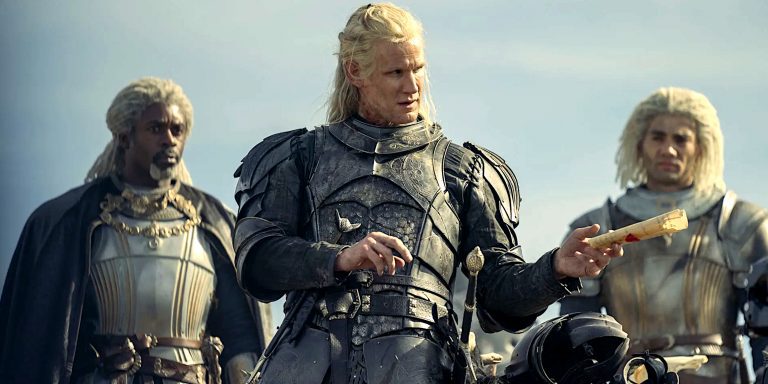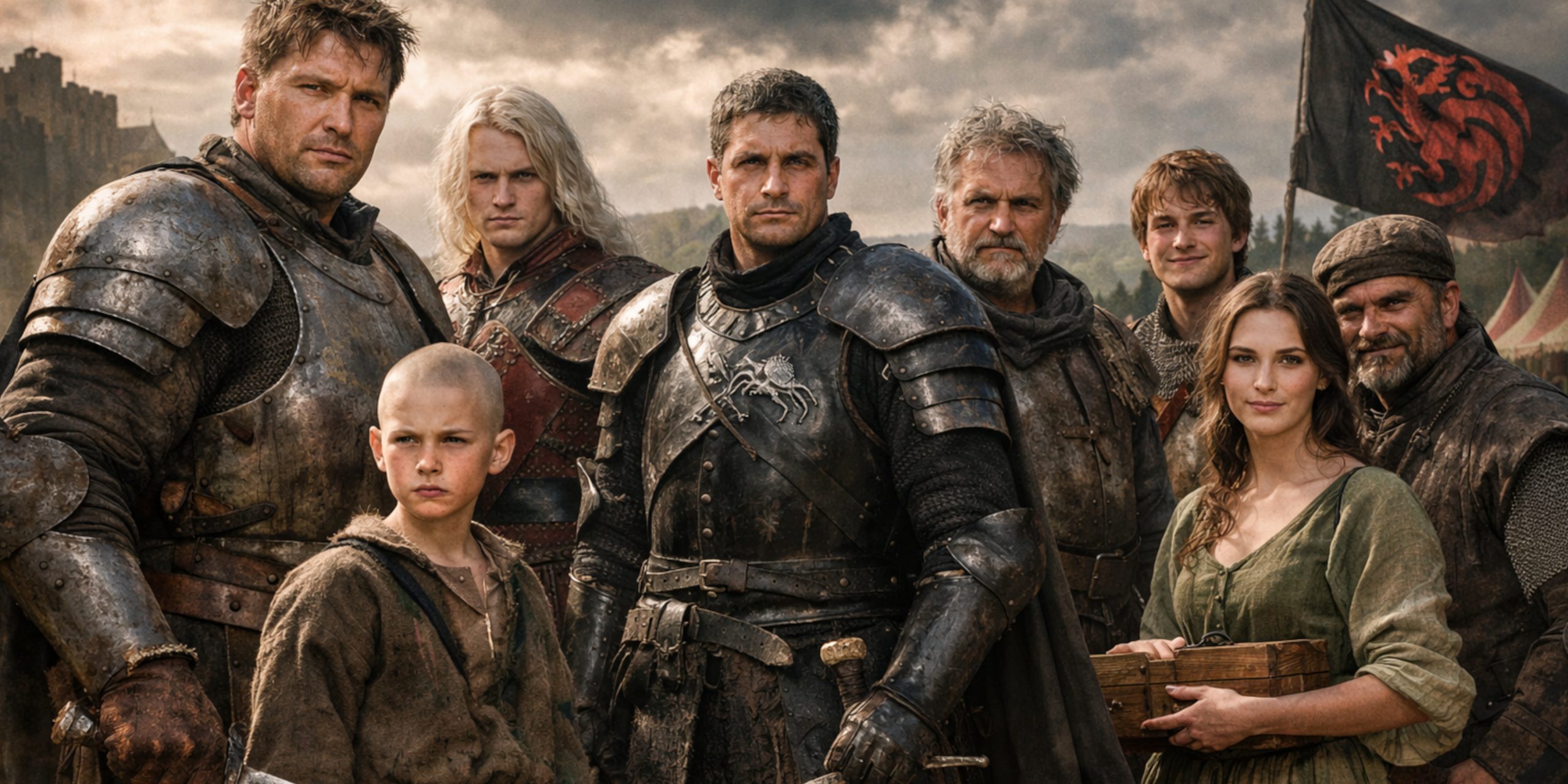
This series sits in a quieter corner of Westeros history, which is partly why it works. No dragons blotting out the sun, no continent-wide apocalypse, just people, swords, egos, and the slow realisation that honour is harder to live with than it sounds. Based on George R. R. Martin’s Dunk and Egg novellas, A Knight of the Seven Kingdoms focuses on character first, spectacle second, and that choice shapes everyone you meet.
Below is a clear guide to the major players, why they matter, and what they quietly reveal about the Seven Kingdoms.
Ser Duncan the Tall (Dunk)
Dunk is not clever in the polished, Small Council sense. He thinks slowly, speaks plainly, and solves most problems with his hands. What he does have is a strong moral compass and a very large frame to carry it around in. Standing well over six and a half feet, he is constantly underestimated intellectually and overestimated as a threat.
His background as a Flea Bottom orphan turned squire explains much of his behaviour. Dunk believes knighthood is about protection and restraint, not banners and bloodlines. That belief keeps getting him into trouble, usually with people who were born powerful and never learned to doubt themselves.
Dunk is also the emotional anchor of the story. When the politics become murky, his reactions stay honest. When the world bends toward cruelty, he pushes back, even when it costs him.
Aegon Targaryen (Egg)
Egg begins the story shaved-headed, sharp-tongued, and deeply unimpressed by authority figures. He is also, inconveniently, a Targaryen prince. This contradiction drives much of the series’ quiet tension.
Unlike many royal children in Westeros, Egg is curious about ordinary life. He asks too many questions, pushes too hard, and learns faster than Dunk would like. His time on the road is an education in hunger, injustice, and how badly the realm actually functions when no one is watching.
What makes Egg compelling is restraint. The story never lets him forget who he is, but it also refuses to let that define him completely. You see early traces of the ruler he may become, along with the doubts that will haunt him.
Prince Aerion Targaryen (Aerion Brightflame)
Aerion is the cautionary tale walking around in silk and arrogance. He believes Targaryen blood places him above consequence, pain, and basic decency. Where Egg questions power, Aerion worships it.
His cruelty is not subtle. He humiliates, provokes, and injures others simply because he can. The danger lies in how socially protected he is. Aerion shows what happens when nobility becomes insulation against accountability.
Every scene with him tightens the story. He is not chaotic evil, he is systemic evil. He behaves badly and expects the world to bend around it.
Prince Baelor Targaryen (Baelor Breakspear)
Baelor is everything Aerion is not. Calm, measured, and deeply aware of his responsibility, he represents the best version of Targaryen rule. He listens before speaking and acts only when necessary.
As Hand of the King, Baelor understands the fragile balance holding the realm together. He sees Dunk not as a threat but as a test of whether justice can exist without pedigree.
There is a quiet tragedy to Baelor. You sense how much better Westeros might be if men like him were the rule rather than the exception.
Maekar Targaryen
Maekar sits somewhere between his sons. Stern, disciplined, and emotionally distant, he believes order is maintained through strength and obedience. His parenting style is exactly as warm as you would expect.
He is not malicious, but he is rigid. That rigidity helps explain why his children fracture in such different directions. Maekar’s presence adds weight to the family dynamic and reminds you that even well-intentioned authority can cause damage when it refuses to adapt.
Tanselle
Tanselle is an artist, a puppeteer, and quietly one of the most grounded characters in the story. She lives outside the knightly fantasy entirely, which allows her to see through it.
Her relationship with Dunk is not built on destiny or grand romance. It is built on shared vulnerability and mutual respect. Tanselle’s importance lies in her perspective. She shows what the consequences of noble violence look like for people without swords or titles.
She also serves as a reminder that culture survives even when power fails.
Steely Pate
Pate is a hedge knight in the loosest sense of the term. He is rough, pragmatic, and far more comfortable bending rules than honouring them. Where Dunk strives to be better, Pate just wants to get by.
He provides contrast rather than villainy. Pate shows what knighthood looks like when stripped of idealism. There is no judgement in that portrayal, only realism.
Raymun Fossoway
Raymun represents youthful optimism with a sigil attached. He believes in chivalry because he has not yet seen it break. His admiration for Dunk feels earned rather than naive.
Through Raymun, the story explores how legends start. Someone does something decent at the right moment, and a younger witness carries that memory forward.
Seven Swords Takeaway
What makes A Knight of the Seven Kingdoms work is scale. These characters are not fighting for the Iron Throne. They are fighting for dignity, fairness, and sometimes just a safe place to sleep.
Each person reflects a different response to power. Dunk resists it. Egg questions it. Aerion abuses it. Baelor tries to civilise it. Together, they create a portrait of Westeros that feels lived-in rather than mythologised.
Watch Dunk introduction: