Who Was Eorpwald?
Eorpwald ruled the Kingdom of East Anglia in the early seventh century, and yet we know remarkably little about him. What survives comes largely through one voice, the Northumbrian monk Bede. That alone should make us cautious.
Eorpwald was the son of Rædwald, one of the most powerful rulers in southern Britain during his lifetime. Rædwald famously maintained both a pagan and a Christian altar, hedging his bets in an age when religion was politics by another name.
When Rædwald died around 624, Eorpwald succeeded him. Within a few years he converted to Christianity under the influence of the Northumbrian king Edwin of Northumbria. This conversion placed East Anglia within a growing network of Christian kingship that stretched across much of England.
His reign was short. Around 627 he was assassinated by a pagan nobleman named Ricberht. After his death, the kingdom briefly reverted to paganism.
Eorpwald’s life is a study in fragility. His reign likely lasted only three years. Yet his conversion marked East Anglia’s first official step into Christian kingship.
Political Context and Power
East Anglia in the early seventh century was not a quiet backwater. Under Rædwald, it had been a leading power among the Anglo-Saxon kingdoms. The decisive defeat of Æthelfrith of Northumbria by Rædwald earlier in the century had reshaped northern politics.
By the time Eorpwald came to the throne, power had shifted northwards to Edwin of Northumbria. Eorpwald’s baptism was almost certainly political. Accepting Christianity meant aligning with Edwin’s authority and influence.
Conversion in this period was rarely just personal belief. It was diplomacy, security, and sometimes survival.
The cost of that decision was fatal.
Battles and Military Acumen
There are no recorded battles directly attributed to Eorpwald. This silence does not mean inactivity, but it does deny us narrative detail.
East Anglia remained a wealthy and strategically placed kingdom during his reign. Its coastal position gave it maritime connections across the North Sea, linking it with Scandinavia and the Frankish world. Military organisation would have centred on:
- A royal warband of household retainers
- Local levies raised by regional leaders
- Coastal defence and river control along the Suffolk and Norfolk waterways
If Eorpwald inherited his father’s military structure, it would have been formidable by southern English standards. Rædwald had demonstrated battlefield competence and political reach. Eorpwald’s challenge was less about battlefield glory and more about maintaining unity in a kingdom divided by religion.
His assassination suggests factional conflict rather than foreign invasion. In that sense, his greatest military challenge was internal cohesion.
Arms and Armour of His Era
We do not possess objects directly tied to Eorpwald himself. However, the extraordinary burial at Sutton Hoo, often associated with his father Rædwald, provides a vivid picture of elite East Anglian martial culture.
Typical high-status equipment of the period included:
Weapons
- Pattern welded swords with broad blades and short guards
- Spears with leaf-shaped iron heads
- The seax, a long single-edged blade worn as both tool and weapon
- Shields with wooden boards and ornate iron bosses
Defensive Gear
- Mail shirts for elite warriors
- Helmets constructed from iron plates, sometimes elaborately decorated
- Round shields reinforced with metal fittings
The Sutton Hoo helmet, now one of the most iconic early medieval artefacts, reflects a warrior aristocracy conscious of status, myth, and spectacle. Even if Eorpwald never wore such a helmet, he ruled within that same martial culture.
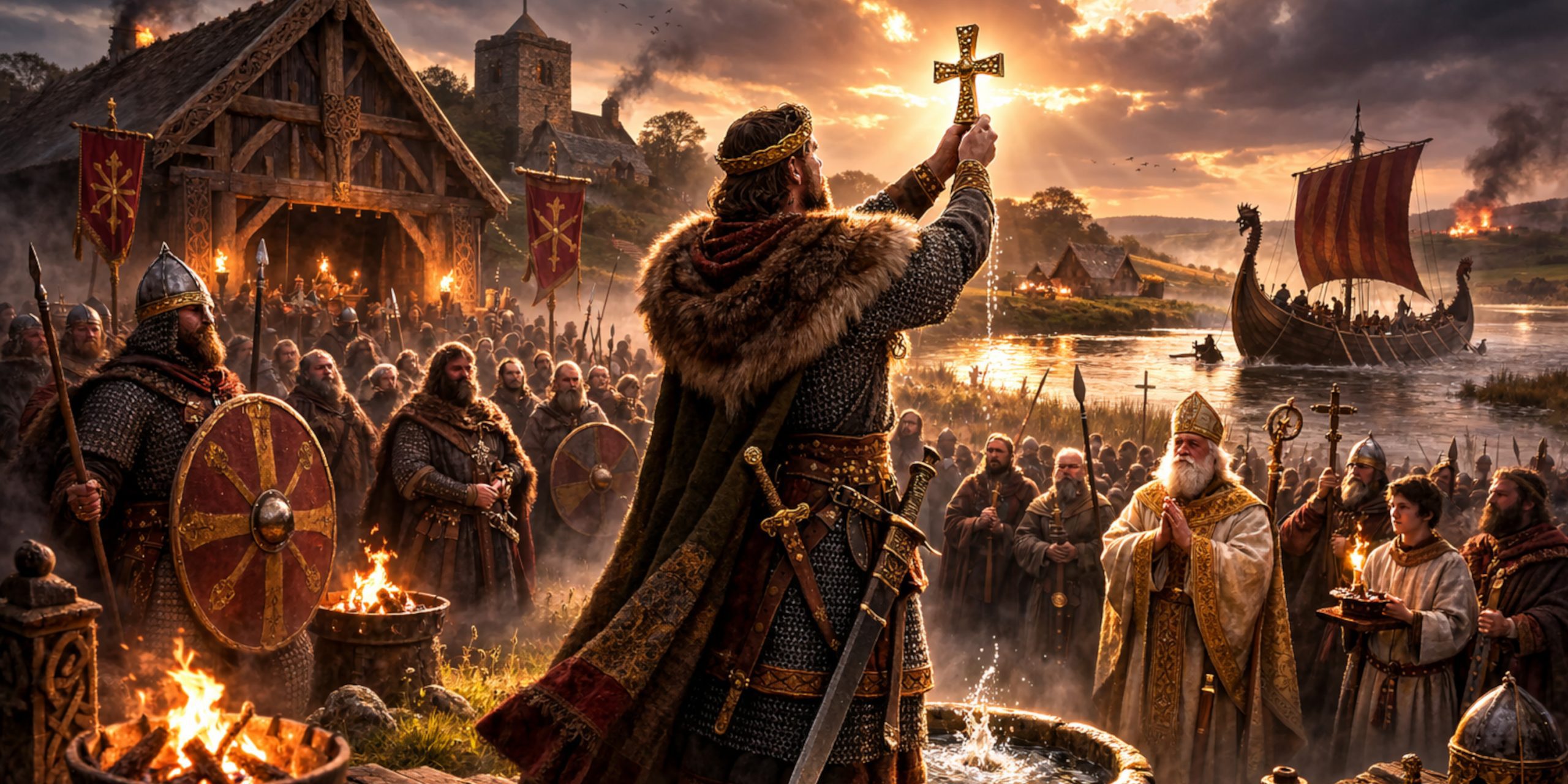
It is hard not to imagine him standing in a timber hall, beneath carved beams, surrounded by men who measured loyalty in steel and kinship.
Conversion and Religious Policy
Eorpwald’s baptism marked East Anglia’s first official embrace of Christianity. Bede describes him as accepting the faith under Edwin’s influence.
This was not yet a stable transformation. There were no established dioceses in East Anglia during his reign. Missionary work intensified only after his death, particularly under his successor Sigeberht.
Christian kingship in this era meant:
- Patronage of missionaries
- Construction of early churches
- Diplomatic alignment with other Christian rulers
Eorpwald’s assassination reveals how precarious this shift was. Pagan elites remained powerful. Religious identity could fracture kingdoms.
In my view, Eorpwald’s short reign captures the uncertainty of the early Anglo-Saxon conversion more honestly than grander narratives do. There was no neat transition. There was risk, backlash, and blood.
Archaeology and Latest Findings
While no artefact can be firmly labelled as belonging to Eorpwald, East Anglia continues to yield rich archaeological evidence from the early seventh century.
Sutton Hoo remains central to our understanding of East Anglian royal culture. Excavations and reanalysis of materials, including soil chemistry and textile fragments, have deepened insight into trade links with the Frankish world and possibly Byzantium.
Recent metal detector finds across Suffolk and Norfolk have produced early gold coins known as thrymsas, suggesting economic vitality and continental contact during the period.
Settlement archaeology has also revealed timber halls and high-status sites that illuminate the structure of early Anglo-Saxon kingship. These discoveries reinforce the impression that Eorpwald ruled a sophisticated and internationally connected kingdom.
Where to See Artefacts from His Era
Although nothing can be definitively attributed to Eorpwald himself, artefacts from his immediate cultural world can be viewed at:
- British Museum, which houses the Sutton Hoo treasures
- National Trust site at Sutton Hoo, where visitors can explore the burial mounds and exhibition centre
- Norwich Castle Museum, which displays regional Anglo-Saxon material culture
Standing before the Sutton Hoo helmet, one feels the weight of a world in transition. Pagan imagery and Christian influence overlap. Power and belief are still negotiating their terms.
Legacy
Eorpwald’s reign was brief, yet it marked the first official Christian kingship in East Anglia. After his murder, paganism resurfaced temporarily, but Christianity eventually prevailed.
He is remembered as a martyr by later Christian writers, though his sainthood rests largely on Bede’s account. His significance lies less in military triumph and more in symbolic change.
History often favours conquerors and empire builders. Eorpwald was neither. He was a transitional figure, caught between inherited pagan aristocracy and emerging Christian kingship.
For historians, he is a reminder that transformation is rarely smooth. Sometimes it lasts three years and ends with a blade in the dark.
Final Assessment
Eorpwald remains an elusive king. The sources are sparse, the chronology compressed, and the political stakes immense.
Yet through archaeology, comparative study, and cautious reading of Bede, a picture emerges of a young ruler navigating power, faith, and factional tension in one of the most dynamic periods of early English history.
He ruled briefly. He died violently. And in that short span, he nudged a kingdom toward a new religious and political order.
For such a shadowy figure, that is no small legacy.
Watch the documentary: