Few monarchs have controlled their image with the precision of Elizabeth I of England. She ruled for forty four years in an age when a woman on the throne was treated as a temporary inconvenience by many of Europe’s political minds. Yet Elizabeth did something rather remarkable. She turned her unmarried status into one of the most successful political brands in European history.
The phrase “Virgin Queen” was not merely a personal description. It was an idea carefully crafted and maintained. Court pageantry, portraits, speeches, and diplomatic manoeuvres all reinforced it. The result was a monarch who appeared both unattainable and symbolically married to her kingdom.
From a historian’s perspective the cleverness is difficult not to admire. Elizabeth took what her critics considered a weakness and quietly turned it into armour.
The Political Problem Elizabeth Faced
When Elizabeth became queen in 1558, the situation was precarious.
England had endured decades of religious conflict. The Tudor dynasty itself felt fragile after the turbulent reigns of Henry VIII, Edward VI, and Mary I. European monarchs also expected female rulers to marry quickly so a husband could provide stability and produce heirs.
Elizabeth’s council repeatedly pressed the issue of marriage.
Yet marriage carried serious risks.
A foreign husband might dominate English politics. A powerful English noble might provoke rival factions. A husband could even claim authority over the queen herself, something many continental rulers believed entirely proper.
Elizabeth understood the danger clearly. Her solution was not to reject marriage outright, but to keep the possibility alive without ever allowing it to happen.
Diplomats spent decades negotiating hypothetical marriages that never quite reached the altar. It was political theatre, and Elizabeth directed it with impressive patience.
The Birth of the Virgin Queen Image
The “Virgin Queen” identity did not appear overnight. It developed gradually during Elizabeth’s reign.
By the 1570s the idea had become central to royal propaganda. Elizabeth was portrayed as a ruler uniquely devoted to her realm. She had chosen England over personal desire.
Poetry and court pageants reinforced this message. Elizabeth was compared to Astraea, the classical goddess of justice who ruled during a mythical golden age. She was also associated with Diana, the chaste goddess of the hunt.
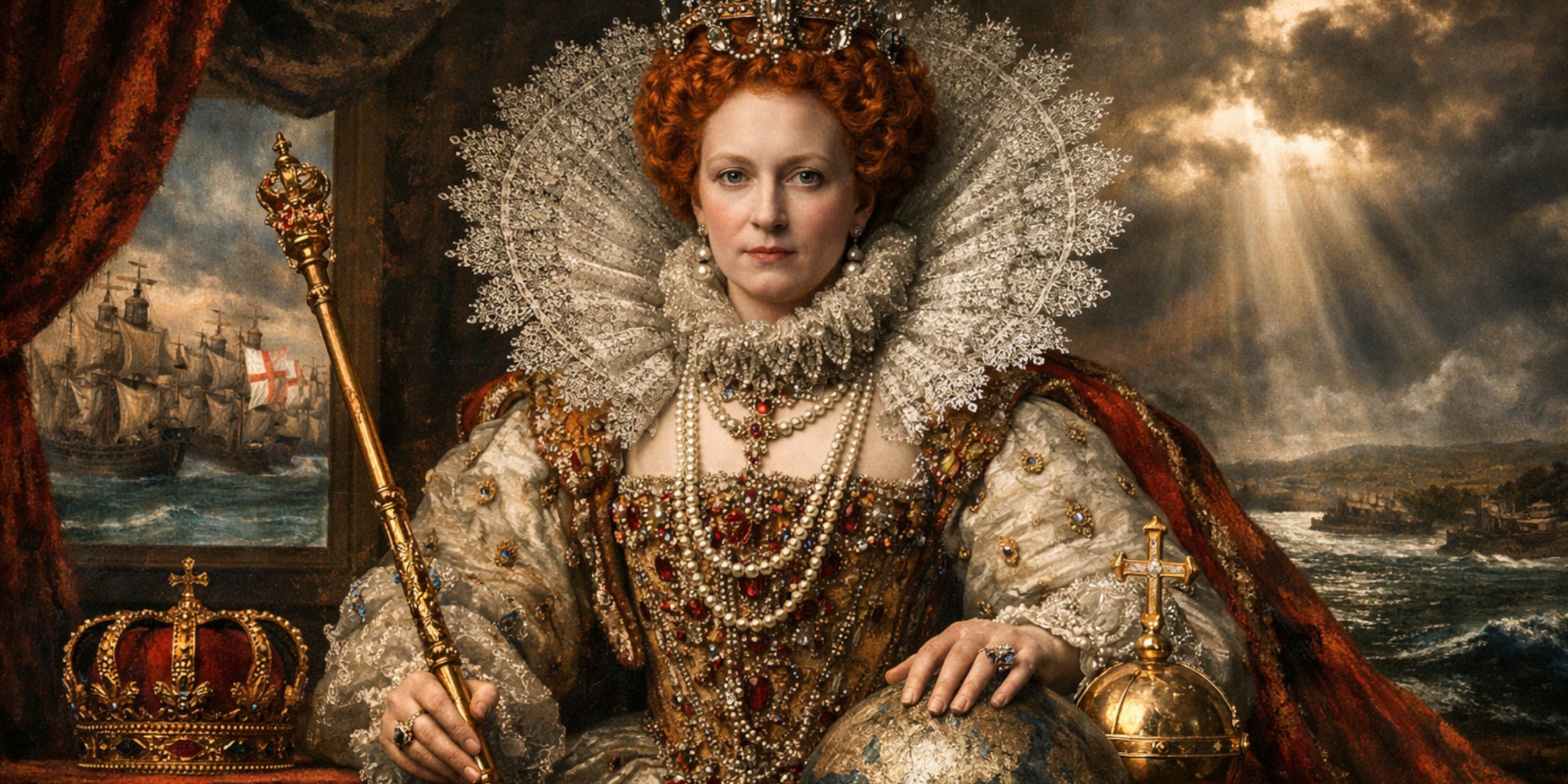
Court artists played their part as well. Elizabeth’s portraits rarely attempted realism. Instead they constructed an almost mythological figure.
The famous Armada Portrait, painted after the defeat of Spain in 1588, shows Elizabeth surrounded by imperial symbols. Pearls decorate her clothing, a traditional symbol of purity. Her hand rests calmly beside a globe.
It is not subtle.
The message reads quite plainly. England’s queen belongs to no man.
Courtship as Diplomacy
Elizabeth’s approach to marriage negotiations became one of her most effective diplomatic tools.
Several suitors appeared over the years. Among them were:
- Philip II of Spain, briefly proposed after Mary I’s death
- Archduke Charles of Austria
- Francis, Duke of Anjou, the younger brother of the French king
- Robert Dudley, Elizabeth’s close companion and favourite
None of these negotiations produced a marriage, though some came remarkably close.
Foreign courts often believed they had a genuine chance. Elizabeth encouraged this belief. A potential marriage could buy England valuable time during negotiations or soften political tensions.
The French match with the Duke of Anjou in the late 1570s provides a good example. The proposal seriously alarmed many English Protestants. Yet the negotiations helped keep France friendly during a dangerous period.
Elizabeth ultimately withdrew, as she had done before.
One begins to suspect she knew precisely what she was doing all along.
Symbolism and Royal Propaganda
Elizabeth’s image was carefully controlled through visual symbolism.
Official portraits followed strict guidelines approved by the crown. The queen appeared eternally youthful, even when she had reached her sixties. Artists removed signs of age entirely.
Symbols reinforced her authority.
Common elements in Elizabethan portraits include:
- Pearls representing purity
- Globes suggesting imperial ambition
- Eyes and ears embroidered on clothing, symbolising vigilance
- Serpents representing wisdom and cunning
- Roses and Tudor emblems linking Elizabeth to dynastic legitimacy
The portraits were widely copied and displayed in noble houses across England. In effect they functioned as political posters.
It is propaganda of a very elegant sort.
The Cult of Gloriana
By the final decades of Elizabeth’s reign, the queen had become something approaching a national icon.
Writers and poets embraced the imagery enthusiastically. Edmund Spenser, in The Faerie Queene, presented Elizabeth as Gloriana, the noble ruler of a mythical realm.
The cult of Gloriana combined classical myth with patriotic symbolism. Elizabeth was no longer merely a monarch. She had become an idea.
One suspects Elizabeth understood the power of this transformation perfectly well.
Archaeology and Material Evidence
Archaeological evidence offers intriguing glimpses into Elizabethan royal culture.
Excavations at Richmond Palace, one of Elizabeth’s favoured residences, have uncovered fragments of decorative plasterwork and ceramics connected with the late Tudor court. These remains reveal the visual splendour surrounding royal appearances.
At Greenwich Palace, the birthplace of Elizabeth, archaeologists have uncovered foundations of Tudor structures and objects linked to court life. Decorative tiles and domestic artefacts offer a small window into the environment in which the queen grew up.
Another fascinating site is Kenilworth Castle, associated with Robert Dudley. Archaeological surveys confirm the vast scale of the entertainments staged there during Elizabeth’s visit in 1575. Dudley spent enormous sums transforming the castle into a theatrical setting designed to impress the queen.
The spectacle included elaborate gardens, artificial lakes, and staged performances.
Whether Elizabeth was impressed enough to consider marriage remains uncertain.
The historians suspect not.
Contemporary Views of Elizabeth
Elizabeth’s contemporaries often commented on her unmarried status.
Some admired it as a mark of independence. Others found it baffling.
A Venetian ambassador recorded his impressions of the queen in the 1550s:
“She is a woman of keen wit and judgement, proud yet gracious, and determined in her decisions.”
Elizabeth herself frequently addressed the subject with theatrical flair.
In her famous speech to Parliament in 1559 she remarked:
“And in the end this shall be for me sufficient, that a marble stone shall declare that a queen, having reigned such a time, lived and died a virgin.”
During the crisis of the Spanish Armada she offered another memorable statement at Tilbury:
“I know I have the body of a weak and feeble woman, but I have the heart and stomach of a king.”
Elizabeth rarely missed an opportunity to reinforce her carefully crafted persona.
Legacy of the Virgin Queen Myth
The Virgin Queen image shaped Elizabeth’s legacy for centuries.
It allowed her to avoid the political dangers of marriage while projecting authority in a male dominated world. England experienced relative stability during her reign, and the defeat of the Spanish Armada cemented her reputation as a formidable ruler.
Of course the reality behind the myth remains debated. Elizabeth’s relationship with Robert Dudley, and later with the Earl of Essex, continues to fascinate historians.
Yet whether she loved anyone deeply or not, the public image never faltered.
The queen belonged to England.
And in the ruthless theatre of sixteenth century politics, that was probably the most powerful marriage she could have made.