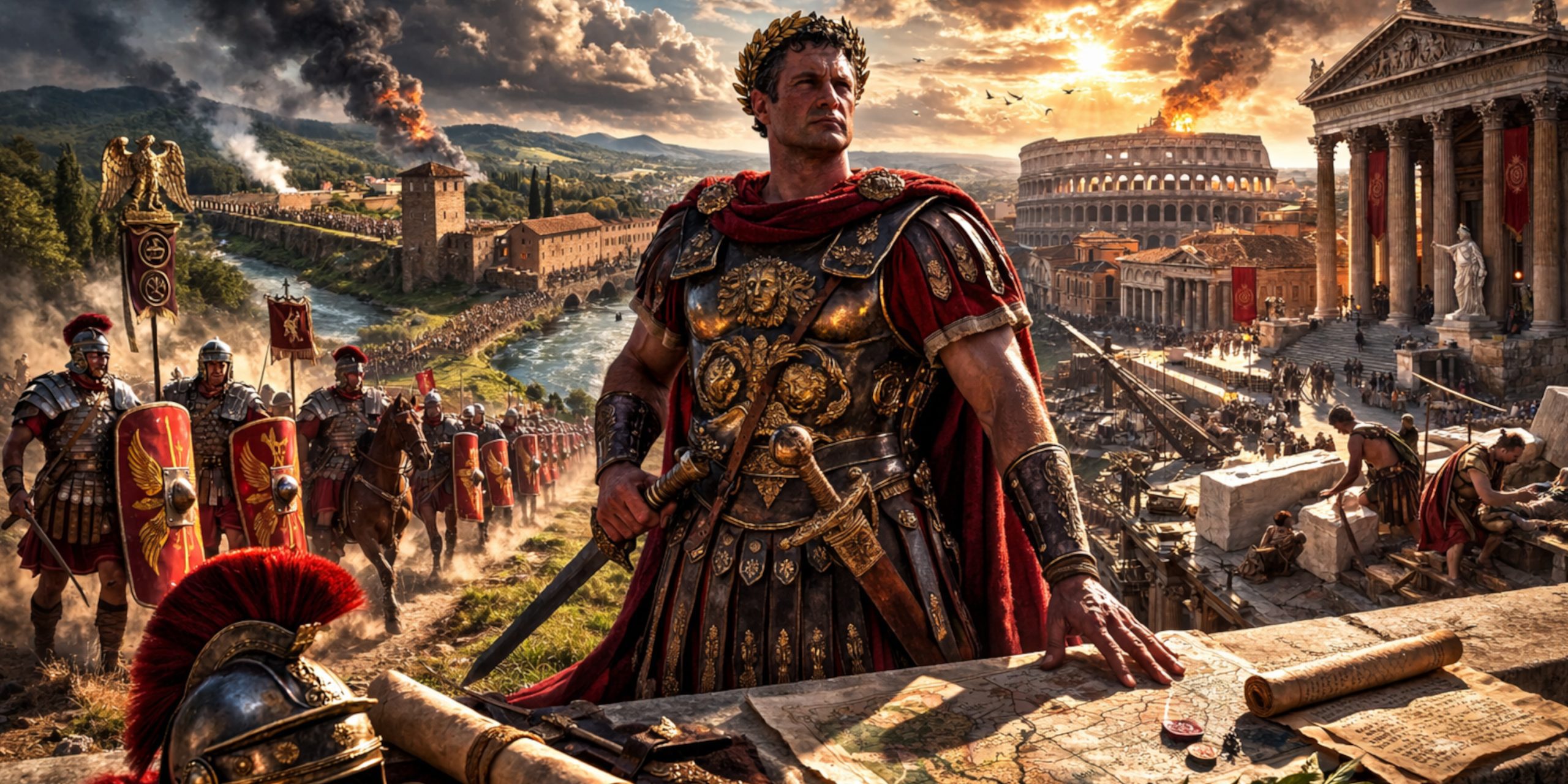
Domitian ruled the Roman Empire from 81 to 96. He was the youngest son of Vespasian and the brother of Titus. Together they formed the Flavian dynasty, the family that stabilised Rome after the chaos of the Year of the Four Emperors.
Domitian’s reputation has long been clouded by hostility. Ancient senatorial writers described him as paranoid and tyrannical. Yet the archaeological record and provincial evidence tell a more complicated story. He strengthened the frontiers, reformed the economy, invested in building projects, and insisted on imperial authority with a firmness that unsettled the old aristocracy.
As a historian, I find him difficult to dismiss. He was not charming, and he did not pretend to be. But Rome under Domitian was orderly, solvent, and militarily alert.
Early Life and Accession
Domitian was born in 51. Unlike his father and brother, he did not command armies during the civil wars of 69. He remained in Rome, largely sidelined, observing the machinery of power rather than leading it.
When Titus died unexpectedly in 81, Domitian was proclaimed emperor by the Praetorian Guard. He moved quickly to consolidate authority. He took the title dominus et deus, lord and god, more seriously than his predecessors. Whether this was arrogance or political theatre is debated, though it clearly disturbed the Senate.
Domestic Policy and Administration
Domitian was an active administrator. He strengthened the imperial bureaucracy and appointed equestrians to key posts, limiting senatorial influence. Financially, he revalued the coinage early in his reign and kept careful oversight of taxation. The treasury was healthy, even after expensive wars and building programmes.
He also emphasised moral legislation and religious revival. He restored traditional cults and reinforced imperial worship. In Rome he rebuilt the Capitol after fire and completed major projects left unfinished by Titus.
His relationship with the Senate deteriorated over time. Executions for treason increased in the later years of his reign. Ancient writers, many from senatorial backgrounds, never forgave him.
Battles and Military Acumen
Domitian inherited relatively stable frontiers but faced pressure in several regions.
Britain
In Britain, campaigns under Governor Agricola pushed Roman control further north. Though much of the credit is attributed to Agricola, imperial support and reinforcement came from Domitian. The withdrawal from Scotland later in the reign was strategic rather than purely defensive.
The Rhine and Germania
In 83, Domitian personally led a campaign against the Chatti in Germania. He took the title Germanicus. Critics claimed the victory was exaggerated, yet the fortification of the Limes Germanicus suggests a systematic and thoughtful frontier policy.
The Dacian Wars
The most serious challenge came from King Decebalus of Dacia. Early Roman forces suffered setbacks. Domitian eventually concluded a negotiated settlement, subsidising Dacia in exchange for peace. This treaty was mocked by later writers, especially under Trajan, who would conquer Dacia outright. Still, Domitian preserved stability without committing the empire to a draining war.
Assessment
Domitian was not a battlefield hero in the mould of Julius Caesar. He preferred strategic oversight and strong defensive lines. His focus was frontier consolidation, not reckless expansion. It is a cautious style, but not an incompetent one.
Arms and Armour of Domitian’s Legions
Under Domitian, Roman military equipment reflected the mature form of early Imperial design.
Infantry Equipment
- Helmet: Imperial Gallic and Imperial Italic types, iron with brass fittings
- Body Armour: Lorica segmentata widely used, alongside mail and scale
- Shield: Rectangular scutum with central boss
- Sword: The gladius, especially Mainz and Pompeii types
- Dagger: Pugio with decorated hilt
Cavalry and Auxiliaries
Auxiliaries used oval shields and longer spathae. Archers and cavalry units from eastern provinces provided specialised capabilities.
Archaeological finds from forts along the Rhine and Danube reveal high production quality. Decoration was common, indicating pride and unit identity. Domitian maintained supply and standardisation across legions, reinforcing discipline and cohesion.
Building Programme and Material Legacy
Domitian was an energetic builder.
He completed the Flavian Palace on the Palatine Hill, transforming it into a more formal imperial residence. He constructed the Stadium of Domitian, whose outline still shapes Piazza Navona today. He restored temples, rebuilt public spaces, and reinforced Rome’s monumental character.
Coinage from his reign is abundant. Gold aurei and silver denarii display refined portraiture, projecting strength and divine favour. Surviving examples are held in major collections across Europe.
Where to See Artefacts from Domitian’s Reign
- Vatican Museums, busts and inscriptions
- British Museum, coins and military equipment
- Museo Nazionale Romano, sculpture and architectural fragments
- Archaeological parks along the German limes, including reconstructed forts
His portrait statues were often reworked after his death due to damnatio memoriae, the formal condemnation of memory. This makes intact pieces especially intriguing.
Latest Archaeological Insights
Recent excavations on the Palatine continue to refine our understanding of Domitian’s palace complex. Structural analysis reveals advanced engineering in vaulting and water management.
Frontier archaeology in Germany has uncovered fort expansions dated securely to his reign, reinforcing the idea of systematic military planning. Coin hoards across Britain and the Danube provinces show stable circulation patterns, suggesting economic resilience rather than crisis.
Material culture is quietly correcting the literary narrative.
Assassination and Damnatio Memoriae
Domitian was assassinated in 96 in a palace conspiracy involving members of his household and possibly the Praetorian Guard. The Senate swiftly declared him a public enemy and ordered his memory erased.
Statues were altered. Inscriptions were chiselled away. His name was removed from monuments.
Yet erasure was incomplete. Coins survived. Buildings endured. Soldiers remembered.
Historical Reputation
Ancient sources such as Tacitus and Suetonius portray Domitian harshly. They emphasise cruelty and fear. Modern historians tend to adopt a more measured view. His administration was efficient. The frontiers were secure. The empire was financially sound.
He lacked warmth. He demanded obedience. He ruled as an autocrat in a system that pretended to be republican.
As a historian, I find Domitian emblematic of the tension at the heart of the Principate. Rome wanted strong leadership but disliked being reminded that it was no longer a republic. Domitian did not disguise that truth. For that, he paid with both his life and his reputation.
Takeaway
Domitian remains one of Rome’s most debated emperors. He strengthened the empire’s borders, invested in its capital, and centralised authority with relentless determination. His flaws were real, particularly in his treatment of elites. Yet the material record suggests competence rather than chaos.
History often reflects the voices of the offended. Archaeology, by contrast, is indifferent. In Domitian’s case, it is proving to be a more forgiving witness.
Watch the documentray: