A historian’s uneasy catalogue of suffering, survival, and the limits of medieval medicine
The medieval world had a talent for turning everyday life into a negotiation with death. War and famine did their part, but disease was the quiet tyrant, indifferent to rank, piety, or good intentions. It crept through cities, monasteries, and farms alike, leaving behind both fear and a paper trail of desperate prayers, baffled physicians, and occasional grim humour.
What follows is not a cheerful read, but it is an honest one.
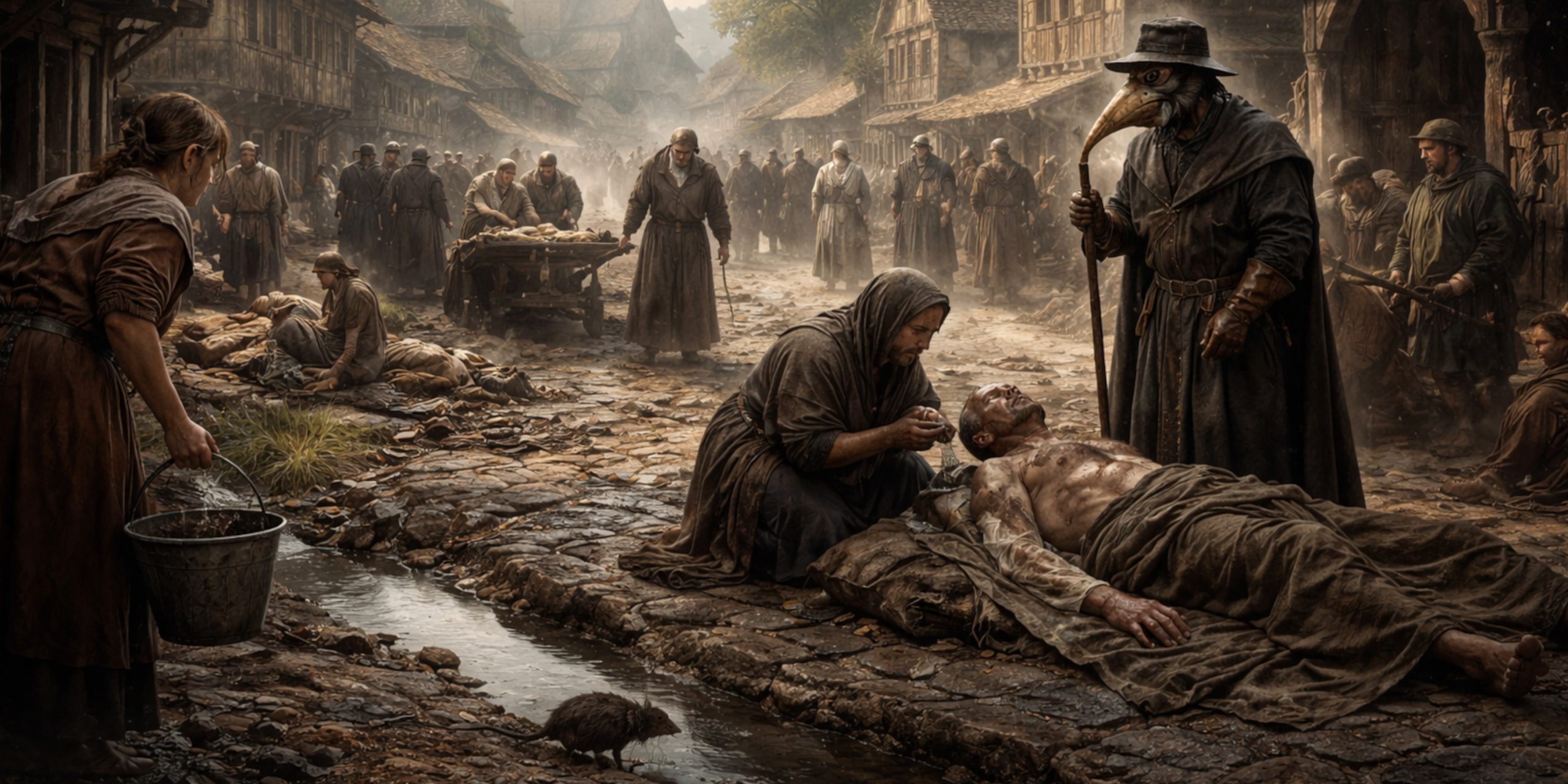
The Black Death (Bubonic Plague)
No disease defined the medieval period quite like the plague. Arriving in Europe in the mid 14th century, it tore through populations with unsettling speed.
Symptoms and course
- Painful swollen lymph nodes known as buboes
- Fever, delirium, blackened skin in later stages
- Death often within days
Mortality rates varied, though in many regions a third to a half of the population vanished within a few years. Entire villages simply ceased to exist, which does make modern property disputes feel rather trivial.
Contemporary voice
“So many died that all believed it was the end of the world.”
— Agnolo di Tura
Physicians blamed foul air, planetary alignments, or divine punishment. In fairness, they were working without microscopes and under considerable pressure.
Leprosy (Hansen’s Disease)
Leprosy carried a slower cruelty. It rarely killed quickly, but it dismantled the body piece by piece and the social life even faster.
Symptoms and course
- Skin lesions and numbness
- Progressive nerve damage
- Loss of extremities over time
Sufferers were often isolated in leper houses. Some regions required them to carry bells to warn others of their presence, which feels less like medicine and more like ritualised fear.
Contemporary voice
“They are dead to the world, yet still alive.”
— Orderic Vitalis
Despite the stigma, some leper hospitals were surprisingly well organised and even charitable. Medieval society could be harsh, but not always heartless.
Smallpox
Smallpox was a master of survival and transmission, leaving behind survivors who were often permanently marked.
Symptoms and course
- High fever followed by a rash that became fluid filled pustules
- Severe scarring for survivors
- Blindness in some cases
Mortality could reach frightening levels, especially among children. Unlike plague, it lingered, returning again and again.
Contemporary voice
“The disease disfigures even those it spares.”
— Ibn Sina
One cannot help but notice that medieval beauty standards must have been somewhat forgiving.
Ergotism (St Anthony’s Fire)
Ergotism came not from contagion but from contaminated rye. It offered a particularly theatrical set of symptoms.
Symptoms and course
- Burning sensations in limbs
- Hallucinations and convulsions
- Gangrene leading to loss of fingers or limbs
Victims sometimes reported visions, which led to religious interpretations. In a less forgiving light, it was food poisoning with a dramatic flair.
Contemporary voice
“A burning fire consumes the limbs.”
— Raoul Glaber
Hospitals dedicated to St Anthony treated sufferers, which at least gave the disease a patron saint, if little else.
Dysentery
Dysentery lacks the dramatic flair of plague or ergotism, but it was relentless and often fatal, especially in armies and crowded towns.
Symptoms and course
- Severe diarrhoea, often with blood
- Dehydration and weakness
- Rapid decline without recovery
It thrived where sanitation failed, which is to say, almost everywhere.
Contemporary voice
“More perish from flux than from the sword.”
— Jean Froissart
Soldiers feared it almost as much as battle. It had the decency to arrive before the enemy did.
Tuberculosis
Known as consumption, tuberculosis worked slowly, draining life over months or years.
Symptoms and course
- Persistent cough, often with blood
- Weight loss and fatigue
- Gradual wasting of the body
Unlike plague, it allowed time for reflection, prayer, and prolonged suffering. Medieval literature occasionally dressed it in a strange sort of tragic beauty, which says more about the writers than the disease.
Contemporary voice
“The body wastes away, as if eaten from within.”
— Hildegard of Bingen
Typhus
Typhus flourished in cramped and unwashed conditions. Prisons, ships, and siege camps provided ideal settings.
Symptoms and course
- High fever and rash
- Delirium and confusion
- High mortality in outbreaks
It often followed war, which suggests that medieval armies carried more than just swords into battle.
Contemporary voice
“Fever takes them as swiftly as the enemy.”
— Niccolò Machiavelli
A Historian’s Takeaway of sorts
Medieval disease shaped economies, faith, urban planning, and even the pace of history itself. Labour shortages after the plague shifted power toward workers. Fear of contagion changed burial practices. Entire belief systems bent under the weight of repeated catastrophe.
It is tempting to view the period as uniquely grim. Yet there is something familiar in the responses. Panic, blame, improvisation, and occasional brilliance. The difference is that we now have antibiotics, sanitation, and a better sense of what causes illness. Medieval people had faith, folklore, and a willingness to try almost anything once.
If nothing else, their survival rate is a quiet testament to resilience, or stubbornness, depending on your mood.