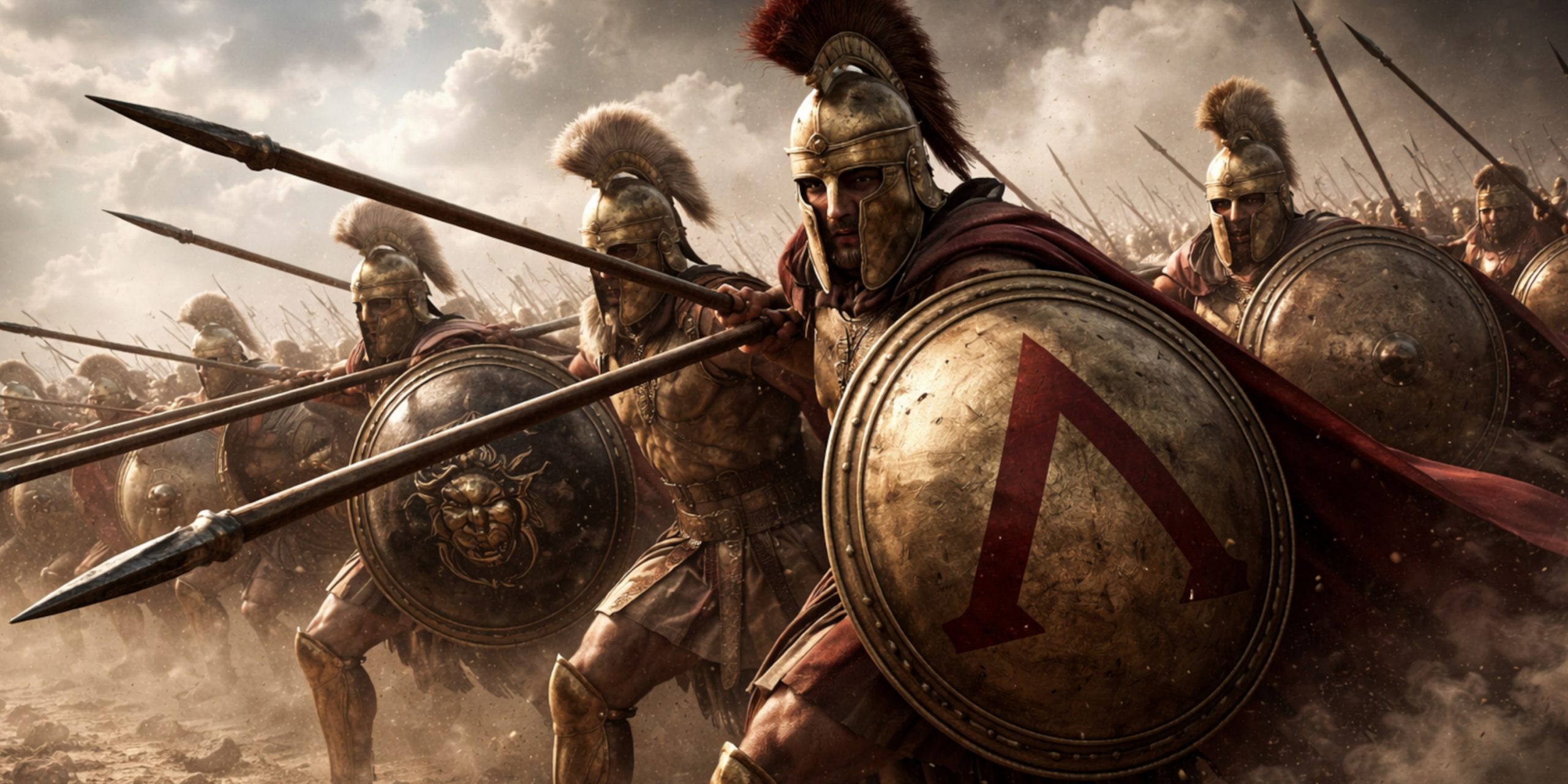
The Classical Greek hoplite sits at the centre of ancient warfare not because he was flashy or individually heroic, but because he was stubbornly collective. Victory did not belong to the fastest runner or the strongest arm. It belonged to the man who held his place in line, kept his shield up, and trusted the neighbour to his left to do the same. As a military system, the hoplite was blunt, communal, and surprisingly effective. As a cultural phenomenon, he tells us almost everything about how Greek city states understood duty, citizenship, and war.
What Was a Hoplite?
A hoplite was a heavy infantryman drawn largely from the citizen body of a Greek polis. Service was not usually professional in the modern sense. These men paid for their own equipment, trained periodically, and fought when called upon. This immediately shaped the nature of Greek warfare. Armies were limited by who could afford armour, campaigns were seasonal, and battles tended to be decisive rather than prolonged.
The name comes from the hoplon, the great round shield that defined the entire system. Without it, there is no hoplite warfare. With it, individual skill mattered less than cohesion and discipline, which was both a strength and, on bad days, a source of mutual panic.
The Phalanx and How It Fought
The hoplite fought in the phalanx, a dense formation usually eight ranks deep, sometimes more. Shields overlapped, spears projected forward, and the entire block advanced as one. Ancient authors loved to describe the moment of impact, when two walls of bronze and wood collided with a noise that was apparently unforgettable.
The popular image of neat lines politely shoving one another is only partly true. The initial spear clash was violent and chaotic. Once spearheads snapped, bent, or became unusable, the fight collapsed into a brutal press where short swords came into play. Maintaining formation under those conditions required discipline, courage, and a tolerance for discomfort that modern reenactments can only hint at.
Arms and Armour of the Hoplite
Helmet and Body Protection
Early hoplites wore heavy bronze armour. Over time, equipment evolved as cost, comfort, and mobility were reconsidered.
Common elements included
• Bronze helmets such as the Corinthian, Chalcidian, and later Attic types
• Bronze cuirasses or layered linen armour known as the linothorax
• Greaves protecting the shins, often anatomically moulded
The Corinthian helmet offered excellent protection but terrible peripheral vision and breathing. It is telling that later designs opened the face. Surviving long enough to win mattered more than looking impressive on pottery.
Shield
The aspis, sometimes called the hoplon, was the defining piece of equipment. Roughly one metre in diameter, wood faced with bronze, and carried with a distinctive double grip, it protected both the bearer and the man beside him. Losing it was a serious offence in many poleis, socially and legally. Sparta in particular had little patience for men who came home without their shield.
Spears and Swords
The primary weapon was the doru, a thrusting spear around two to three metres long. It featured an iron spearhead and a bronze butt spike, the sauroter, which could be used if the spear snapped or as a secondary point.
When the spear failed, hoplites turned to swords. These were not duelling weapons but practical tools for close quarters.
Common sword types included
• The xiphos, a short double edged sword ideal for stabbing in tight formation
• The kopis, a forward curving blade better suited to cutting, more common among cavalry but used by some hoplites
The xiphos in particular reflects hoplite pragmatism. It is compact, unromantic, and efficient. A sword for men who did not expect to fight alone.
Training, Discipline, and Citizen Soldiers
Training varied widely between city states. Sparta is the obvious outlier, with its lifelong military system. Most Greek poleis relied on periodic training and social expectation rather than full time drill.
What unified them was cultural pressure. Cowardice was not merely a personal failing but a civic one. To break ranks was to endanger friends, family, and neighbours. This made the phalanx psychologically powerful. It also meant that when morale broke, it often broke suddenly and catastrophically.
Archaeology and the Physical Evidence
Our understanding of hoplites is shaped by a combination of archaeology and art. Excavated armour from sanctuaries such as Olympia and Delphi shows both the craftsmanship involved and the cost. Helmets bent from combat, shield fragments, and spearheads recovered from battlefield contexts reinforce literary accounts of close range violence.
Mass graves associated with battles such as those near Marathon reveal trauma consistent with spear thrusts and blunt force injuries rather than arrow wounds. This supports the idea that hoplite warfare was decided at close quarters, face to face, with very little room for personal comfort.
Pottery, particularly black figure and red figure vase painting, fills in the gaps. These images are stylised and sometimes idealised, but they show us how Greeks wanted to remember their warriors, which is revealing in itself.
Contemporary Voices from Antiquity
Herodotus observed that Greek warfare was shaped as much by custom as by necessity, noting how battle was often arranged by agreement and fought on open ground. Thucydides, less sentimental, described the terrifying confusion of battle and the way fear spread through ranks faster than orders.
Plutarch later recorded Spartan sayings that captured hoplite values succinctly. One mother, handing her son his shield, is said to have told him to return with it or on it. It is a neat line, perhaps too neat, but it reflects a real expectation that survival came second to duty.
Strengths, Limits, and the End of the Hoplite Age
The hoplite system worked because it matched the social structure of the polis. It produced disciplined citizen armies capable of decisive victories. It struggled when faced with more flexible forces, missile heavy tactics, or prolonged campaigning.
By the fourth century BC, warfare was changing. Professional soldiers, lighter troops, and combined arms approaches began to dominate. Macedonian innovations under Philip II and Alexander did not abandon the phalanx, but they transformed it beyond recognition.
The classical hoplite did not vanish overnight. He simply became obsolete, which is the quiet fate of most military systems.
The Takeaway
Hoplites show us a moment when warfare, politics, and identity aligned closely. These men were not anonymous professionals. They were farmers, craftsmen, and citizens who fought for communities they would return to, assuming they survived.
There is something bracing about that simplicity, even if it came wrapped in bronze and fear. As a historian, I find it difficult not to admire a system that asked so much of ordinary people and then trusted them to stand firm. I also find it easy to be grateful that modern citizenship rarely requires standing in a spear wall.