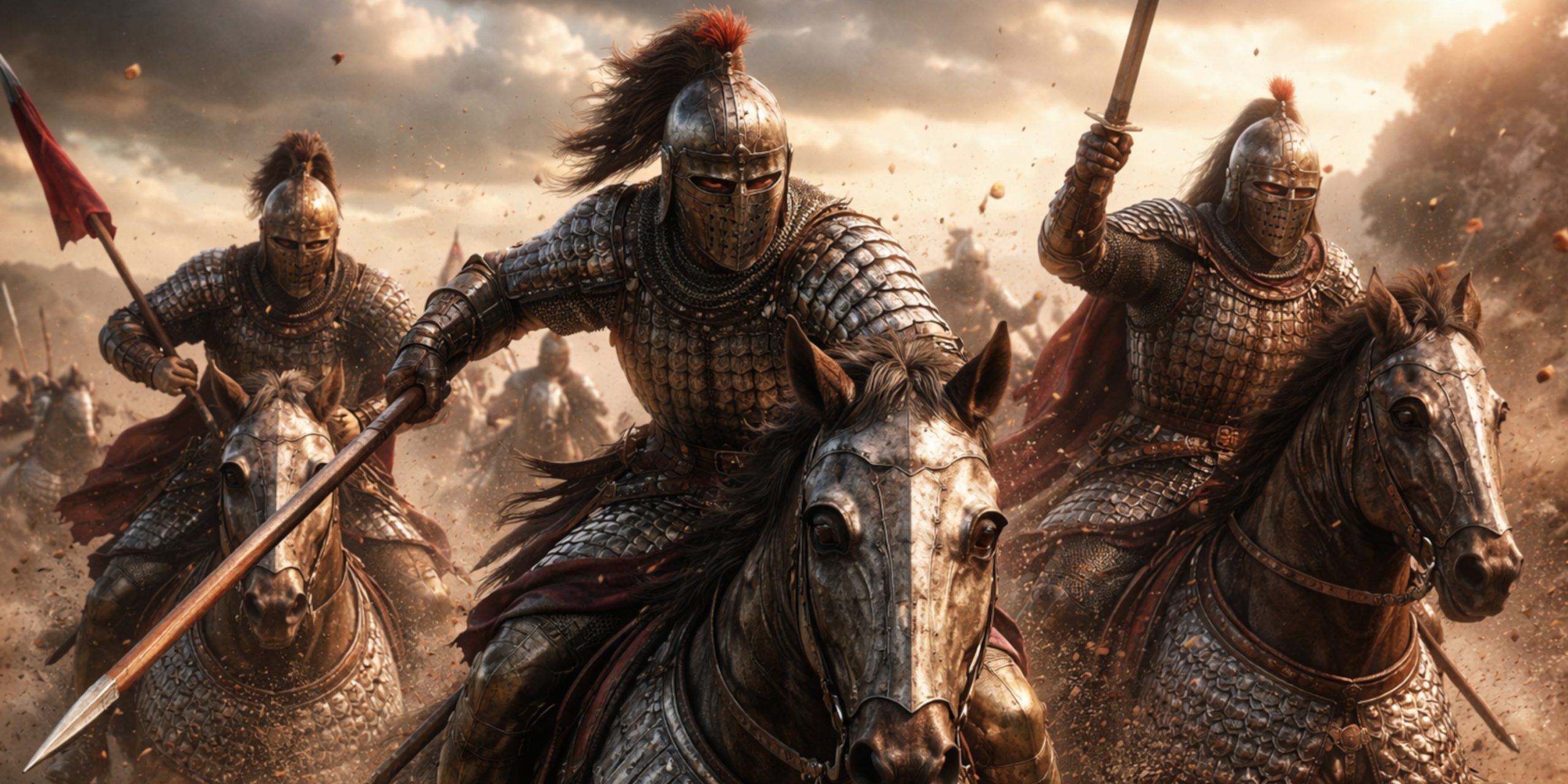
Few cavalry types have captured the imagination quite like the cataphract. These were not simply horsemen in armour. They were mobile fortresses, rider and mount encased in iron or scale, advancing with the unnerving patience of men who knew that very little could harm them head on.
The term itself derives from the Greek kataphraktos, meaning covered or fully enclosed. It was applied by Greek and Roman writers to describe the heavy cavalry of eastern empires, first the Parthians, then the Sasanians, and later adopted in modified form by the Romans and Byzantines.
To study cataphracts is to watch a slow but decisive shift in ancient warfare. Infantry still mattered, but shock cavalry was beginning to dominate the field.
Origins and Development
The earliest clear examples appear among the Iranian peoples of the Eurasian steppe and the Near East. The Parthian Empire fielded heavily armoured nobles who fought with long lances and bows. Their victories against Rome, particularly at Battle of Carrhae, made the Roman world painfully aware of what disciplined heavy cavalry could achieve.
Under the Sasanian Empire, cataphracts reached a high degree of refinement. Armour coverage increased, equipment became more standardised, and elite cavalry units formed the backbone of imperial armies.
The Romans responded by raising their own heavily armoured cavalry units, often called clibanarii. By the time of the Byzantine Empire, cataphract style cavalry was fully integrated into imperial military doctrine.
The irony is clear. Rome, which once prided itself on infantry discipline, eventually embraced the armoured horseman it had once feared.
Forces and Organisation
Cataphracts were typically drawn from aristocratic or landholding classes. Their equipment was expensive, and maintaining an armoured warhorse required wealth and infrastructure.
Common features of organisation included:
- Elite status within the army
- Close association with noble households or royal retainers
- Combined use of lance and secondary weapons
- Integration with lighter cavalry and missile troops
They rarely fought alone. Even at Carrhae, Parthian success relied on coordination between cataphracts and horse archers.
Arms and Armour
Rider Armour
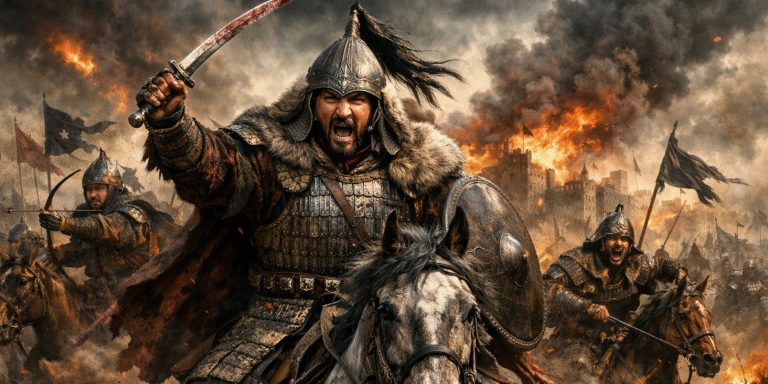
Cataphracts wore extensive protection, often including:
- Lamellar or scale cuirasses covering torso and limbs
- Arm and leg guards
- Iron or bronze helmets, sometimes fully enclosing the face
- Mail elements in later Roman and Byzantine examples
Sasanian depictions show riders almost entirely encased, leaving only narrow eye slits. One suspects visibility was not ideal, though intimidation was certainly achieved.
Horse Armour
The mount was often protected by:
- Scale or lamellar chamfrons for the head
- Quilted or metal barding across neck and flanks
- Fabric padding beneath metal plates
This added significant weight, reducing speed but increasing resilience in frontal charges.
Primary Weapon: The Kontos
The defining weapon was the kontos, a long two handed lance. It could exceed three metres in length and was often used without a shield. The rider relied on armour for protection while delivering a powerful shock impact.
Contemporary writers described the force vividly. Plutarch noted of the Parthians that their lances could transfix two men at once. Whether literal or rhetorical, the message is clear.
Secondary Weapons
Once the initial charge broke formation, cataphracts drew swords. Common types included:
- The spatha, used by Romans and later Byzantines
- The spathion, a Byzantine development
- Iranian straight swords, predecessors to later Middle Eastern blades
Some also carried maces or axes, particularly in later Byzantine service.
Tactics and Battlefield Role
Cataphracts excelled in controlled shock action. Their role was to:
- Break enemy lines through concentrated charge
- Exploit gaps created by missile fire
- Target enemy commanders
They were less effective in rough terrain or prolonged pursuit. Their strength lay in discipline and momentum, not speed.
At Carrhae, Roman infantry squares proved vulnerable to repeated cavalry assaults supported by arrows. Later Roman reforms aimed to prevent precisely this scenario.
Ammianus Marcellinus described Sasanian armoured cavalry as “men clad in plates of iron, so that the joints of their limbs were covered”. He clearly found them impressive, perhaps uncomfortably so.
Archaeology and Material Evidence
Archaeological evidence supports literary accounts.
Key finds include:
- Armour fragments from Dura-Europos, showing scale and lamellar construction
- Rock reliefs at Naqsh-e Rostam depicting Sasanian cavalry in full armour
- Parthian era reliefs at Hatra
- Byzantine military manuals such as the Strategikon, describing heavy cavalry equipment
The physical remains confirm substantial metal use, though full suits rarely survive intact. Organic components, leather and textiles, are largely lost to time.
One must always balance artistic representation with practical reality. Reliefs favour grandeur. The battlefield likely involved mud, fatigue and occasional equipment failure.
Contemporary Views
Classical authors alternated between admiration and anxiety.
Plutarch wrote of Parthian cavalry at Carrhae as glittering in steel, their appearance alone enough to unsettle Roman troops.
Ammianus Marcellinus, observing Sasanian forces centuries later, described them as iron statues come to life.
The Byzantines, more pragmatic, treated them as a tool to be refined rather than a spectacle to be feared.
Decline and Legacy
By the medieval period, the fully armoured cataphract gave way to evolving heavy cavalry traditions. Western knights and eastern armoured lancers inherited many features, though equipment and tactics adapted to new contexts.
The Byzantine cataphract system gradually declined due to economic strain and changing warfare. Maintaining heavily armoured cavalry was costly. When state finances faltered, so did the iron horseman.
Yet their influence endured. The concept of shock cavalry in full armour shaped military doctrine from Late Antiquity into the High Middle Ages.
Seven Swords Takeaway
As a historian, I find cataphracts fascinating not simply for their armour, but for what they represent. They mark a turning point where mobility and protection fused into something formidable. They forced Rome to adapt, reshaped eastern warfare, and left an imprint on cavalry traditions for centuries.
They were not invincible. No soldier ever is. But when rider and horse advanced together under iron scales, the psychological effect alone must have been considerable.
Even today, looking at a relief of a Sasanian cavalryman, one cannot help but feel a certain respect. And perhaps mild relief that one does not have to mount a fully armoured horse in summer heat.