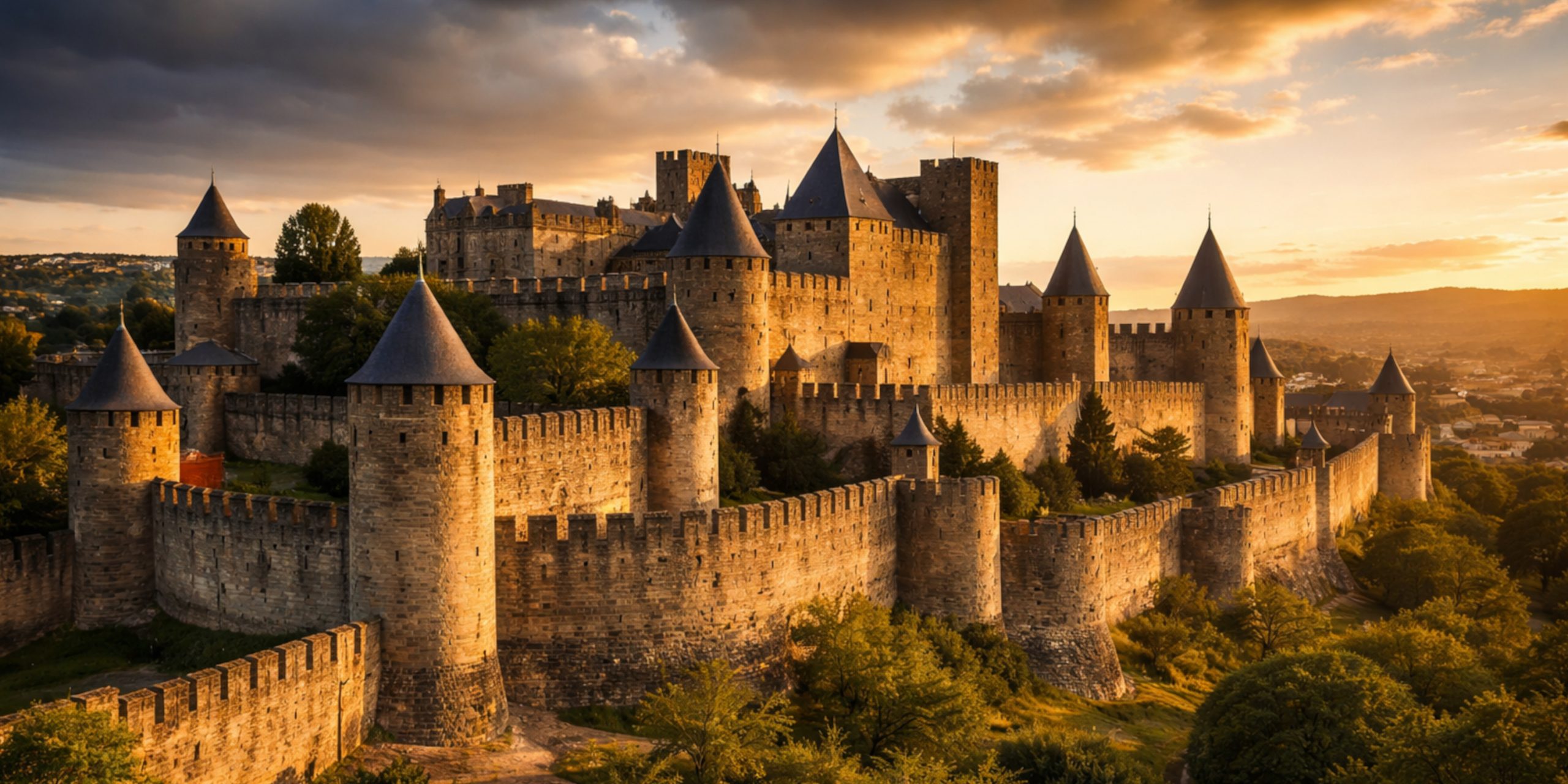
There are castles that impress, and then there is Cité de Carcassonne. Dominating the landscape with a kind of stubborn confidence that suggests it has seen everything and expects to see a great deal more.
Perched above the River Aude in southern France, Carcassonne stands as one of the best preserved fortified cities in Europe. Its walls, towers, and layered defences are not the product of a single moment, but the accumulation of centuries of anxiety, ambition, and occasional panic.
As a historian, I find it difficult not to admire the sheer persistence of the place. It has been Roman, Visigothic, Carolingian, feudal, royal, neglected, nearly demolished, and then triumphantly restored. Not bad for a site that once faced serious discussion about being turned into a quarry.
Origins and Early Development
Long before it became a medieval showpiece, Carcassonne began as a Roman settlement known as Carcaso. By the 3rd and 4th centuries, it had been fortified with thick stone walls, a sensible precaution given the increasingly uncertain state of the Roman frontier.
After the fall of Roman authority, the site passed through several hands:
- Visigoths took control in the 5th century, strengthening the defences
- Franks seized it in the 8th century after a prolonged struggle
- It later became part of the Carolingian frontier zone, a buffer against Islamic territories to the south
What survives today still carries traces of those early phases. Some of the lower stonework in the inner walls is unmistakably Roman, neat and purposeful, in contrast to the more improvisational medieval additions above.
Medieval Expansion and Royal Control
The Carcassonne most visitors recognise today largely took shape between the 11th and 13th centuries.
The powerful Trencavel family, viscounts of Carcassonne, transformed the site into a formidable feudal stronghold. Their rule ended rather abruptly during the Albigensian Crusade, when the city was captured by crusading forces in 1209.
From that point, Carcassonne became a royal fortress under the French crown. The kings of France had no intention of losing such a strategic prize and invested heavily in its defences.
Key developments included:
- Construction of the double line of walls, a rare and intimidating feature
- Reinforcement of towers and gatehouses such as the Narbonne Gate
- Creation of a militarised frontier stronghold facing the Crown of Aragon
The result was less a castle and more a fortified city designed to resist determined assault.
Architecture and Defensive Design
Carcassonne’s strength lies not in a single structure but in layers of defence that work together with quiet efficiency.
At its height, the city featured:
- Around 3 kilometres of walls
- Over 50 towers, varying in shape and period
- A double enceinte, allowing defenders to fall back while maintaining pressure
The inner core, the Château Comtal, acted as a final refuge and command centre.
Defensive features included:
- Narrow killing zones between walls
- Arrow slits designed for crossbow use
- Machicolations for dropping stones or worse on attackers
- A gate system that forced enemies into exposed positions
It is the sort of place that makes you reconsider the wisdom of medieval siege warfare. Standing below those walls, one suspects many attackers did exactly that.
Sieges and Military History
Carcassonne’s reputation as an impregnable fortress is not entirely undeserved, though it did face moments of real danger.
The Siege of 1209
During the Albigensian Crusade, the city was besieged by crusader forces led by Simon de Montfort.
The outcome was not decided by a dramatic breach of walls, but by water.
- The besiegers cut off access to fresh water
- Conditions inside deteriorated rapidly
- The city surrendered after only a few weeks
It was a pragmatic defeat rather than a heroic last stand, though I suspect the inhabitants would have preferred the latter for posterity.
Later Conflicts
After becoming a royal fortress, Carcassonne was rarely taken by force.
- It served as a defensive bulwark against Aragon
- During the Hundred Years’ War, it remained secure
- By the early modern period, its military importance declined
By the 17th century, advances in artillery rendered its high medieval walls less effective. The fortress that once intimidated armies began to look rather picturesque instead.
Occupants Timeline
Carcassonne’s long history can be traced through its successive rulers:
- Roman Empire: fortified settlement established
- Visigoths: expansion and consolidation of defences
- Franks: conquest and integration into the Carolingian realm
- Trencavel dynasty: feudal lords who shaped the medieval city
- French Crown: post 1209, major fortification and royal control
- Early modern period: gradual decline in military relevance
- 19th century restoration: revival under Eugène Viollet-le-Duc
Each phase left marks on the structure, sometimes literally layered on top of one another.
Archaeology and Restoration
By the 19th century, Carcassonne had fallen into neglect. Parts of the walls were crumbling, and there were serious proposals to dismantle sections altogether.
Enter Eugène Viollet-le-Duc, who undertook a sweeping restoration project beginning in the 1850s.
His work is both admired and debated:
- He stabilised and reconstructed large sections of the fortress
- Added pointed slate roofs to towers, not strictly authentic to the region
- Reimagined parts of the site according to his interpretation of medieval design
Modern archaeology has since refined our understanding of the site:
- Roman foundations are clearly identifiable in the inner walls
- Excavations reveal continuous occupation layers
- Artefacts include ceramics, weapons, and domestic items
One might say Viollet-le-Duc saved Carcassonne. One might also say he improved it slightly beyond recognition. Both statements can be true at once.
Contemporary Accounts and Impressions
Medieval chroniclers rarely wasted ink on neutral descriptions, and Carcassonne appears in sources as both prize and warning.
A crusader account from the early 13th century describes the city as:
“Strong beyond easy taking, with walls that seem to defy both man and engine.”
Later visitors, particularly in the 19th century, saw something different. The writer Prosper Mérimée noted its ruinous state before restoration, calling it:
“A monument abandoned to time, yet still imposing in its decay.”
It is a rare site that can be admired both for its strength and for its near disappearance.
Legacy and Cultural Impact
Today, Carcassonne is recognised as a UNESCO World Heritage Site and one of the most visited historical landmarks in France.
Its influence extends well beyond its walls:
- A model for medieval fortress design studies
- Inspiration for literature, games, and historical reconstructions
- A case study in restoration philosophy and debate
It also has a habit of looking almost too perfect, as though it has wandered out of a particularly ambitious historical painting.
Takeaway
Carcassonne is not just a relic. It is a conversation between past and present, between what was built, what was lost, and what was later imagined back into existence.
Standing on its ramparts, one feels the weight of centuries layered in stone. And perhaps also a quiet relief that one is visiting as a tourist rather than attempting to storm the place.
A sensible decision, all things considered.