Caracalla remains one of Rome’s most unsettling emperors. He ruled with ferocity, spent lavishly on the army, and left monuments that still dominate the Roman landscape. Sources pull him in opposite directions. Some paint a brutal tyrant driven by paranoia. Others show a ruler who understood, perhaps better than most, where imperial power actually rested in the third century. As a historian, I find him hard to like but impossible to dismiss.
Early Life and Rise to Power
Born Lucius Septimius Bassianus in AD 188, Caracalla was shaped by the harsh military culture of his father, Septimius Severus. From childhood he followed the army, absorbing the rhythms of campaigning rather than the refinements of senatorial life. His nickname came from a Gallic hooded cloak he popularised among soldiers, an early hint of how carefully he cultivated martial image.
Joint rule with his brother Geta after Severus’ death was always a fiction. The murder of Geta in AD 211, carried out in their mother Julia Domna’s presence, set the tone for the rest of Caracalla’s reign. Power would be personal, violent, and uncompromising.
Imperial Rule and Political Character
Caracalla governed through fear and reward in equal measure. The senate was marginalised, sometimes humiliated. Informers thrived. Yet this was not chaos. The emperor’s most famous civil measure, the Constitutio Antoniniana of AD 212, extended Roman citizenship to almost all free inhabitants of the empire. Cynics point to tax revenue. They are not wrong. Still, the decree reshaped Roman identity and law in ways that outlived him by centuries.
What strikes me is how little Caracalla cared for elite approval. His Rome was a soldier’s empire, blunt and transactional.
Arms and Armour
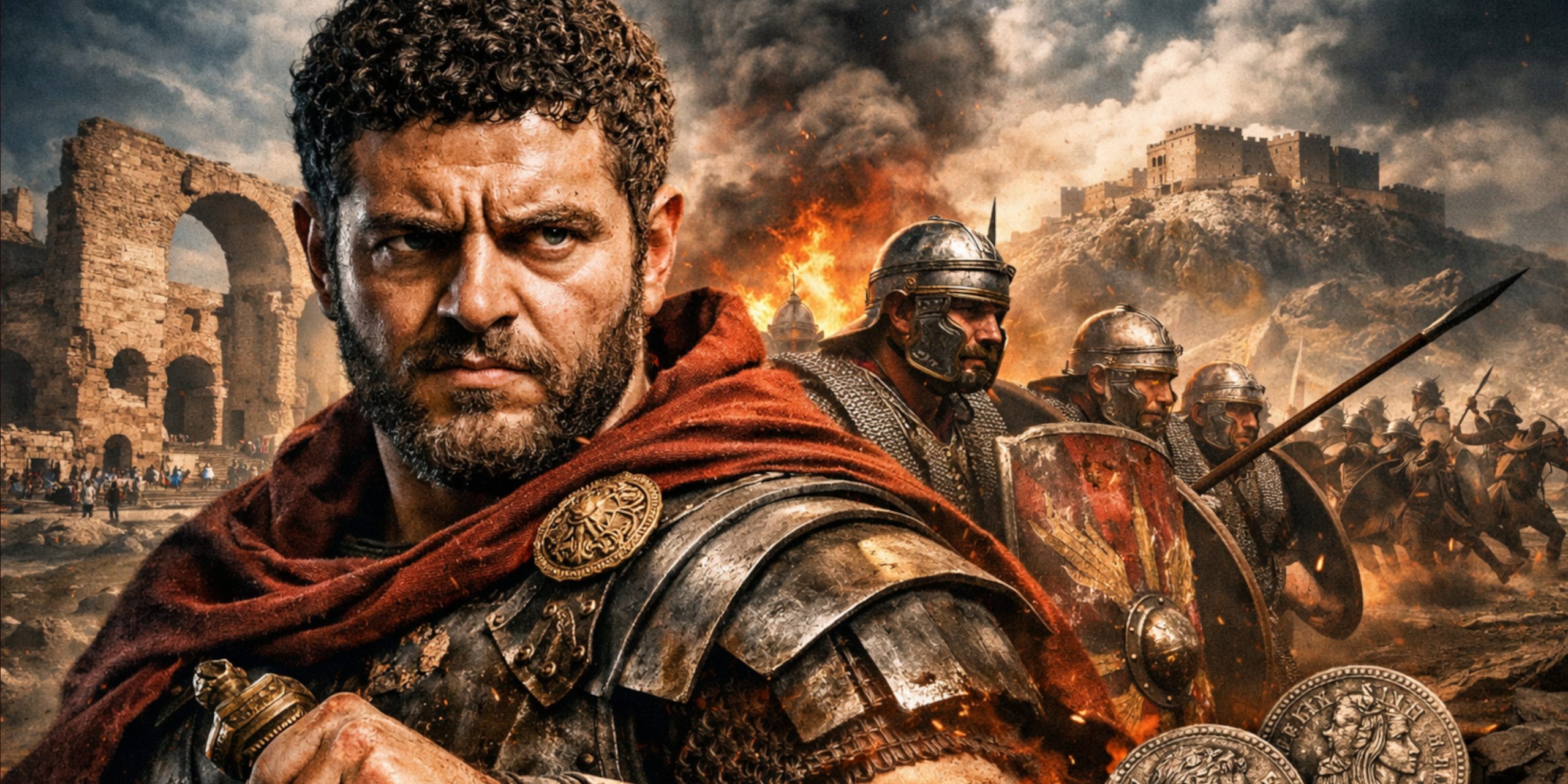
Caracalla dressed and equipped himself like a campaigning general, not a palace ruler. Contemporary descriptions and sculptural evidence show him favouring the military cuirass, short tunic, and heavy cloak associated with active command.
The army under Caracalla relied on standard early third century Roman equipment. Legionaries carried the gladius and increasingly the longer spatha, reflecting shifts toward cavalry influenced warfare. Helmets of the Niederbieber and Intercisa types were common, offering improved neck and face protection. Segmentata armour was fading, replaced by mail and scale, which proved more practical on extended campaigns.
Caracalla’s personal weaponry is unknown, but his iconography often emphasises readiness for combat rather than ceremonial splendour. He wanted to look dangerous, and he succeeded.
Battles and Military Acumen
Caracalla understood the psychology of the army better than many of his predecessors. He raised soldiers’ pay significantly, a decision that strained the treasury but bought loyalty. This was not generosity. It was insurance.
His campaigns along the Rhine and Danube were solid if unspectacular, focused on deterrence rather than conquest. The real test came in the east. Caracalla styled himself as a new Alexander and launched operations against Parthia. The campaign was aggressive but incoherent, marked more by ambition than strategic clarity.
Still, dismissing him as militarily incompetent misses the point. Caracalla kept the frontiers intact during a volatile period. He knew when to fight and when to posture. His failure was not tactical but political. The army’s loyalty to him personally did not translate into stability for the empire.
The Baths of Caracalla
No monument captures the contradiction of Caracalla better than his baths in Rome. Vast, opulent, and technically astonishing, they were completed after his death but conceived during his reign. These were not indulgences for the elite. They were public spaces on an imperial scale, offering exercise, leisure, and hygiene to thousands.
Walking through the ruins today, one senses both generosity and dominance. The baths proclaim that even a ruler feared for his cruelty could still give Rome something magnificent.
Death and Aftermath
Caracalla was assassinated in AD 217 while travelling near Carrhae. The act was small, almost mundane, carried out by a disgruntled officer. His death brought no relief. Instead it opened a period of instability that would plague the empire for decades.
As a historian, I see irony here. Caracalla built his rule on the army, yet that same military culture made emperors expendable.
Where to See Artefacts from His Reign
Material remains of Caracalla are widely scattered and surprisingly accessible. His portrait busts appear in major collections, including the Vatican Museums, the Capitoline Museums in Rome, the British Museum, and the Louvre. Coinage bearing his image is common, reflecting both his long reign and heavy military spending.
The Baths of Caracalla themselves remain the most powerful artefact of his rule. Even stripped of marble and statuary, their scale tells you everything about the resources he could command.
Latest Archaeology and Research
Recent archaeological work at the Baths has focused on service corridors, water systems, and decorative fragments, revealing just how complex the operation of the complex was. Studies of coin hoards from the early third century also continue to refine our understanding of the economic strain caused by Caracalla’s military pay rises.
Portrait analysis has advanced as well. Scholars now recognise deliberate changes in his official imagery over time, moving from youthful idealism to the severe, scowling visage that defines him today. It was propaganda carved in stone.
Seven Swords Takeaway
Caracalla is uncomfortable history. He does not fit the reassuring narrative of enlightened emperors or civil decline through softness. He represents a harder truth. The Roman Empire survived by adapting to power realities, and in his era those realities were brutal.
I would not defend him as a man. I would defend his significance. To understand Caracalla is to understand why the Roman world began to feel different after him, harsher, more militarised, and far less forgiving.
Watch the documentary: