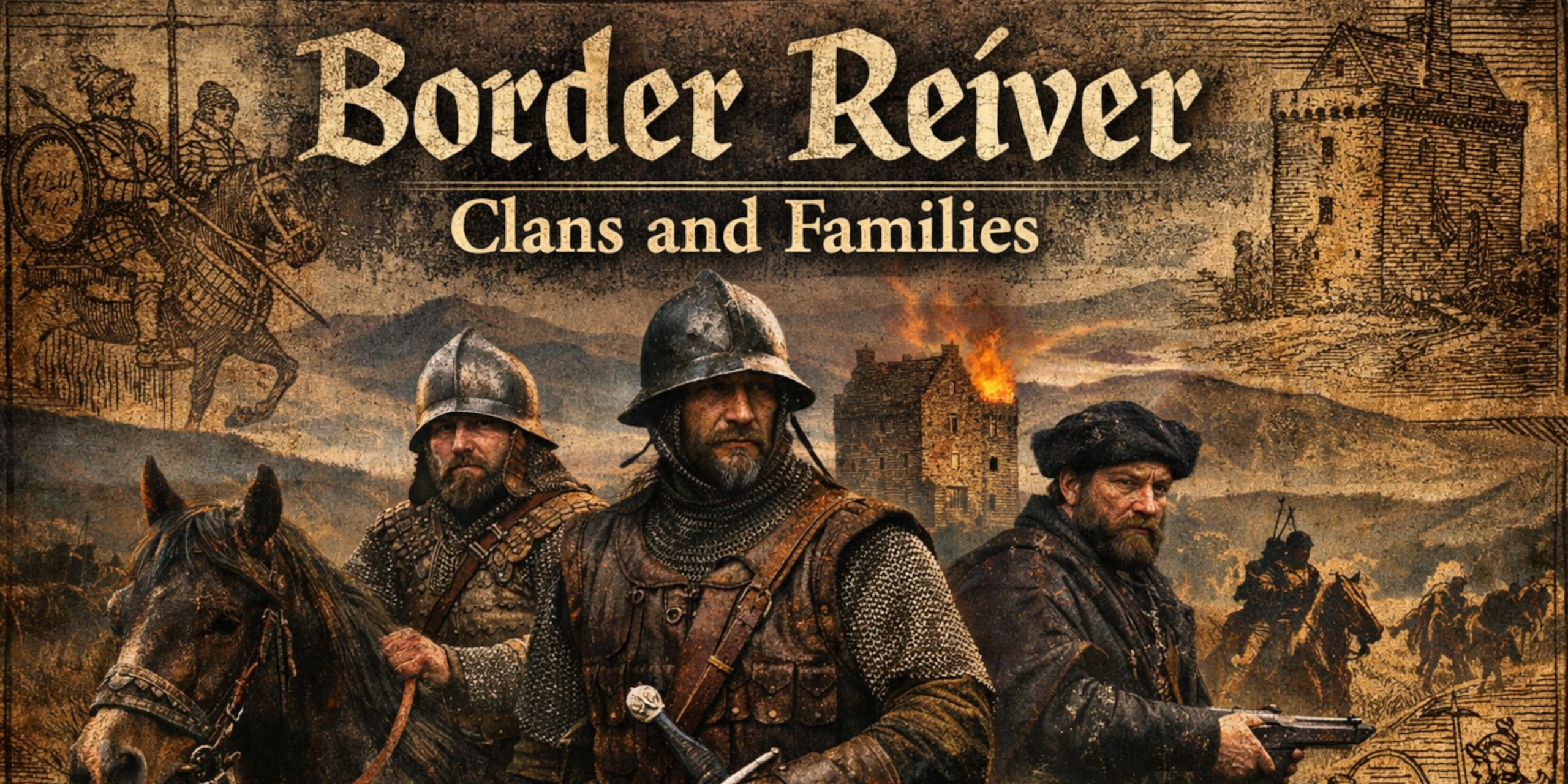
If you strip away the broader story of the Anglo-Scottish border, what you are left with is something far more personal. Names. Surnames. Families that behaved less like households and more like small, armed nations.
The Border Reivers were not a single group. They were dozens of competing kin networks, each with its own territory, grudges, and sense of honour that could shift depending on the day. You did not survive here by being English or Scottish. You survived by being an Armstrong, an Elliot, a Graham, or something equally stubborn.
And once your surname mattered more than your country, things were always going to get complicated.
The Family Structure of the Reivers
Reiver society revolved around extended kin groups, often referred to as “surnames.” These were not just families in the modern sense.
They functioned as:
- Military units
- Political alliances
- Systems of protection and revenge
- Economic networks built on raiding and livestock
A single surname could include dozens of households spread across a valley or region. Loyalty to that name was absolute. Betraying it was not just unwise, it was often fatal.
Marriage alliances, fosterage, and informal pacts linked families together. At the same time, rivalries could run for generations, sometimes without anyone remembering exactly how they began.
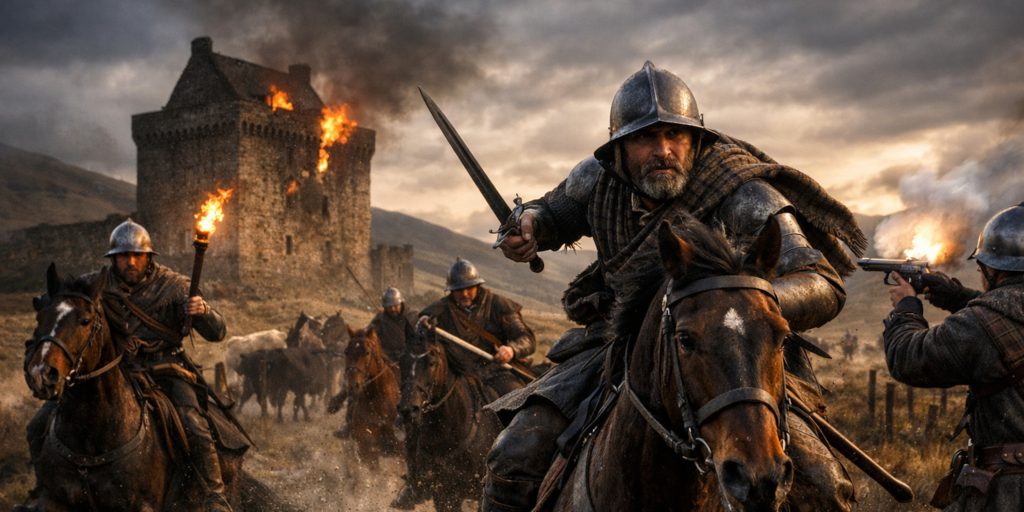
The Armstrongs: Lords of Liddesdale
If one family comes close to embodying the Reiver world, it is the Armstrongs.
Centred in Liddesdale, they controlled one of the most strategically important regions along the border. Their strength came from numbers, organisation, and a willingness to ignore authority when it suited them.
What set them apart:
- Large kin network capable of fielding significant raiding parties
- Control of key routes between Scotland and England
- Frequent defiance of both crowns
Royal officials often found themselves negotiating rather than enforcing. There is a quiet admission in that, one the Armstrongs would have appreciated.
The Elliots: Riders of the Border Hills
The Elliots were deeply embedded in the same landscape as the Armstrongs, often working alongside them.
They had a reputation for speed and coordination. If the Armstrongs were the weight of the frontier, the Elliots were its movement.
Key traits:
- Strong presence around Liddesdale and Teviotdale
- Skilled mounted raiders
- Flexible alliances depending on circumstance
They were not always the most powerful family, but they were often the hardest to catch, which in this line of work counted for quite a lot.
The Grahams: Masters of the Debatable Lands
The Grahams thrived in one of the most peculiar regions of the border, the Debatable Lands.
This was territory claimed by both England and Scotland, and properly controlled by neither. For the Grahams, this was less a problem and more an opportunity.
Why they mattered:
- Operated in a political grey zone
- Skilled at exploiting lack of authority
- Persistent in feuds and reprisals
They built influence not through dominance, but through resilience. When no one quite knows who is in charge, the people who adapt fastest tend to win.
The Johnstones: Power and Vengeance in Annandale
The Johnstones held Annandale and became synonymous with one of the most intense feuds of the borderlands.
Their long conflict with the Maxwells shaped the politics of the region and occasionally spilled into outright warfare.
Notable features:
- Strong territorial control in Annandale
- Deep involvement in clan feuds
- Central role in the Battle of Dryfe Sands
There is something almost grimly predictable about their story. Power leads to rivalry, rivalry leads to violence, and violence rarely resolves anything.
The Maxwells: Nobility on the Edge of Chaos
The Maxwells occupied a slightly different position. They were not just Reivers, they were also part of the Scottish nobility.
This gave them resources and influence, but it also dragged them into the same cycles of feud and retaliation.
What defined them:
- Control of Caerlaverock Castle
- Political connections to the Scottish crown
- Ongoing conflict with the Johnstones
They were a reminder that status did not necessarily bring stability. If anything, it simply raised the stakes.
The Kerrs and Scotts: Wardens and Power Brokers
Some families moved between the worlds of reiving and governance.
The Kerrs and Scotts often held positions as Wardens of the Marches, tasked with maintaining order in a region that resisted the concept entirely.
Their role:
- Acting as intermediaries between crown and clans
- Leading military responses to raids
- Participating in the same networks they were meant to control
It is difficult not to admire the confidence required to appoint a Border family to police other Border families. Results were, predictably, mixed.

Smaller Families and Riding Names
Beyond the major clans, dozens of smaller surnames contributed to the constant tension of the frontier.
Scottish Border Reiver Clans
| Clan | Septs | Area of Influence | Key Strongholds | Notable Figures |
|---|---|---|---|---|
| Armstrong | Fairbairn, Foster | Liddesdale, Debatable Lands | Gilnockie Tower, Hollows Tower | Johnnie Armstrong (executed 1530); Kinmont Willie (escaped Carlisle Castle, 1596) |
| Bell | Bell of Blacket House, Kirkconnel | Annandale, Dumfriesshire | Blacket House | Richard Bell (notorious raider) |
| Burn | Bourne, Burnes | Liddesdale, Eskdale | Burnfoot | Walter Burn (raided English East March) |
| Crosier | Croser, Crosser | Eskdale, Ewesdale | Langholm | Walter Crosier (feuded with Armstrongs) |
| Elliott | Eliott, Elliotson | Teviotdale, Liddesdale | Redheugh Tower | Gilbert Elliot of Stobs (skirmish leader) |
| Glendinning | Glendennyn, Glendonwyn | Eskdale, Annandale | Glendinning Tower | Thomas Glendinning (raided Cumberland) |
| Graham | Grame, Grimes | Eskdale, Debatable Lands | Netherby Hall | Richard Graham (exiled by James VI) |
| Hall | Halle, Haule | Teviotdale | Halls of Hendersyde | John Hall (raided Northumberland) |
| Irvine | Irving, Irwin | Annandale | Bonshaw Tower | Christopher Irvine (border feudist) |
| Johnstone | Johnston | Annandale | Lochwood Tower | James Johnstone, 1st Lord (Battle of Dryfe Sands, 1593) |
| Kerr | Tait, Carr, Ker | Teviotdale, Jedburgh | Ferniehirst Castle | Sir Thomas Kerr (raided English East March); Andrew Tait (Kerr ally) |
| Maxwell | Makiswell | Nithsdale | Caerlaverock Castle | Lord Maxwell (killed at Dryfe Sands, 1593) |
| Nixon | Nickson, Nix | Liddesdale | None recorded | Archie Nixon (feuded with Armstrongs) |
| Routledge | Rutledge, Rutter | Redesdale | None recorded | Robert Routledge (raided Cumberland) |
| Scott | Scot, Scote | Teviotdale, Ettrick Forest | Branxholme Castle | Sir Walter Scott of Buccleuch (rescued Kinmont Willie, 1596) |
English Border Reiver Families
| Family | Septs | Area of Influence | Key Strongholds | Notable Figures |
|---|---|---|---|---|
| Charlton | None recorded | North Tyne, Redesdale | Hesleyside Hall | Sir Edward Charlton (raided Scottish Middle March) |
| Dacre | None recorded | Cumbria, Gilsland | Naworth Castle | Lord William Dacre (defended English West March) |
| Dodd | Dodds, Dods | Tynedale, Redesdale | Dod Hill | William Dodd (raided Liddesdale) |
| Forster | Foster | Northumberland, Redesdale | Bamburgh Castle | Sir John Forster (Warden of the English Middle March) |
| Hedley | Headley | Northumberland | None recorded | Adam Hedley (cross-border raider) |
| Heron | Heryn | Northumberland, East March | Ford Castle | Sir John Heron (fought Scottish incursions) |
| Milburn | Milbourne | Tynedale | Milburn Hall | William Milburn (raided Liddesdale) |
| Musgrave | Mosgrove | Westmorland, Cumberland | Edenhall | Sir Richard Musgrave (skirmish veteran) |
| Ridley | Riddell | Northumberland | Uncertain | Nicholas Ridley (infamous raider) |
| Robson | None recorded | Redesdale | None recorded | Robert Robson (prominent raider) |
| Shaftoe | Shafto | Northumberland | Bavington Hall | Sir Robert Shaftoe (border conflict leader) |
| Taylor | Tailor, Taylour | Cumberland | Rose Castle | John Taylor (raided Annandale) |
| Trotter | Troter | Borders, Northumberland | Morton Riggs | William Trotter (cross-border raider) |
These families might not dominate entire regions, but they were far from insignificant. Many acted as allies, dependants, or opportunistic raiders in their own right.
In a society like this, even a smaller name could become dangerous with the right connections.
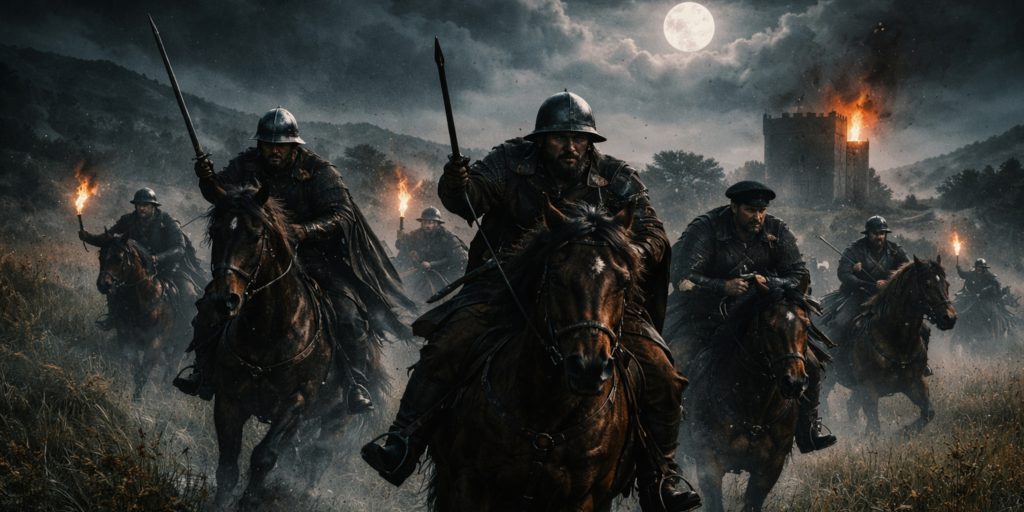
How Family Feuds Shaped the Border
Notable Feuds with Dates
| Feud | Clans/Families Involved | Dates | Key Events | Outcome |
|---|---|---|---|---|
| Armstrong vs. Johnstone | Armstrong (Scotland) vs. Johnstone (Scotland) | Early 16th C.–1596 | Kinmont Willie Armstrong’s rescue from Carlisle Castle by Scott of Buccleuch. | Temporary truce brokered by James VI; both clans later suppressed post-1603. |
| Maxwell vs. Johnstone | Maxwell (Scotland) vs. Johnstone (Scotland) | 1593 | Battle of Dryfe Sands: Johnstones ambushed Maxwells near Lockerbie. | Lord Maxwell killed; Johnstones gained dominance in Annandale. |
| Scott vs. Kerr | Scott (Scotland) vs. Kerr (Scotland) | 1520s–1545 | Battle of Melrose (1526): Kerrs allied with English to defeat Scotts. | Feud escalated. |
| Graham vs. Musgrave | Graham (Scotland) vs. Musgrave (England) | 1542–1550 | Cross-border raids intensified during the Rough Wooing. | Grahams exiled to Ireland; Musgraves retained control of Westmorland. |
| Elliot vs. Crosier | Elliot (Scotland) vs. Crosier (Scotland) | 1510–1530 | Disputes over Liddesdale territories led to cattle raids and ambushes. | Elliots absorbed Crosier lands; Crosiers faded into obscurity. |
| Forster vs. Heron | Forster (England) vs. Heron (England) | 1558–1569 | Clashed over authority in the English East March. | Forsters retained Warden role; Herons diminished politically. |
| Charlton vs. Robson | Charlton (England) vs. Robson (England) | 1480–1500 | Bloody raids over Redesdale grazing rights. | Intermarriage temporarily eased tensions; feud reignited in the 1520s. |
| Nixon vs. Armstrong | Nixon (Scotland) vs. Armstrong (Scotland) | 1570–1590 | Disputes over Debatable Lands led to retaliatory raids. | Armstrongs dominated; Nixons relegated to minor clan status. |
Feuds were not random outbreaks of violence. They were structured, remembered, and often expected.
A typical pattern might look like this:
- A raid or insult
- Retaliation by the affected family
- Escalation through allies and kin
- Cycles of revenge lasting years or decades
The Johnstone and Maxwell conflict is the most famous, but it was far from unique. These disputes shaped alliances, dictated marriages, and influenced where people chose to live.
In many ways, the history of the border is simply the sum of these overlapping feuds.
The End of the Clan Power
The decline of the Reiver families came when the political landscape finally changed.
When James VI and I unified the crowns in 1603, the border ceased to function as a contested frontier.
He took direct action:
- Leading figures from major families were arrested or executed
- Reiver strongholds were dismantled
- Families were relocated or broken apart
For the first time, there was no advantage in playing one kingdom against the other. Without that tension, the clan system that had sustained the Reivers began to unravel.
Legacy of the Reiver Families
Many of these surnames still exist today across northern England and southern Scotland.
Their legacy lives on in:
- Local place names
- Family histories and genealogies
- Border ballads and oral traditions
There is a certain temptation to see them as romantic figures. Riders under moonlight, loyal to kin, defying authority.
Personally, I think the reality is a little sharper. These were families shaped by necessity, operating in a world where hesitation could be fatal and trust was a limited resource.
Still, there is something enduring about the way they organised themselves. Not admirable in every sense, certainly not gentle, but undeniably effective for their time.
And perhaps that is why their names have lasted.
Clans Subject to Ecclesiastical Condemnation
Several clans faced formal censure for their lawlessness, including:
- Armstrong
- Bell
- Burn
- Crosier
- Elliott
- Forster
- Glendinning
- Graham
- Hall
- Hedley
- Irvine
- Johnstone
- Kerr (and sept Tait)
- Milburn
- Nixon
- Robson
- Routledge
- Scott
- Taylor
Legacy & Suppression
The Reivers’ era ended under James VI/I, who pacified the borders after the 1603 Union of the Crowns. Key actions included:
- Mass Executions: “Jeddart Justice” (summary hangings without trial).
- Transportation: Exiled Reivers became mercenaries in European wars.
- Fortification Demolition: Peel towers dismantled to disrupt raiding.
Modern Descendants:
- Tait: Survives in the Scottish Borders as a distinct surname.
- Burn: Evolved into the Burnes of Kemnay, a prominent Aberdeenshire family.
Key Locations to Visit:
- Ferniehirst Castle (Jedburgh): Kerr stronghold with Tait connections.
- Dod Hill (Northumberland): Dodd family’s raiding base.
- Glendinning Tower (Eskdale): Ruins of Glendinning power.
Border Reiver Clans and Families: Q&A
What were Border Reiver clans?
Border Reiver clans were extended family networks that operated across the Anglo-Scottish border between roughly the 13th and early 17th centuries. These were not formal clans in the Highland sense, but tightly bound kin groups linked by blood, marriage, and shared interest.
They functioned as self-contained systems of:
- Protection
- Retaliation
- Raiding and resource gathering
If your surname carried weight, you had allies. If it did not, life was considerably shorter.
Which were the most powerful Border Reiver families?
Several families dominated the borderlands at different times, though a few stand out consistently.
The most influential included:
- Armstrong
- Elliot
- Graham
- Johnstone
- Maxwell
- Kerr
- Scott
The Armstrongs in particular often behaved like a regional power in their own right. When royal officers start negotiating with you rather than arresting you, you are doing something right, or very wrong depending on perspective.
Were these families loyal to England or Scotland?
Not reliably.
Many families operated on both sides of the border and shifted allegiance depending on circumstance. Loyalty to kin usually outweighed loyalty to crown.
A raid into England by a Scottish-based family might be followed by cooperation with English authorities the following month. Consistency was not the goal. Survival was.
How did family feuds work?
Feuds were long-term conflicts between families, often triggered by theft, violence, or perceived insults.
They tended to follow a pattern:
- Initial raid or grievance
- Retaliation by the affected family
- Escalation through allies
- Ongoing cycles of revenge
Some feuds lasted generations. By that point, the original cause was often forgotten, but the obligation to continue was not.
Did smaller families matter, or just the major clans?
Smaller families absolutely mattered.
Names like Nixon, Crozier, Charlton, Ridley, and Fenwick might not dominate large territories, but they played key roles as:
- Allies to larger clans
- Independent raiders
- Local power brokers in specific areas
In a landscape built on shifting alliances, even a modest surname could become dangerous with the right backing.
How were Border Reiver families organised?
Organisation was informal but effective.
Each family typically had:
- A leading figure or dominant branch
- Networks of related households
- Informal alliances with other surnames
There was no central authority in the modern sense. Influence came from reputation, numbers, and the ability to act quickly when needed.
It was less a hierarchy and more a web. A very sharp, occasionally murderous web.
What weapons did the Reiver families use?
Reiver families favoured practical, mobile equipment suited to fast raids.
Common weapons included:
- Light lances for mounted attacks
- Swords, including early basket-hilted types
- Daggers for close encounters
- Small firearms later in the period
Armour was usually light, such as a jack of plates and a steel bonnet helmet. Speed mattered far more than heavy protection.
Why were the Armstrongs so dominant?
The Armstrongs combined several advantages:
- Large kin network
- Strategic control of Liddesdale
- Ability to organise large raiding parties
They also showed a consistent willingness to ignore authority. This may sound obvious, but not every family could sustain that level of defiance without being crushed.
The Armstrongs managed it for quite some time.
What ended the power of these families?
The decline came after James VI and I unified the crowns in 1603.
Without a contested border, the conditions that allowed Reiver families to thrive disappeared.
The crown took firm action:
- Arresting or executing leading figures
- Breaking up kin networks
- Forcing resettlement
Once the political gap closed, the space these families operated in simply vanished.
Do these families still exist today?
Yes, many of the surnames still exist across northern England and southern Scotland.
What remains is cultural rather than political:
- Family histories and genealogies
- Local traditions and ballads
- Place names tied to former territories
The raids have stopped, which most people would consider an improvement, but the names themselves have proven surprisingly durable.
Were the Border Reivers romantic outlaws?
They can be presented that way, and often are.
The reality is less polished. These were communities built around survival, opportunism, and at times quite brutal violence.
Personally, I think they are more interesting when viewed without the romantic filter. Not heroes, not villains, but families doing whatever was necessary in a place where law was optional and consequences were uneven.
That, if anything, makes them harder to forget.