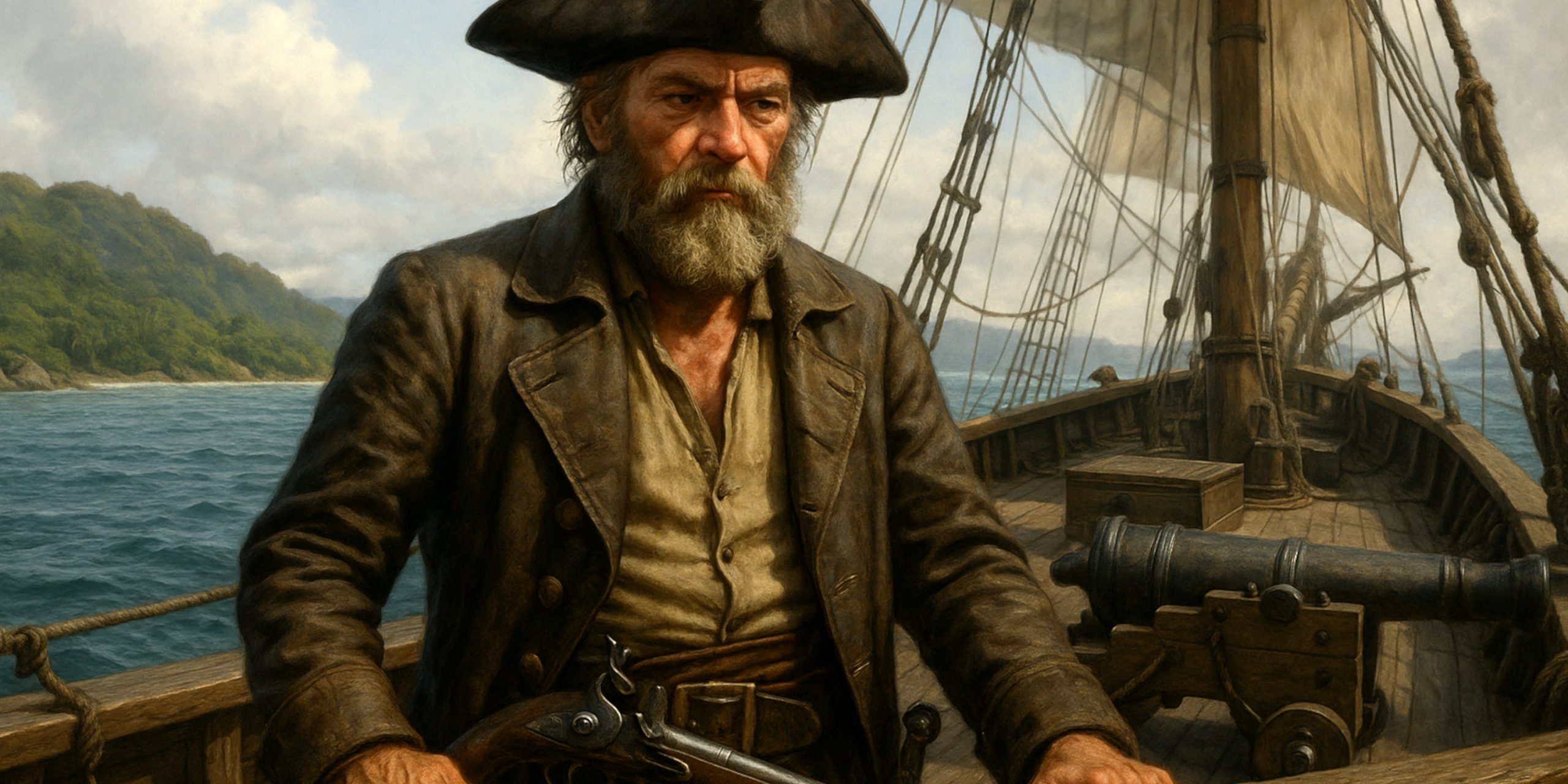
Benjamin Hornigold is one of those figures who straddles the blurry line between pirate legend and colonial opportunist. He began as a daring sea wolf and ended as a loyal servant to the Crown, which is rather like watching a rock star become a tax collector. Still, his story shaped the age of piracy as much as any golden-toothed rogue swinging from a yardarm in popular imagination.
Early Life and Rise to Infamy
Not much is known about Hornigold’s early years, which is typical for pirates and problematic for historians. He likely hailed from England, perhaps Norfolk, and surfaced in the records around 1715 when he began privateering in the Caribbean. Like many of his kind, Hornigold found privateering to be a profitable prelude to full-blown piracy.
By 1717, he had taken command of the Benjamin, a sloop nimble enough to chase merchant ships yet armed enough to put fear into their hearts. His haunts included the Bahamas, particularly the then lawless haven of Nassau, which he helped establish as a pirate republic of sorts. It was there that Hornigold’s influence reached its peak, and where he took a certain Edward Teach under his wing.
Mentorship of Blackbeard
Yes, that Edward Teach. The future Blackbeard likely served as Hornigold’s first mate, learning both the art of intimidation and the practicalities of command. Hornigold’s crews were known to plunder only foreign ships, a half-hearted attempt to stay in favour with the English crown. That moral distinction vanished when his pupils went freelance.
One can almost imagine Hornigold, in some smoky Nassau tavern, telling his young protégé that moderation would keep them alive longer. Blackbeard clearly disagreed, and history has sided with neither man in matters of longevity.
Weapons and Ships
Hornigold’s preferred vessel was the Benjamin, though he later commanded the Ranger, a brigantine better suited for larger hauls. His armament was typical of the era:
- Cutlasses and boarding axes for close combat
- Flintlock pistols and muskets for intimidation more than accuracy
- Cannon ranging from four- to nine-pounders, used sparingly to preserve valuable prizes
Pirates were, after all, businessmen at sea, albeit with unconventional HR policies.
Bounty and Treasure
Despite his reputation, there is little evidence that Hornigold ever buried treasure or amassed the kind of riches later ascribed to him. His rewards came in the form of influence, ships, and the loyalty of younger captains. Still, Nassau’s pirate council considered him something of a statesman, proof that charisma can count as currency.
By 1718, however, the mood had changed. The new governor of the Bahamas, Woodes Rogers, arrived bearing royal pardons for those who would renounce piracy. Hornigold accepted swiftly. Whether from pragmatism, fear, or exhaustion is up for debate.
The King’s Man
Hornigold’s decision to take the King’s Pardon in 1718 marked a sharp turn in his career. Rogers employed him to hunt down his former comrades. It is hard to say if Hornigold felt guilt or grim satisfaction, but one suspects a little of both.
His most famous pursuit was against Charles Vane, another Nassau outlaw who refused the pardon. Ironically, Vane escaped, perhaps poetic justice for Hornigold’s betrayal of his own kind.
Battles and Notable Raids
While Hornigold was never known for grand naval battles, his raids on merchant ships were numerous and effective. Between 1716 and 1717 he captured dozens of sloops and brigs along the Cuban coast, Hispaniola, and the Carolinas.
- 1717: Captured a French sloop off Cuba and forced its crew to hand over their cargo and hats, Hornigold’s men, having drunk too much rum, had thrown theirs overboard in celebration. A frivolous demand, but an oddly human one.
- 1718: Pursued Vane and his ship, the Ranger, before being ordered into anti-piracy service under Rogers.
Contemporary Quotes
“Hornigold, though once the terror of merchants, is now become the scourge of pirates, and in the King’s employ hunts those he lately called brothers.”
– Anonymous Nassau report, 1719
“He had a commander’s presence, but not the appetite for tyranny that made men like Teach feared.”
– Captain Charles Johnson, A General History of the Pyrates (1724)
Fate
In 1719, Hornigold met his end not by musket or rope, but by nature’s indifference. While pursuing pirates near the coast of Honduras, his ship reportedly struck a reef and sank. There were few survivors, and no great eulogy.
It is an oddly quiet death for a man who once dictated terms to half the Caribbean.
Legacy
Hornigold’s greatest legacy is arguably the men he inspired, and later hunted. Blackbeard, Sam Bellamy, and others carried forward his methods, if not his restraint. Nassau’s pirate republic may have crumbled, but its mythos lives on, and Hornigold’s name remains entangled in it.
He represents the contradiction of his age: a man who could not decide whether to fight the empire or serve it. Perhaps in that, he was more honest than the rest.
The Seven Swords Takeaway
As a historian, I find Hornigold’s story less romantic than tragic. He was a pragmatist in a time that rewarded flamboyance. His decision to surrender may seem cowardly to some, yet it reveals a rare glimpse of self-awareness in an era when pirates usually chose spectacle over survival.
Still, one imagines him looking back at Nassau, its taverns filled with ghosts of men he once led, and wondering whether the King’s gold felt half as good as stolen silver.
Watch the documentary: