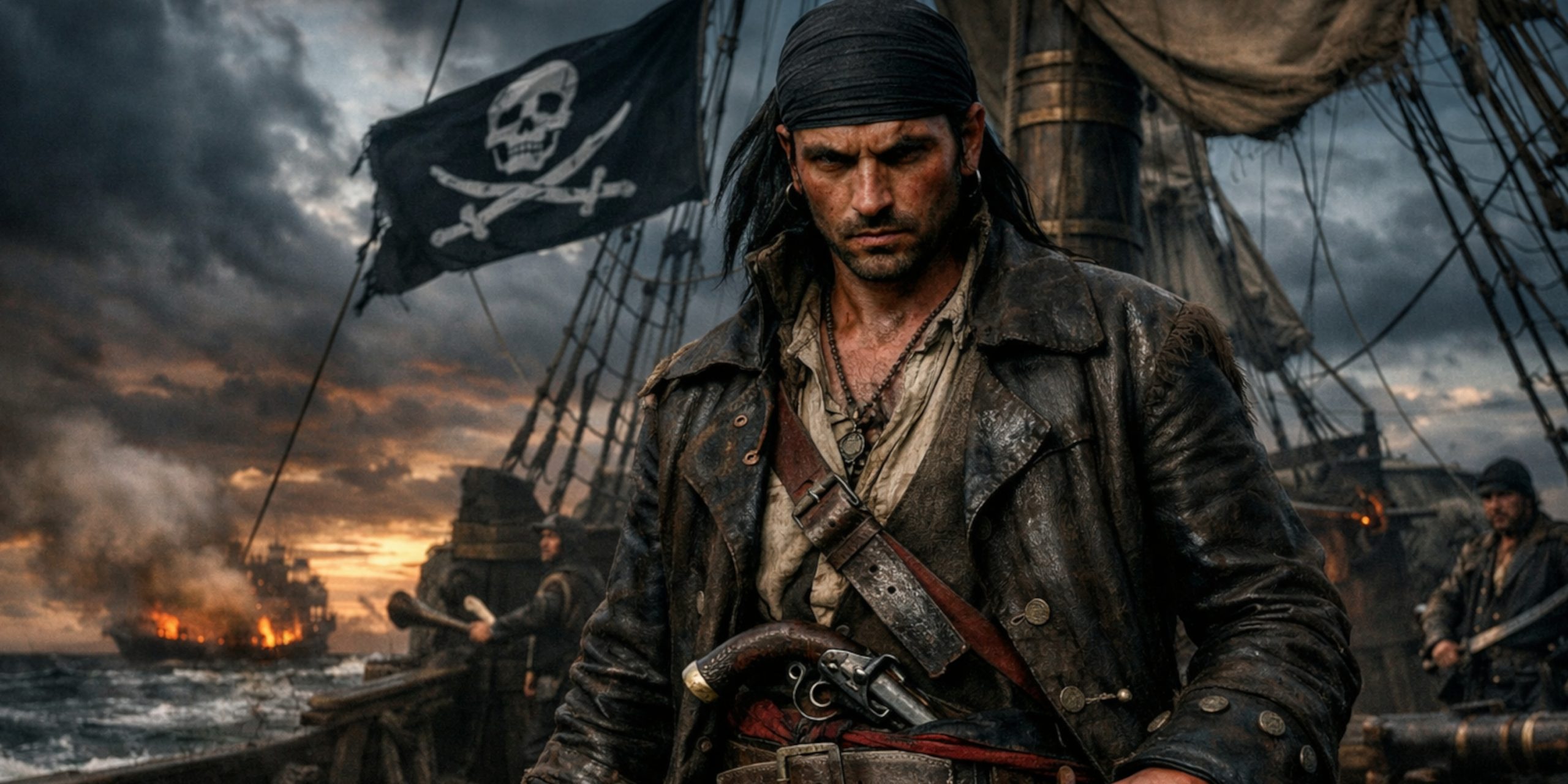
Benito de Soto was not a romantic rogue, nor a charming rogue, nor really any sort of rogue worth inviting to dinner. He was a violent Galician pirate whose name became notorious in the late 1820s after a string of Atlantic attacks, most famously the assault on the Morning Star. If many pirates have acquired a varnish of legend over time, de Soto seems to have resisted it through sheer unpleasantness.
What makes him so compelling is precisely that lack of glamour. He belonged to the last grim chapter of Atlantic piracy, after the great age of buccaneering had faded but before the sea had become fully policed by modern imperial power. His brief career was savage, profitable for a moment, and catastrophically short. That, one suspects, is often how such men end.
Who was Benito de Soto?
Benito de Soto Aboal was born in Galicia, in north-western Spain, on 22 March 1805. He later emerged as the most infamous figure among a pirate crew operating in the South Atlantic and central Atlantic during the late 1820s. Modern summaries and maritime scholarship agree that he became captain of the pirate vessel commonly associated with the Defensor de Pedro, though the ship has often also been linked in later retellings with the name Burla Negra, or “Black Joke”.
He operated in a world shaped by the upheavals that followed the Spanish American wars of independence. Privateering, semi-legal raiding, mutiny, and outright piracy often overlapped. Men who had once sailed under a flag of convenience could slide very quickly into something far uglier. Benito de Soto did exactly that.
The historical setting
De Soto’s career belongs to the messy Atlantic of the 1820s, when imperial authority had frayed across parts of the Spanish world and maritime violence had not yet been fully stamped out. This was not the era of parrots, peg legs and tavern songs. It was a harsher, more bureaucratic age, which somehow makes it nastier. Ships still carried rich cargoes across enormous distances, convoys could scatter, and isolated vessels were vulnerable once out of sight of protection.
That mattered enormously in the case of de Soto. A straggling merchantman in the mid-Atlantic was, to a pirate captain with guns and no conscience, little more than a floating opportunity. The Morning Star became the most infamous example. The National Maritime Museum summary of Michael E. A. Ford’s work notes that de Soto’s heavily armed pirate ship lay in wait off Ascension Island for vulnerable ships falling behind convoy.
How Benito de Soto became a pirate
The exact details of his early life are thinner than one would like. As with many seafaring criminals of the period, the archive becomes much clearer only once bodies and lawsuits start accumulating. The broad outline, however, is reasonably clear. De Soto had been involved with a ship operating in the Atlantic world of privateering and post-independence disorder. At some point, mutiny and seizure turned that vessel into a pirate ship, and de Soto rose to command it.
That rise tells us something about him. Pirate crews were not democracies in any noble sense, but command still required nerve, ruthlessness and the ability to dominate violent men. Benito de Soto evidently possessed all three, which is not praise. Smallpox also possesses admirable efficiency, and one does not erect statues to it.
His ship
The vessel most closely associated with him is usually identified as the Defensor de Pedro. Some later sources and traditions connect it with the name Burla Negra, translated as “Black Joke”. The naming is a little tangled in the record, and historians have noted the confusion, so it is wisest not to pretend perfect certainty where the sources do not provide it. What is clear is that de Soto commanded a fast, heavily armed pirate craft capable of overtaking merchant shipping in the Atlantic.
A pirate ship of this sort was built for pursuit, intimidation and quick violence. She needed enough sail to run down prey, enough guns to force surrender, and enough hardened men aboard to board, loot and kill if resistance was offered. De Soto’s vessel plainly met those requirements, because multiple ships fell victim to it.
Weapons and fighting style
Benito de Soto’s crew operated with the standard weapons of late Atlantic piracy, but “standard” should not make them sound quaint. These were deadly tools of short-range maritime assault.
They likely relied on cannon to stop and intimidate target vessels, then boarded with pistols, muskets, cutlasses, knives and boarding axes. Contemporary pirate actions in this period depended on shock, speed and terror. Fire a shot or two, close quickly, swarm aboard, kill any resistance, then plunder before help appears. De Soto’s recorded attacks fit that pattern with unpleasant clarity.
The cutlass, in particular, remained the classic boarding weapon for good reason. It was short, brutal, practical in confined spaces, and ideal for a deck turned into chaos. Pistols added immediate fear at close quarters, while muskets or long guns could dominate a merchant crew before boarding began. Cannon, even when not used to sink, were excellent instruments of persuasion. Piracy often preferred lootable ships to sunken ones.
The attack on the Morning Star
This is the crime for which Benito de Soto is remembered, and remembered with disgust. In 1828 the British ship Morning Star, homeward bound from Ceylon and separated from convoy, was attacked in the Atlantic. According to the Royal Museums Greenwich catalogue summary, she had struggled to keep up with the other East Indiamen and was overhauled by de Soto’s pirate vessel near Ascension Island.
The attack was not a simple robbery. It became a massacre. Survivors later described murder, plunder and extraordinary brutality. The case shocked contemporaries because it seemed to combine old-fashioned piracy with a level of cold-blooded violence that even a hard maritime age found revolting. This was one reason Benito de Soto’s name travelled so widely in British and Atlantic reporting.
The Morning Star affair also hardened de Soto’s reputation into something close to legend. Not the playful sort. The sort told in courtrooms, newspaper columns and frightened maritime conversation.
Other attacks and prizes
The Morning Star was not his only victim. Modern accounts also associate de Soto with attacks on the American ship Topaz and other vessels in 1828. These raids involved plunder and violence, showing that his command was not a one-off aberration but a sustained pirate career, however short-lived.
As for bounty and treasure, this is where pirate lore loves to rush in wearing theatrical boots. The reality is less romantic. Benito de Soto did take prizes, loot cargoes and seize valuables from ships and passengers. That much is firmly grounded. But there is no solid evidence for a vast buried treasure in the story, and certainly nothing on the scale that later pirate mythology likes to promise. His “treasure” was the immediate wealth stripped from captured ships: money, portable valuables, stores, and whatever cargo could be sold or redistributed.
In other words, he was not building a golden legend. He was stealing movable property at sea and spending it before the law caught up with him.
Contemporary reactions and quotations
Contemporary observers did not treat Benito de Soto as a dashing adventurer. They treated him as a murderer and pirate, which seems refreshingly sensible.
The surviving printed and archival trail around the Morning Star case, later trials and maritime commentary helped fix his reputation as one of the most brutal pirates of the period. The Royal Museums Greenwich description calls him “notorious” and describes the pirate ship as “heavily armed”, waiting specifically to pick off isolated merchant vessels.
Because the surviving source base here is scattered across catalogues, later scholarly reconstructions, and trial-era reporting rather than one tidy edited dossier, I am being careful not to invent a neat little bouquet of verbatim quotations. The main contemporary tenor is unambiguous, though: de Soto was discussed as a pirate of exceptional cruelty, especially after the Morning Star attack.
That caution matters. One of the quickest ways to make pirate history worse is to start handing famous villains lines they never actually said.
Was there a bounty on Benito de Soto?
De Soto was certainly pursued as a wanted pirate, and his crimes triggered energetic efforts to identify and capture him. What the available sources support clearly is a determined legal and naval hunt following the public outrage around his attacks. I have not found a trustworthy source in this search that gives a specific formal bounty sum, so I would rather leave that point uncertain than dress guesswork up as fact.
That uncertainty aside, his notoriety functioned almost like a bounty in practice. Once recognised, he was a marked man.
Capture
Benito de Soto did not die gloriously in a blaze of cannon fire, which feels right. He was eventually captured and brought to Gibraltar. Modern summaries state that he was tried there on 20 January 1830 after being identified as the pirate responsible for the Atlantic outrages of 1828.
His capture closed the net around one of the last major Atlantic pirate cases of the era. Other members of his crew were also arrested and tried in Spain, where several were executed in January 1830.
There is something grimly fitting in that administrative ending. For all the terror he spread across the ocean, the final answer came in court procedure, sentencing, and the hangman’s rope.
Trial, fate and execution
De Soto was hanged in Gibraltar on 25 January 1830. He was only twenty-four years old. That detail often startles people, perhaps because savagery feels older when written on the page. Yet many maritime criminals of the period were very young men, formed by violence early and dispatched by it earlier still.
His execution marked the end of a brief but notorious pirate career. No buried fortune, no island kingdom, no ageing corsair chuckling by the fire. Just a gallows, legal records, and a reputation stained by the murder of seamen and passengers who had the misfortune to lag behind convoy in the open Atlantic.
Why Benito de Soto has his place in history
Benito de Soto matters because he sits at the very edge of the old pirate world and the modern Atlantic. He reminds us that piracy did not vanish neatly with the eighteenth century, nor was it always wrapped in folklore and theatrical nonsense. In his case it was what it often truly was, armed robbery, murder, opportunism, and maritime collapse exploiting moments when law and empire lost their grip.
He also matters because the Morning Star case preserved the human cost. Behind the pirate name there were terrified crews, wrecked voyages, dead sailors and survivors who carried the memory home. History can sometimes polish monsters into curiosities. Benito de Soto resists polishing.
Frankly, good.
What we can say with confidence
We can say that Benito de Soto was a Galician pirate active in the late 1820s, that he commanded a heavily armed pirate vessel associated with the Defensor de Pedro, that he attacked ships in the Atlantic including the Morning Star and Topaz, that his violence shocked contemporaries, and that he was captured, tried in Gibraltar, and hanged on 25 January 1830.
We should be more cautious about tidy legends concerning hidden treasure, exact bounty sums, and some of the more colourful ship-naming traditions that later retellings repeat too confidently. Pirate history is full of embroidery. De Soto needs none.
Takeaway
If one were forced to summarise Benito de Soto in a single line, one might call him a pirate from the dying age of Atlantic sea robbery who achieved notoriety not through swagger but through brutality. He was effective for a moment, feared by many, and dead by twenty-four. There is a warning in that arc, though not a subtle one.
The sea has produced plenty of fascinating villains. Benito de Soto was one of the nastier specimens, and the records, sparse though parts of them are, leave little room for sentiment.