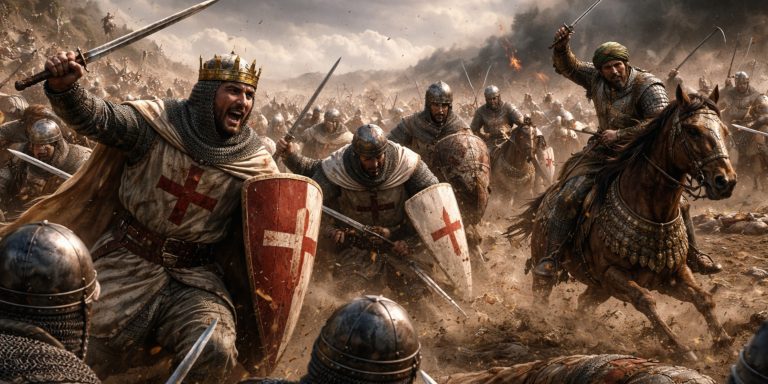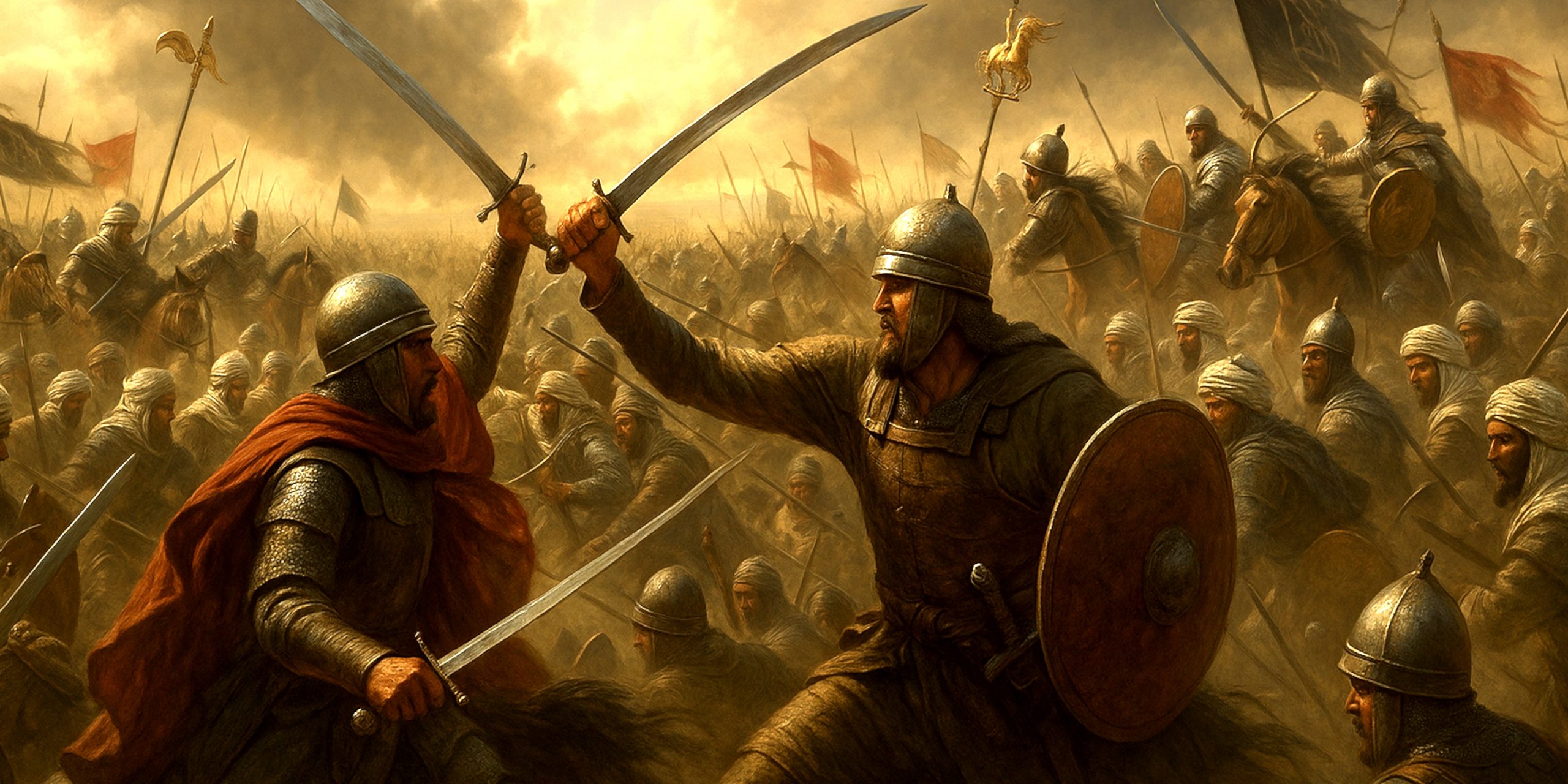
The Battle of Yarmouk in 636 was one of those moments where the map of the Near East seemed to shift under the feet of its armies. The clash between the Rashidun Caliphate and the Eastern Roman Empire decided the future of Syria, yet it unfolded with a strangely intimate quality. Ancient writers lingered over dust storms, sudden cavalry charges, and banners whipping in the wind. They also complained a surprising amount about the heat, which tells you something about human priorities in war.
The battle earned its reputation not because it was elegant, but because it was final. When the Romans withdrew, the landscape of imperial power in the region went with them.
Forces
A concise summary of the armies involved.
Rashidun Caliphate
- Estimated strength ranged from 25,000 to 40,000.
- Core troops consisted of seasoned infantry from Arabia, reinforced by contingents from Syria and Iraq.
- Cavalry played a decisive role, especially the mobile units led by Khalid ibn al Walid.
Eastern Roman Empire
- Common estimates place the force between 80,000 and 120,000, though historians routinely roll their eyes at ancient headcounts.
- A mixed body of Roman regulars, Armenian and Ghassanid allies, along with local levies drawn from Syria and the Levant.
- Heavy cavalry, the cataphract style units, were expected to break the Arab lines but found the terrain and tactics stacked against them.
Table: Comparative Forces
| Side | Estimated Numbers | Key Components | Command Structure |
|---|---|---|---|
| Rashidun Caliphate | 25,000 to 40,000 | Arab infantry, light and medium cavalry, archers | Overall command: Khalid ibn al Walid |
| Eastern Roman Empire | 80,000 to 120,000 | Infantry cohorts, heavy cavalry, Armenian and Ghassanid allies | Command split among several generals, nominally under Vahan |
Leaders
Rashidun Caliphate
- Khalid ibn al Walid, known for rapid manoeuvre and an enviable habit of appearing where no one expected him.
- Abu Ubaydah ibn al Jarrah, respected for calm leadership and the sort of patience every army needs but rarely enjoys.
- Iyad ibn Ghanm and Shurahbil ibn Hasana, both commanding regional contingents.
Eastern Roman Empire
- Vahan, the Armenian general attempting to hold together a coalition that had all the cohesion of wet sand.
- Theodore Trithyrius, senior Roman officer managing administration but also taking the field.
- Jabala ibn al Aiham, king of the Ghassanids, one of the few men on the Roman side who understood the local terrain and tribes.
Arms and Armour
Both armies arrived with equipment shaped by centuries of frontier warfare.
Rashidun Caliphate
- Swords: Primarily straight edged Arab blades and early curved saif forms, practical for close fighting.
- Lances and spears: Favoured by cavalry for reach.
- Bows: Composite bows used by both infantry and mounted troops.
- Armour: Light mail, leather cuirasses, simple helmets. Protection was modest, which made the troops fast and responsive.
Eastern Roman Empire
- Swords: The spathion, a straight double edged blade. Officers and cavalry relied on it heavily.
- Lances and kontaria for the cavalry, designed for shock charges.
- Bows and slings employed by auxiliaries.
- Armour: Mail or lamellar cuirasses, helmets with nasal guards, large oval shields for infantry. Cataphract cavalry used heavier lamellar and sometimes horse armour, although the July heat did them no favours.
Table: Leaders and Troop Composition (Arms and Armour Emphasis)
| Side | Key Leaders | Sword Types | Armour | Notable Units |
|---|---|---|---|---|
| Rashidun Caliphate | Khalid ibn al Walid, Abu Ubaydah, Iyad, Shurahbil | Early curved saif, straight Arab blades | Light mail, leather, simple helmets | Mobile cavalry, disciplined infantry blocks |
| Eastern Roman Empire | Vahan, Theodore Trithyrius, Jabala ibn al Aiham | Spathion | Lamellar, mail, heavy cavalry gear | Cataphracts, Armenian infantry, Ghassanid horsemen |
Contemporary Voices
Several early Islamic historians and later Byzantine chroniclers left impressions of the battle. Their tone varies from reverent to despairing, which reflects their fortunes.
- Al Waqidi preserves a remark attributed to a veteran who said, “The dust rose so thick it wrapped the world. We knew friend from foe only by their voices.”
- A Byzantine account laments, “The wind turned against us, and with it the judgement of heaven, or so the soldiers muttered.”
- Khalid himself reportedly told his men, “Hold the line and trust your feet, for God grants victory to those who stand their ground.” Whether he said this on horseback at full gallop is anyone’s guess.
Archaeology
Tangible traces of the battle are uncooperative. The plain south of the Golan Heights has been disturbed by centuries of agriculture and settlement, so archaeologists must work like detectives with half the evidence missing.
- Surface finds include scattered arrowheads of Near Eastern design, although assigning them directly to Yarmouk is an optimistic sport.
- A few late Roman lamellar fragments have been discovered in the region, consistent with sixth or seventh century armour.
- Landscape modelling suggests several likely lines of advance and retreat along the ravines, matching the textual accounts of troops pressed against steep drops.
- The battlefield’s exact boundary remains debated, a reminder that real history is much messier than tidy textbook maps.
Battle Timeline
A simplified sequence of events helps clarify how the six day confrontation unfolded.
Day One
Skirmishing across the front. Both sides probed weaknesses. The heat, according to one source, was so intense that even the horses protested.
Day Two
Roman forces attempted to break the Muslim left wing. Khalid redistributed cavalry to stabilise the sector.
Day Three
A major push by the Romans nearly unhinged the centre. Counter attacks restored the balance before nightfall.
Day Four
The Ghassanid cavalry clashed repeatedly with Arab horsemen. Neither achieved decisive success.
Day Five
Khalid’s mobile guard executed flanking movements that disrupted Roman supply access and morale.
Day Six
A coordinated Rashidun offensive broke Roman cohesion. Many units were forced toward ravines and narrow exits. The Roman army began a general retreat that quickly turned chaotic.
Legacy
Yarmouk ensured that Syria passed into the hands of the Rashidun Caliphate. It also ended Rome’s practical ability to reclaim the province. Some historians describe this as the moment Late Antiquity finally surrendered to the Medieval Near East. Others prefer more restrained language, possibly from fear of academic arguments that last for years.
Either way, the battle reshaped the region. Armies on both sides learned hard lessons about mobility, logistics, and leadership. Those lessons were not always applied, but that is also a tradition with deep historical roots.
Watch the documentary: