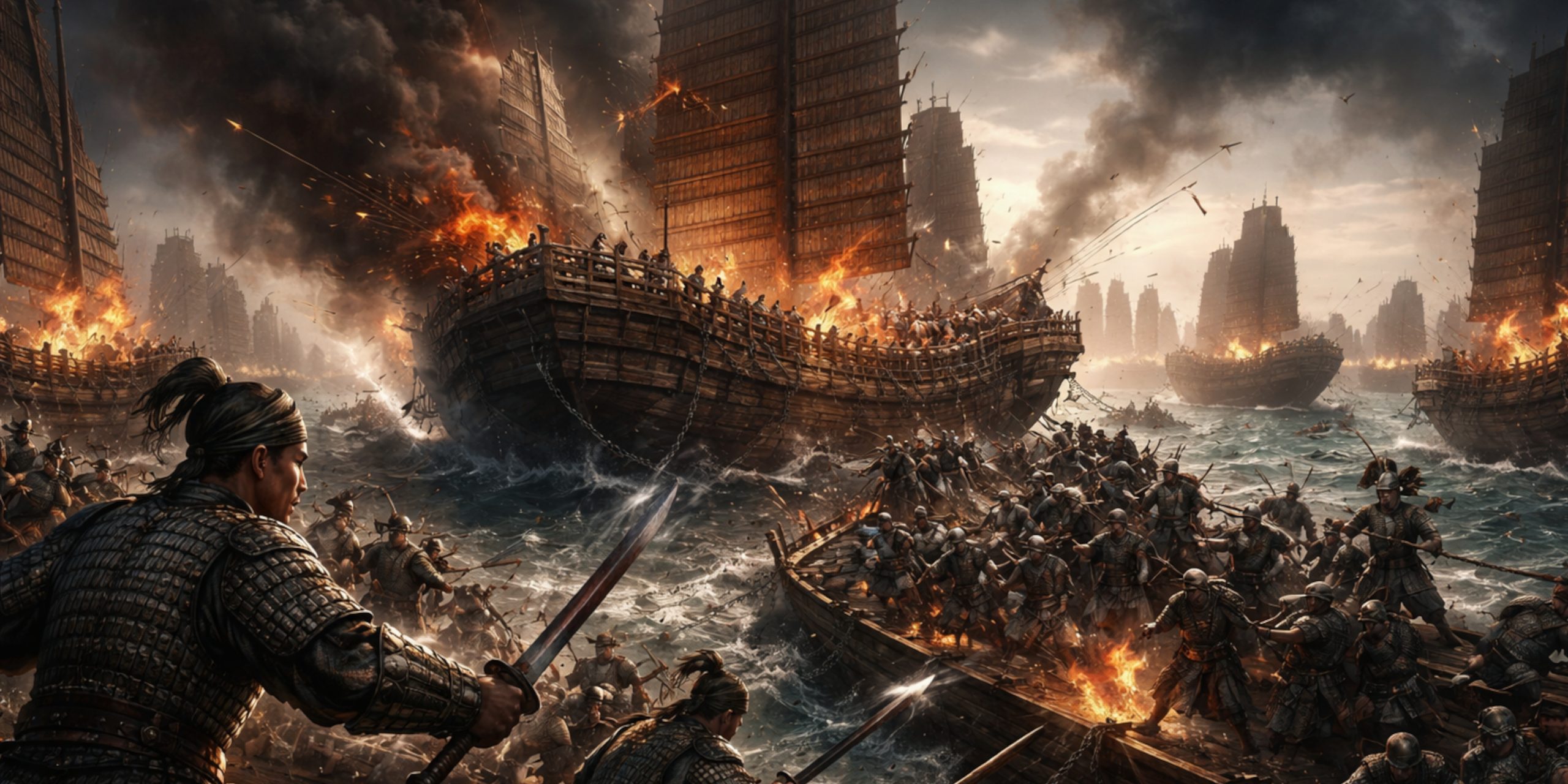
The Battle of Yamen closed the book on the Song dynasty with an ending that still feels raw, even after centuries of retelling. Fought on the waters off southern China, it was not a clash of armies in the familiar sense but a grim naval siege that collapsed into annihilation. As a historian, I find Yamen unsettling precisely because it lacks the drama of manoeuvre or reversal. It is history written in a narrowing circle.
Background
By 1279 the Southern Song court had been reduced to a floating refuge, pursued relentlessly by the Yuan dynasty. The Mongol conquest of China was almost complete, and what remained of Song authority existed in exile, clinging to ships, child emperors, and ritual rather than territory. Yamen, near modern Guangdong, became the final stand because there was nowhere else to run.
Forces
Song Dynasty
| Element | Details |
|---|---|
| Command | Zhang Shijie |
| Emperor | Zhao Bing |
| Strength | Estimated 1,000 to 1,200 ships |
| Troops | Sailors, marines, court retainers, refugees |
The Song fleet was impressive in scale but fatally constrained. Ships were chained together to prevent desertion, a decision that would later feel like a slow tightening noose.
Yuan Dynasty
| Element | Details |
|---|---|
| Command | Zhang Hongfan |
| Supreme Authority | Kublai Khan |
| Strength | Several hundred warships |
| Troops | Mongol and Chinese sailors, marines, archers |
The Yuan forces combined Mongol command discipline with experienced Chinese naval crews. By this stage of the conquest, they had learned how to fight at sea as ruthlessly as they did on land.
Arms and Armour
Naval warfare at Yamen was brutal and intimate. Once ships locked together, combat became a floating melee.
Weapons in use
- Jian, straight double edged swords favoured by officers and retainers.
- Dao, single edged sabres widely used by sailors and marines for close fighting.
- Spears and polearms for boarding actions.
- Crossbows for ship to ship fire, though their impact faded once vessels closed.
Armour
- Lamellar armour of iron or hardened leather, worn by elite troops.
- Quilted jackets and padded coats for common sailors.
- Shields were rare aboard ship, space mattered more than protection.
This was not elegant warfare. It was slippery decks, smoke, shouting, and the constant risk of drowning. Romantic notions of swordplay have no place here.
Battle Timeline
Early March 1279
Yuan forces locate the Song fleet anchored near Yamen.
Initial Engagement
Yuan ships probe the Song formation. The chained Song vessels hold firm but cannot manoeuvre.
Encirclement
The Yuan fleet surrounds the Song position, cutting off access to fresh water and supplies.
Final Assault
After days of pressure, Yuan forces launch a full scale attack. Boarding actions overwhelm the Song ships one by one.
Collapse
Song resistance disintegrates. Admiral Zhang Shijie attempts a breakout but fails.
Death of the Emperor
Court official Lu Xiufu carries the child emperor Zhao Bing into the sea, ending the dynasty.
Archaeology and Material Evidence
Physical remains of the battle are scarce, as is often the case with naval engagements. However, coastal archaeology in Guangdong has uncovered Song era ship timbers, anchors, and ceramics consistent with a refugee fleet. These finds align with contemporary descriptions of a court living at sea, complete with kitchens, shrines, and administrative spaces aboard ship. The absence of large scale wreckage suggests many vessels were burned or salvaged after the battle, a practical end to a tragic episode.
Contemporary Accounts
Song loyalist writings are saturated with grief and moral anguish. One chronicler wrote that “the sea was filled with the sound of weeping, and heaven itself turned away.” Yuan sources are more restrained, framing the victory as inevitable and necessary, though even they acknowledge the scale of the slaughter.
There is a telling silence in some official Yuan histories. When an event is too final, words tend to shrink.
Legacy
Yamen marked the complete collapse of the Song dynasty and the consolidation of Yuan rule over China. It also stands as a warning about rigidity in warfare. The decision to chain the fleet together was meant to enforce loyalty. Instead, it removed the last option for survival. History is full of bad calls, but this one is painfully clear in hindsight.
As a historian, I cannot help but feel that Yamen is less a battle than an ending. There is no clever tactic to admire, no heroic reversal. Only a slow, suffocating certainty, played out on water.
Watch the documentary: