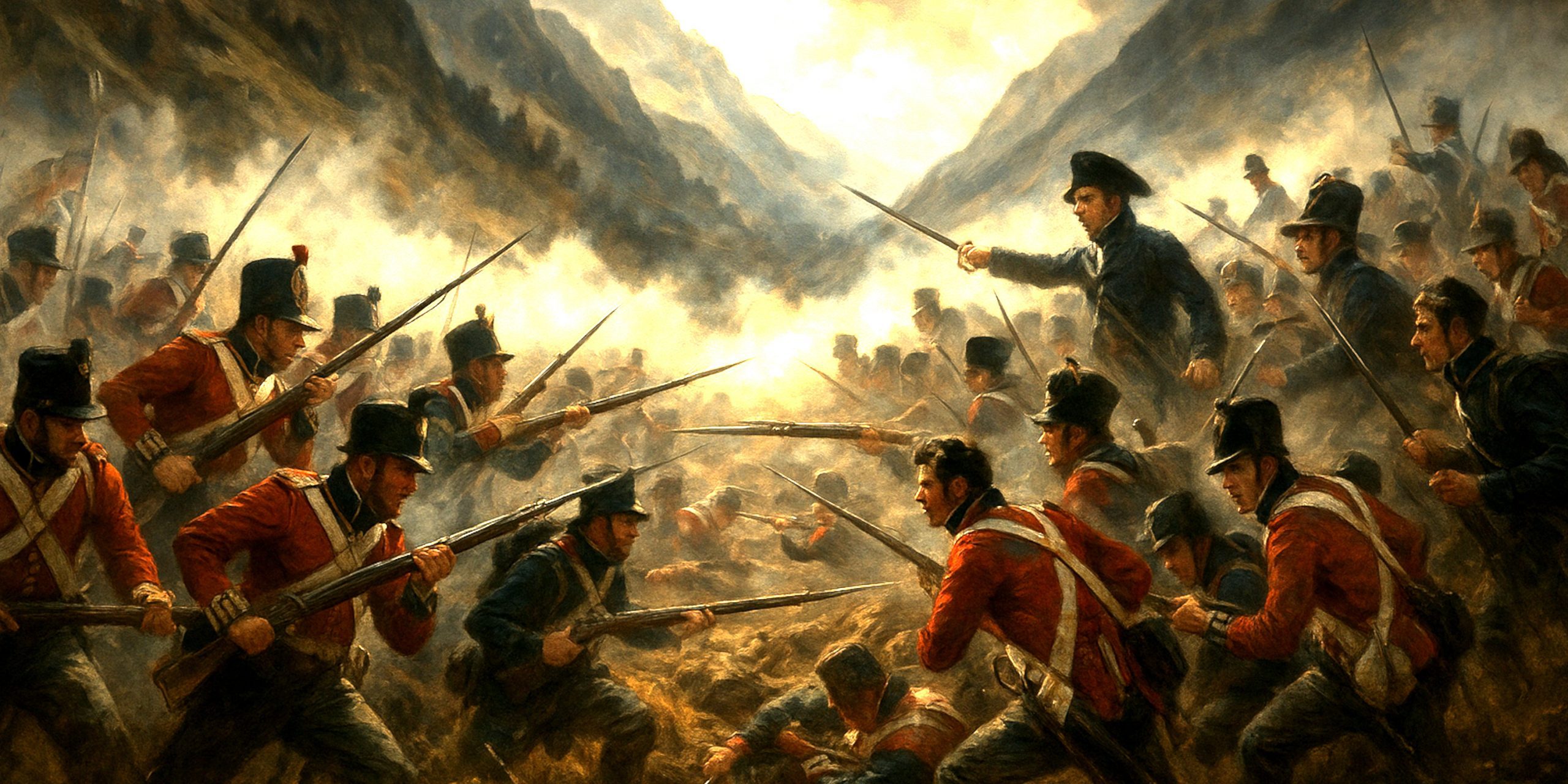
A historian can spend a lifetime trying to convince students that a mountainous battlefield is not just an awkward hiking holiday waiting to happen. The Battle of the Pyrenees in the summer of 1813 proves the point rather neatly. This was no single clash but a loose chain of fierce actions fought along a crooked frontier from Roncesvalles to Sorauren. It came at the moment when Wellington’s army had finally pushed the French out of Spain and now stood on the very threshold of Napoleon’s empire. The French, having no taste for British-led armies on their doorstep, tried one last effort to break the Allied line among the ridges and passes.
The fighting was chaotic, brave, frustrating, and occasionally brilliant. It produced moments of extraordinary leadership. It also produced the usual mountain weather that delights only goats and poets.
Forces
Below is a clear snapshot of the forces on both sides. Figures vary between contemporary reports, official returns, and later estimates, yet the broad proportions hold.
Leaders and Command Structure
| Side | Senior Commanders | Notes |
|---|---|---|
| Allied Army (Britain, Portugal, Spain) | Arthur Wellesley, Marquess of Wellington | Overall command, coordinating widely scattered divisions |
| Sir Rowland Hill | Commanded the right wing near the Bidassoa | |
| Sir Thomas Picton | Led the Third Division with typical thunder | |
| General Cole | Involved heavily around the Roncesvalles area | |
| French Army | Marshal Nicolas Soult | Charged by Napoleon with restoring the French position |
| General Clausel | Led key columns in the central sector | |
| General Reille | Engaged at Sorauren and nearby valleys |
Troop Composition
| Army | Estimated Strength | Infantry | Cavalry | Artillery |
|---|---|---|---|---|
| Allied | About 80,000 available in theatre, though only a portion engaged at any one time | British line regiments, Portuguese line and caçadores, Spanish contingents | Limited use due to terrain, mostly British and Portuguese light cavalry | A mix of British and Portuguese batteries |
| French | Roughly 60,000 under Soult, though dispersed | Veteran French line regiments, voltigeurs and grenadiers | Restricted by slopes and passes | Several batteries moved with difficulty through mountain paths |
Arms and Armour
Napoleonic mountain fighting rarely gives cavalry room to charge and it shows in the equipment choices.
Allied Weapons
• British infantry carried the Brown Bess musket, sturdy and familiar, if not beloved on wet mornings in Navarre.
• Rifles were used by the 95th Rifles and some Portuguese units. Their Baker rifles provided valuable long range fire among the slopes.
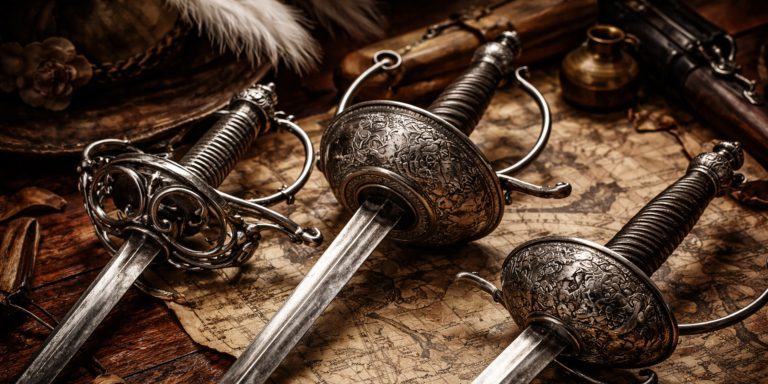
• Officers often carried sabres such as the 1796 infantry officer’s sword. Simple, practical, and a touch elegant when clean.
• Portuguese troops also fielded their standard infantry sabres and side arms.
French Weapons
• French infantry relied on the Charleville musket. It was reliable enough but in the damp forests of the Pyrenees even the best powder sulked.
• Voltigeurs and grenadiers used the light sabre briquet. At close quarters it served its purpose, and occasionally its wielder’s pride.
• Officers carried curved sabres in the light cavalry style, even though there was scarcely room on the mountain paths to swing one.
Armour was near nonexistent. This was a campaign fought by men in coats, packs, and worn boots, not cuirasses. The mountains strip away illusions rather efficiently.
Archaeology
Battle archaeology in the Pyrenees is complicated by two centuries of erosion, forest regrowth, and the cheerful habit of shepherds to move anything that looks remotely interesting. Even so, surveys have uncovered musket balls, fragments of uniform fittings, and occasional buttons attributed to British, Portuguese, and French units.
Most sites confirm the dispersed nature of the combat. Skirmish lines stretched across ridges that modern hikers stroll along without any sense of the frustration Wellington’s staff must have felt while trying to keep the divisions in communication.
Researchers have also examined old paths and mule tracks that formed the arteries of both armies. The narrowness of these routes explains why whole columns sometimes advanced or retreated in single file, a condition that must have tried the patience of everyone involved.
Battle Timeline
25 July 1813
Soult launches his offensive. French columns push through Roncesvalles, forcing the Allied defenders to give ground. Heavy fog adds confusion. Wellington, on hearing the news, moves rapidly to stabilise the situation.
26 July
Fighting intensifies at Roncesvalles. Allied forces withdraw toward Sorauren. The French push hard though their columns begin to clog the valleys. The mountains prove to be no respecter of staff plans.
27 July
First Battle of Sorauren. Wellington selects a strong defensive ridge. French assaults fail to break the Allied position. One British officer wrote that the ridge felt “as if placed there by Providence for the very purpose of holding off an emperor’s pride.”
28 July
French attacks resume but again achieve little. Clausel’s men suffer heavily. By afternoon Soult realises the offensive is spent. The Allied counterstroke begins.
29 July
French forces begin to retreat toward their frontier. Pursuit is cautious due to fog and exhaustion.
30 July
Second Battle of Sorauren. French rearguards hold off Allied attacks but cannot prevent the general withdrawal.
Early August
Soult pulls his army back over the frontier. Wellington re-establishes his line and prepares for the final thrust into France.
Contemporary Quotes
Contemporary voices capture the exhausted tone of the campaign.
British rifleman’s diary:
“We fought the French from mist to mist. The mountains swallowed the sound but not the fear.”
Marshal Soult to a subordinate:
“The enemy gains his advantage by patience. I confess I was not expecting so much patience from an Englishman.”
Wellington to Lord Bathurst:
“The country is abominable for military movements. I find the ridges everywhere except where I want them.”
Historians appreciate that last remark more than we should.
Outcome and Significance
The Battle of the Pyrenees ended Soult’s final hope of reversing France’s fortunes in Spain. It showed Wellington at his most flexible. His defensive work at Sorauren is often cited as a model of using terrain intelligently rather than romantically. The French fought with determination but could not overcome the Allies’ coordination and discipline.
It also marked the moment when the war crossed decisively into French soil. Armies that had once seemed little more than stubborn interlopers were now knocking at the gates of France herself. Napoleon’s empire was shrinking and the mountains had quietly helped to pare it down.
Seven Swords Takeaway
The Battle of the Pyrenees is sometimes overshadowed by the later entry into France or by the glamorous sweep of Waterloo. Yet the fighting among the ridges in July 1813 reveals as much about planning, tenacity, and leadership as any textbook campaign. For those of us who spend our days studying such things, it is a reminder that history often turns not on grand plains but on narrow tracks where men struggled simply to stay in formation.
Watch the documentary: