Sulla’s Brutal Lesson to Mithridates in the Marshes of Boeotia
The Battle of Orchomenus, fought in 86 BC near the Boeotian city of Orchomenus in central Greece, was the decisive second act in Lucius Cornelius Sulla’s campaign against the forces of Mithridates VI of Pontus. If Chaeronea earlier that year proved Roman resilience, Orchomenus demonstrated Roman ruthlessness.
Sulla was outnumbered, short of cavalry, and politically exiled from Rome. Yet by the end of the fighting, the Pontic army lay shattered in the marshes of Boeotia. It was a victory built not merely on discipline, but on engineering, nerve, and an ability to turn desperation into advantage.
Strategic Background
The wider conflict belongs to the First Mithridatic War. King Mithridates VI Eupator of Pontus had swept through Asia Minor and into Greece, presenting himself as a liberator from Roman domination. His general Archelaus commanded large forces in Greece, reinforced by allied contingents and mercenaries.
Sulla, appointed by the Roman Senate but soon declared an enemy by his political rivals, marched east to restore Roman authority. He defeated Archelaus at the Battle of Chaeronea in early 86 BC, but the Pontic army regrouped. Orchomenus would settle the matter.
The geography mattered. The plain near Orchomenus bordered Lake Copais and was cut with marshy ground. It was not ideal terrain for a Roman army lacking strong cavalry. Archelaus knew this and sought to exploit it.
Forces
Ancient figures vary wildly. Plutarch, our main source, writes with admiration for Sulla and does not shy away from dramatic numbers. A cautious estimate is wiser.
Roman Forces under Sulla
| Component | Estimated Strength | Notes |
|---|---|---|
| Legionary Infantry | 15,000 to 20,000 | Hardened veterans of earlier campaigning |
| Allied Infantry | Several thousand | Greek and Italian contingents |
| Cavalry | Limited | A known weakness compared to Pontic forces |
| Engineers and Camp Followers | Present | Crucial to the defensive works |
Pontic Forces under Archelaus
| Component | Estimated Strength | Notes |
|---|---|---|
| Phalanx Infantry | 60,000 or more | Macedonian style sarissa formations |
| Cavalry | Substantial | Including scythed chariots and heavy cavalry |
| Auxiliary Troops | Numerous | Thracian, Greek, and Anatolian contingents |
| Scythed Chariots | Present | Intended to disrupt Roman lines |
The Pontic army likely outnumbered Sulla’s men by at least two to one. The Romans knew it.
Leaders and Troop Composition
Roman Command
- Lucius Cornelius Sulla
Commander in chief. Experienced, politically embattled, and utterly determined. - Senior legates and tribunes, largely veterans loyal to Sulla personally.
Pontic Command
- Archelaus
Trusted general of Mithridates VI Eupator. Competent and cautious, though perhaps too reliant on numbers.
Troop composition reflected contrasting military cultures. The Pontic army leaned on the prestige of Hellenistic phalanx warfare. The Roman army relied on flexible legionary formations.
Arms and Armour
This was a clash between the Roman manipular legion and the Hellenistic phalanx, each with distinct equipment and doctrine.
Roman Equipment
- Helmet: Montefortino and early Coolus types in bronze or iron
- Body Armour: Mail shirt or bronze cuirass
- Shield: Large rectangular scutum
- Primary Weapon: Gladius Hispaniensis, a short thrusting sword ideal for close combat
- Missile Weapon: Pilum heavy javelin
The gladius gave Roman infantry a lethal edge once formations closed. It excelled at stabbing into gaps in armour or beneath shields.
Pontic Equipment
- Helmet: Hellenistic bronze helmets
- Body Armour: Linothorax or scale armour
- Shield: Smaller round shield in phalanx formation
- Primary Weapon: Sarissa pike, up to 5 to 6 metres long
- Secondary Sword: Greek xiphos or kopis
The sarissa created an intimidating hedge of spearpoints. On level ground, it could be devastating. In broken or marshy terrain, cohesion became harder to maintain.
The Battle Timeline
Phase One, Sulla’s Defensive Works
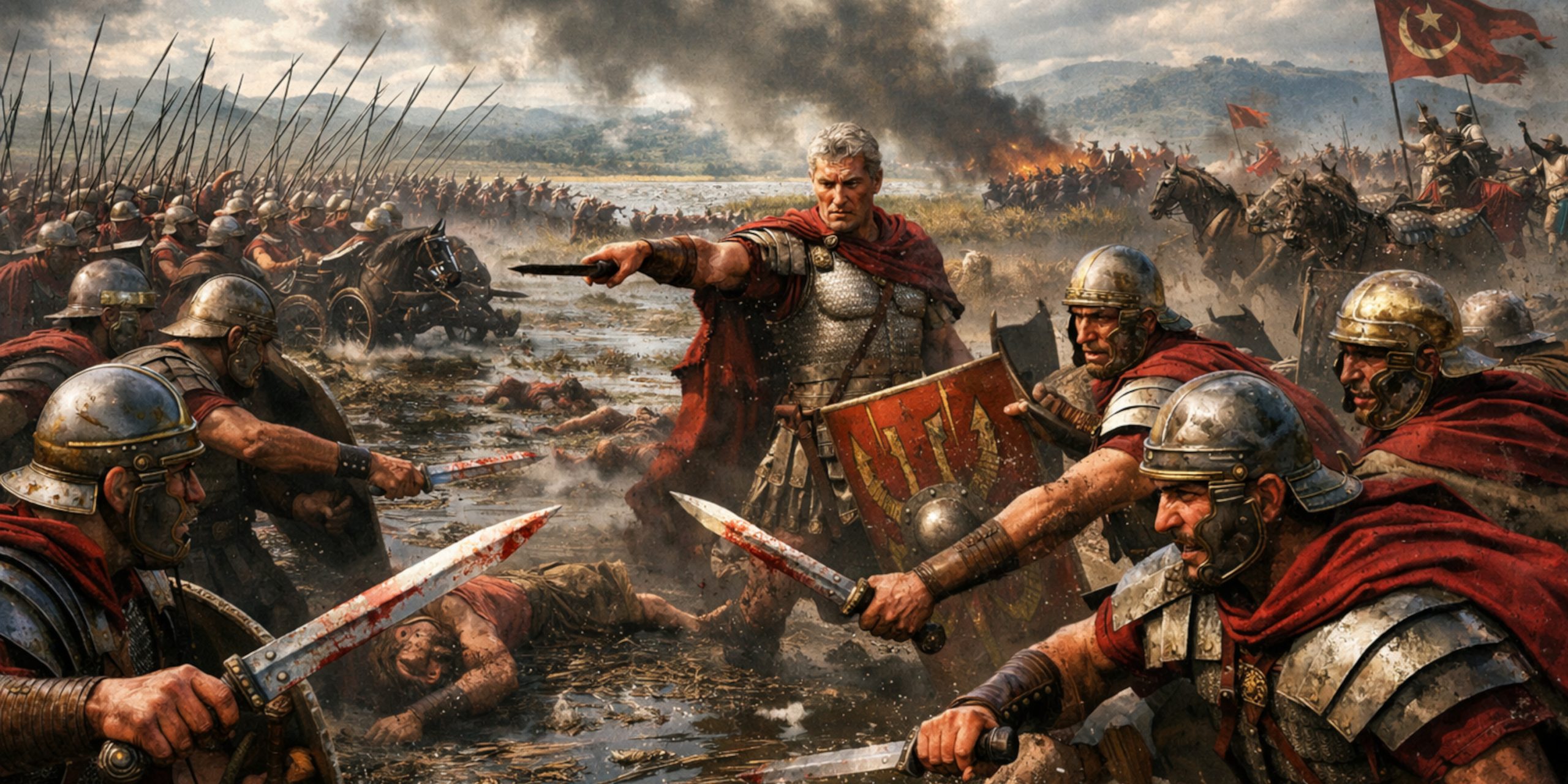
Sulla ordered his troops to dig trenches and build earthworks to limit the effectiveness of Pontic cavalry. This was not glamorous soldiering. Roman legionaries grumbled. Sulla reportedly seized a standard and marched forward himself, shaming his men into action.
Phase Two, Pontic Assault
Archelaus launched an attack before the Roman fortifications were complete. Fighting erupted around the unfinished trenches. Roman discipline held. The scythed chariots failed to break the lines.
Phase Three, Encirclement
Sulla extended his earthworks toward the marsh, gradually compressing the Pontic army’s manoeuvre space. The Pontic troops found themselves pinned between Roman lines and impassable ground.
Phase Four, Collapse
Once the phalanx lost cohesion, the Roman legionaries closed in. The gladius did its grim work at close quarters. Many Pontic soldiers fled toward the marshes and drowned. Others were cut down in retreat.
The slaughter was severe. Ancient sources suggest tens of thousands killed. Even if exaggerated, the scale of defeat was undeniable.
Contemporary Accounts
Our principal narrative source is Plutarch. In his Life of Sulla, he writes that Sulla declared:
“No one shall say that he has left his general in the lurch.”
Plutarch also describes the desperation of the Pontic army as it was hemmed in by the marshes, a detail that aligns with the terrain.
Appian later emphasised the sheer destruction of Mithridates’ field army, presenting Orchomenus as the decisive turning point in Greece.
As a historian, one reads these accounts with caution. Plutarch admired character more than logistics. Still, the consistency across sources suggests a catastrophic defeat for Archelaus.
Archaeology and Landscape
The exact battlefield remains debated, though scholars place it near modern Orchomenos in Boeotia. The draining of Lake Copais in the nineteenth century altered the landscape dramatically, complicating identification.
Archaeological evidence is limited. Scattered finds of weapon fragments and projectiles have been associated with the wider Mithridatic campaigns in Greece. The altered hydrology of the region likely swallowed much physical evidence.
It is a reminder that some of antiquity’s most violent encounters leave only faint traces in soil.
Consequences and Historical Significance
Orchomenus broke the main Pontic army in Greece. Mithridates soon sought terms, leading to the Treaty of Dardanus. Sulla, now master of the eastern war, turned his attention back to Rome and the civil conflict awaiting him.
The battle reinforced the adaptability of the Roman legion against traditional phalanx warfare. It also showcased Sulla’s personal authority over his troops, a quality that would shape Roman politics in darker ways.
If one stands on the Boeotian plain today, it is hard to imagine the noise and chaos that once unfolded there. Yet in 86 BC, this quiet land witnessed a confrontation that reshaped the eastern Mediterranean.
Sulla left Greece not merely victorious, but hardened. Orchomenus was not simply a battle. It was a rehearsal for dictatorship.
Final Assessment
The Battle of Orchomenus stands as a textbook example of Roman flexibility overcoming numerical disadvantage. Engineering, discipline, and opportunism proved more decisive than sheer mass.
As a historian, I find the episode both impressive and unsettling. Sulla’s brilliance is clear. So too is his capacity for severity. The marshes of Boeotia became a grave for Mithridates’ ambitions in Greece, and a stepping stone toward Rome’s internal reckoning.
History often rewards the ruthless. Orchomenus confirms it.