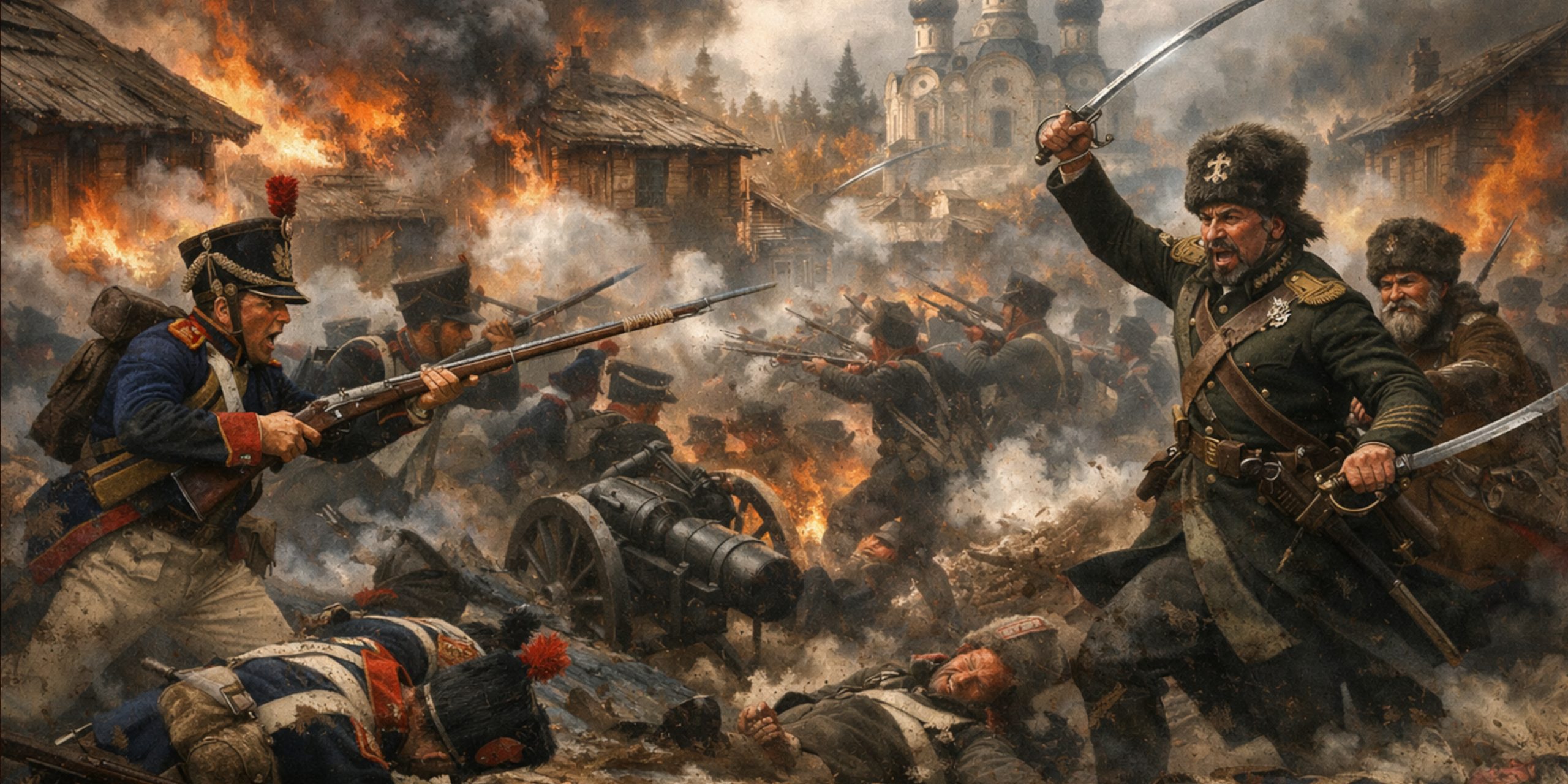
The Battle of Maloyaroslavets sits in an awkward, often misunderstood corner of the Napoleonic Wars. It was not the largest clash of the 1812 campaign, nor the bloodiest, but it may have been one of the most decisive. This was the moment when Napoleon Bonaparte realised that the road south, towards food, shelter, and a survivable winter, was closed to him. What followed was the long retreat along the devastated Smolensk road, a decision that sealed the fate of the Grande Armée long before the snow did.
As a historian, I find Maloyaroslavets fascinating because it feels almost intimate. A town changes hands repeatedly, streets burn, soldiers fight room to room, and strategic consequences unfold far beyond the scale of the battlefield itself.
Background and Strategic Context
After occupying Moscow, Napoleon waited in vain for Tsar Alexander I to sue for peace. With supplies exhausted and winter approaching, the French Emperor attempted a southern withdrawal through Kaluga, a region less ravaged than the route he had used to advance.
Mikhail Kutuzov, commander of the Russian army, anticipated this move. By positioning his forces near Maloyaroslavets, he forced Napoleon into a fight he could ill afford. The battle was less about annihilation and more about denial. Kutuzov did not need a crushing victory. He only needed to block the road.
Forces
Overall Strength
| Side | Estimated Troop Strength |
|---|---|
| French Empire | 20,000 to 25,000 |
| Russian Empire | 30,000 to 32,000 |
The numbers shifted throughout the day as reinforcements arrived, which adds to the fog that still clings to accounts of the battle.
Commanders and Leadership
Senior Commanders
- French Empire
- Napoleon Bonaparte, Emperor and overall commander
- Eugène de Beauharnais, commanding the Italian Corps
- Russian Empire
- Mikhail Kutuzov, Commander in Chief
- Dmitry Dokhturov, leading the advance forces at Maloyaroslavets
Kutuzov’s restraint here deserves attention. He resisted the temptation to chase glory, choosing instead to preserve his army and apply pressure where it mattered most. It was not flashy, but it was ruthlessly effective.
Troop Composition
French Forces
- Line infantry regiments
- Light infantry voltigeurs
- Italian Kingdom troops under Eugène
- Artillery batteries deployed to dominate approaches to the town
- Limited cavalry support due to losses earlier in the campaign
Russian Forces
- Line infantry battalions
- Jaeger light infantry
- Grenadier units
- Strong artillery presence on surrounding high ground
- Cossack detachments harassing French movements
Arms and Armour
Infantry Weapons
- French
- Charleville Model 1777 flintlock musket
- Infantry briquet sabres
- Officer smallswords and infantry spadroons
- Russian
- Model 1808 flintlock muskets
- Infantry hangers and sabres
- Officer sabres influenced by Eastern European and cavalry patterns
Edged Weapons in Use
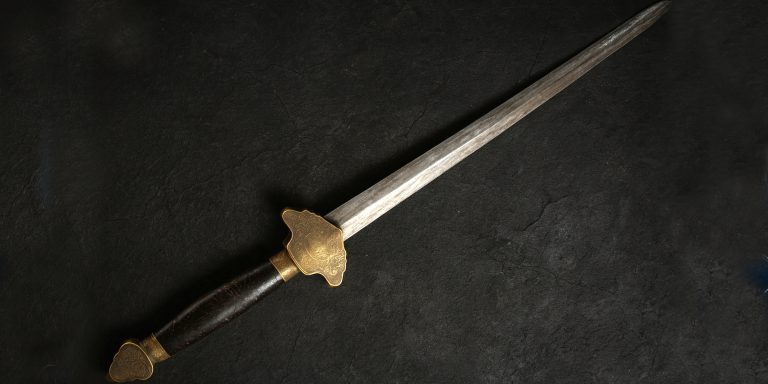
- French officers often carried straight-bladed spadroons or light sabres, practical rather than decorative by this stage of the campaign.
- Russian officers favoured curved sabres, some derived from hussar patterns, better suited to close fighting and symbolic of rank.
Armour was absent in any meaningful sense. By 1812, protection came from formations, discipline, and luck, in roughly equal measure.
The Battle Timeline
Morning
- French advance guard enters Maloyaroslavets.
- Russian forces contest the town aggressively.
- The town changes hands multiple times as infantry fight through narrow streets.
Midday
- Fires break out, reducing visibility and turning the town into a choking maze.
- Artillery duels intensify on surrounding heights.
- Eugène commits more troops in an attempt to secure a decisive breakthrough.
Afternoon
- Russian reinforcements stabilise the line.
- French assaults lose momentum.
- Napoleon arrives but hesitates to commit the Imperial Guard.
Evening
- Fighting subsides with Russians holding the high ground.
- Napoleon withdraws his army northwards.
- Strategic decision made to retreat along the devastated Smolensk road.
Archaeology and Material Evidence
Excavations around Maloyaroslavets have uncovered musket balls, artillery fragments, uniform buttons, and personal effects scattered across the town and nearby fields. The density of finds within the urban area reinforces contemporary accounts of brutal close-quarters fighting.
Burn layers identified in archaeological strata align with descriptions of the town being set ablaze multiple times. It is rare to see textual and physical evidence line up so neatly, and it gives weight to eyewitness claims that Maloyaroslavets was reduced to rubble by nightfall.
Contemporary Accounts
A Russian officer recalled:
“The town burned beneath our feet, yet the men would not yield the streets.”
A French soldier of Eugène’s corps wrote:
“We won the ground and lost the future, though we did not know it that night.”
Napoleon himself later admitted the significance of the encounter, noting that the enemy’s position made further advance south impossible without unacceptable risk.
Outcome and Significance
Tactically, the battle was inconclusive. Strategically, it was catastrophic for the French. Maloyaroslavets denied Napoleon access to fresh supplies and forced him onto a retreat path already stripped bare. The decision not to unleash the Imperial Guard remains one of the most debated moments of the campaign, though with hindsight, it may simply reflect a commander who knew the game was up.
Kutuzov’s victory lay in restraint. He blocked, bled, and waited. History is often kinder to dramatic triumphs, but Maloyaroslavets reminds us that wars are just as often decided by refusal.
Seven Swords Takeaway
If Borodino was a clash of titans, Maloyaroslavets was a quiet verdict. Standing on the battlefield today, it is hard not to feel that this was the moment Napoleon lost Russia, not with a roar, but with a reluctant turn of the army’s wheels back towards the west.