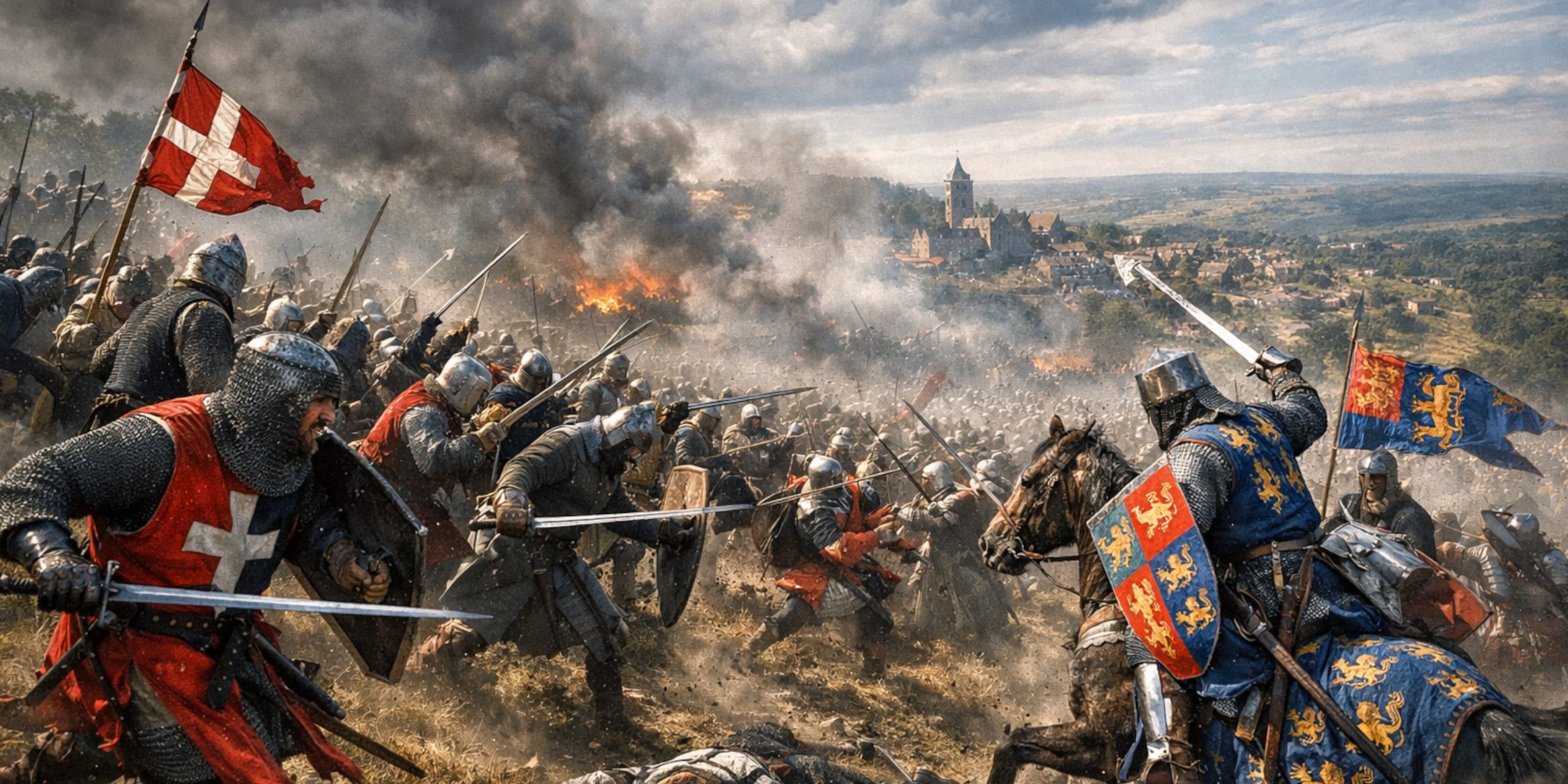
The Battle of Lewes sits at the fascinating midpoint of English medieval politics, when the king was very much alive but his authority was not. Fought on 14 May 1264 near the Sussex town of Lewes, it pitched the royal army of King Henry III against a rebel force led by Simon de Montfort. What followed was not a grand clash of equal hosts, but a sharp lesson in terrain, discipline, and the danger of letting enthusiastic young nobles chase glory downhill.
Background and causes
By the early 1260s, Henry III had managed to irritate much of his nobility. His financial mismanagement, favouritism towards foreign advisers, and habit of promising reform then quietly ignoring it had pushed England into open baronial revolt. The Provisions of Oxford were meant to restrain royal power. Henry resented them. Simon de Montfort insisted they be enforced.
Civil war followed, the sort that creeps rather than explodes. By spring 1264, the two sides manoeuvred in Sussex, each convinced the other was about to overstep. They were both right.
Forces
Royalist army
| Component | Estimated strength | Notes |
|---|---|---|
| Knights and men at arms | 2,000 to 2,500 | Heavily armoured cavalry, the backbone of the royal host |
| Infantry and levies | 5,000 to 6,000 | Less reliable, mixed quality |
| Command | King Henry III | Tactical command largely delegated |
The king’s son, Edward, led the right wing and brought with him a reputation for aggression that would soon become decisive, though not in the way the royalists hoped.
Baronial army
| Component | Estimated strength | Notes |
|---|---|---|
| Knights and men at arms | 1,000 to 1,500 | Fewer in number but tightly controlled |
| Infantry | 4,000 to 5,000 | London militia and marcher troops |
| Command | Simon de Montfort | Experienced, patient, and very aware of the ground |
The baronial army was smaller but better positioned. De Montfort chose his battlefield with care, which is usually a sign that something unpleasant is about to happen to the other side.
Deployment and terrain
The royal army took position near Lewes Priory, while de Montfort occupied the higher ground on the Downs to the north west. This mattered. Medieval warfare has many variables, but gravity is among the most reliable.
Arms and armour
Weapons in use
- Swords
- Knightly arming swords of Oakeshott Types XII and XIII were common on both sides, broad bladed and well suited to cutting against mail.
- Some longer Type XIIIa swords appeared among wealthier knights, offering reach in mounted combat.
- Polearms
- Spears and lances dominated the battlefield, especially in the initial cavalry charges.
- Infantry made use of bills and staff weapons, particularly among the London contingents.
- Missile weapons
- Bows were present but played a secondary role, more harassment than battle winner.
Defensive equipment
- Mail hauberks with coifs were standard.
- Great helms and early enclosed helms were worn by wealthier knights.
- Shields were typically kite or early heater forms, with personal heraldry visible enough for contemporaries to recognise who was running away, which happened rather a lot.
The battle
At dawn on 14 May, de Montfort launched a downhill attack. Edward commanded the royal right and smashed into the London infantry opposite him. They broke quickly. Edward pursued them for miles, a classic error that every medieval commander swore they would never repeat, right before doing exactly that.
With Edward absent, the rest of the royal army found itself under pressure. De Montfort concentrated his forces, overwhelmed the royal centre, and captured King Henry and his brother Richard of Cornwall. By the time Edward returned, flushed with success and probably still breathing hard, the battle was lost.
Battle timeline
| Time | Event |
|---|---|
| Early morning | Baronial army advances downhill from the Downs |
| Morning | Edward routs London infantry and pursues |
| Midday | Royal centre collapses under concentrated attack |
| Early afternoon | King Henry III captured |
| Late afternoon | Edward returns to find the battle decided |
Archaeology and landscape
The battlefield itself has left few dramatic archaeological traces, which is typical for medieval engagements fought largely on open ground. Finds of arrowheads, buckles, and occasional weapon fragments have been reported in the wider Lewes area, though none conclusively tied to a single moment of combat. The landscape, however, still tells the story. The slopes north of Lewes remain a quiet reminder that fighting uphill is rarely a winning strategy.
Contemporary voices
The chronicler William Rishanger wrote that the royal army was undone “not by lack of courage, but by lack of order,” a polite way of saying that too many knights rode off to enjoy themselves at precisely the wrong time.
Another contemporary observed that Edward fought “like a lion,” which is flattering, though lions are not especially famous for knowing when to stop chasing things.
Consequences and legacy
Lewes was a decisive baronial victory. The subsequent Mise of Lewes effectively placed England under de Montfort’s control and forced Henry III to govern under restraint. Although de Montfort’s dominance would be short lived, his summoning of a parliament in 1265 that included commoners secured his place in constitutional history.
For historians, Lewes is a reminder that medieval battles were as much about discipline and restraint as bravery. It is also proof that even future kings have to learn the hard way.