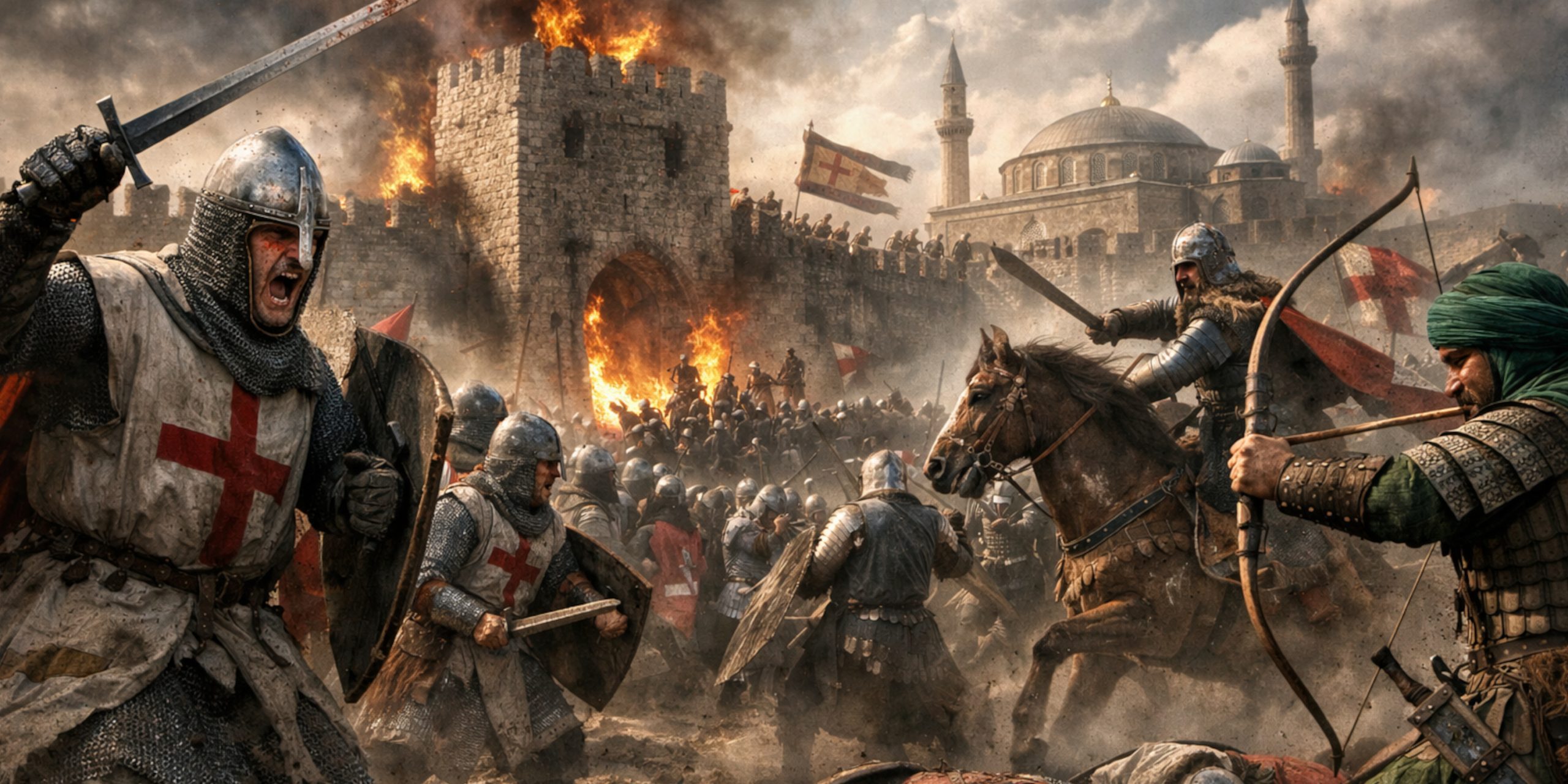
The Battle of Iconium was fought during the Third Crusade, it was less a neat, ceremonial clash and more a brutal assertion of survival by an army that had marched too far, for too long, through hostile country. When Frederick Barbarossa reached Iconium, capital of the Seljuk Sultanate of Rum, diplomacy had collapsed and patience had evaporated. What followed was a hard fought victory that briefly reopened the road east
By the spring of 1190, Frederick Barbarossa was leading one of the largest crusading forces ever assembled across Anatolia. The Seljuk ruler Kilij Arslan II had promised safe passage, but Seljuk raiding parties steadily eroded that agreement. Supplies vanished. Wells were poisoned. Crusaders died of thirst in sight of rivers they could not safely reach.
Iconium, modern Konya, represented both an obstacle and an opportunity. Taking the city would restore morale, secure food, and demonstrate that the imperial army was not a walking corpse column. The Seljuks, confident in their cavalry and the city’s defences, chose to stand.
Forces
Crusader Army
| Component | Estimated Strength | Notes |
|---|---|---|
| Heavy cavalry | 2,000 to 3,000 | Imperial knights and ministeriales |
| Infantry | 15,000 to 20,000 | Spearmen, crossbowmen, levy troops |
| Support | Several thousand | Camp followers and auxiliaries |
The army was exhausted but still disciplined. Frederick’s insistence on order, even while half starved, was not universally loved but it kept the formation intact.
Seljuk Forces
| Component | Estimated Strength | Notes |
|---|---|---|
| Light cavalry | 10,000 to 20,000 | Horse archers and lancers |
| Garrison troops | Several thousand | Defending Iconium itself |
| Irregulars | Variable | Tribal allies and raiders |
The Seljuks relied on mobility, missile fire, and attrition. Against smaller crusading contingents, this worked beautifully. Against a full imperial army, it was a risk.
Leaders and Troop Composition
Crusaders
- Frederick Barbarossa, overall command, leading from the centre despite his age.
- Duke Frederick of Swabia, commanding a wing and handling pursuit.
- Senior German princes and bishops, many more useful with a sword than a sermon.
Seljuks
- Kilij Arslan II, strategic command rather than field leadership.
- Local emirs commanding cavalry screens and city defenders.
Arms and Armour
Crusader Equipment
- Swords: Straight double edged arming swords, broadly Oakeshott Types X to XII, optimised for cutting from horseback.
- Secondary blades: Long knives and early messer like sidearms.
- Armour: Mail hauberks, coifs, conical helmets with nasal guards, kite shields transitioning toward shorter heater forms.
- Missile weapons: Crossbows and short bows, limited but effective during the assault.
Seljuk Equipment
- Swords: Curved blades including early sabre forms, suited to slashing attacks from horseback.
- Bows: Composite reflex bows, the real killers of the Anatolian campaigns.
- Armour: Lamellar, mail shirts, light helmets, prioritising speed over protection.
- Shields: Small round shields, often leather faced.
From a historian’s perspective, this was a textbook clash of military cultures. Heavy shock combat met elastic defence. The surprise is that the heavier force prevailed as decisively as it did.
The Battle Timeline
Morning
The Seljuks harassed the crusader column as it approached Iconium, testing for weakness and attempting to draw units out of formation.
Late morning
Frederick ordered a full advance. Rather than chasing skirmishers, the crusaders pushed straight for the city, absorbing losses and refusing to fragment.
Midday
Crusader infantry reached the walls while cavalry broke through Seljuk screens. Fighting erupted both outside and inside the city almost simultaneously.
Afternoon
Iconium fell. Seljuk resistance collapsed once the city gates were breached and the garrison overwhelmed.
Evening
The crusaders secured supplies and water. For the first time in weeks, the army ate properly. Chroniclers linger on this detail for good reason.
Archaeology and Physical Evidence
Iconium itself has been continuously occupied, which complicates archaeology. That said:
- Medieval fortification lines beneath modern Konya align with descriptions of the 12th century city.
- Seljuk era weapons, including sabre blades and arrowheads, found in central Anatolia match the material culture described by crusader sources.
- No mass grave has been conclusively tied to the battle, which suggests a rout rather than prolonged slaughter inside the city.
Absence of evidence here is not evidence of absence, but it does support the narrative of a sharp, decisive engagement.
Contemporary Quotes
A German chronicler wrote that the army entered Iconium “as men returned from the grave, thin as spectres, yet unbroken in spirit.” One suspects the bread mattered as much as the victory.
The Muslim historian Ibn al Athir noted the ferocity of the attack and the discipline of the crusaders, an acknowledgement that reads as reluctant respect rather than praise.
Significance and Legacy
The Battle of Iconium reopened the road east and restored imperial morale. Strategically, it forced the Seljuks to reconsider direct confrontation with large crusading forces. Symbolically, it reinforced Frederick Barbarossa’s reputation as a commander who could still impose his will at an age when most medieval rulers were planning their tombs.
The irony, and history’s quiet joke, is that this victory was followed shortly by Frederick’s death in the Saleph River. Iconium stands as his final triumph, impressive, hard earned, and slightly tragic.