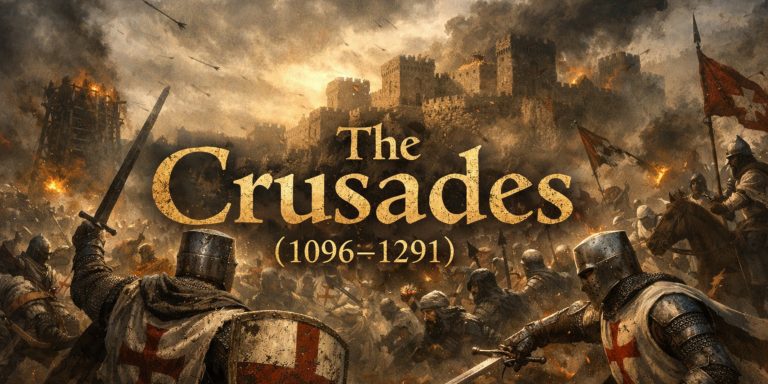
The Battle of Dorylaeum, fought on 1 July 1097, was the First Crusade’s first truly desperate test. Until then the crusaders had stumbled through Asia Minor with the confidence of men who had won a siege and had not yet learned what the Anatolian interior could do to them. Dorylaeum changed that.
On a dry plain near the old Byzantine town of Dorylaeum, the advance guard of the crusader army was caught, surrounded, harassed and very nearly annihilated by the Seljuk Turks under Kilij Arslan. For several tense hours the crusaders fought with the sort of grim stubbornness that medieval chroniclers admired and everyone else would probably describe as sheer panic with helmets on.
By the end of the day the crusaders had won, but only just. Had the battle gone differently, the First Crusade might have ended in the dust of central Anatolia rather than beneath the walls of Jerusalem.
Background
After the capture of Nicaea in June 1097, the crusader army began its march across Asia Minor. The crusading host was too large to move easily as a single body, so it divided into two columns.
The first column, led largely by Bohemond of Taranto, Robert Curthose, Tancred and others, moved ahead. The second, under Godfrey of Bouillon, Raymond of Toulouse and Bishop Adhemar of Le Puy, followed at some distance.
Kilij Arslan, Sultan of Rum, had learned from his failure at Nicaea. At Nicaea he had underestimated the crusaders and been defeated piecemeal. At Dorylaeum he intended to do the opposite. He waited until the crusader columns were separated, then struck at the leading force before the second column could arrive.
The terrain favoured him. The rolling plains and broken ground around Dorylaeum were ideal for mounted archers. The crusaders, heavy cavalry and infantry packed around a vulnerable baggage train, were entering precisely the kind of country they least wanted to fight in.
Forces
Crusader Army
The crusader force caught at Dorylaeum probably numbered between 15,000 and 20,000 men, although only part of that force was present at the start of the battle.
| Component | Estimated Numbers | Notes |
|---|---|---|
| Knights | 700 to 1,500 | Heavy cavalry from Norman, French and Italian contingents |
| Infantry | 10,000 to 15,000 | Spearmen, swordsmen, crossbowmen and camp followers pressed into defence |
| Non-combatants | Several thousand | Women, servants, clergy and baggage train |
Seljuk Army
Kilij Arslan’s force was probably between 6,000 and 10,000 mounted warriors, though some medieval chroniclers wildly inflated the figure. Medieval chroniclers had a habit of multiplying enemy numbers whenever they wanted to make their own side look braver. They were, in that sense, not entirely unlike modern football pundits after a narrow away win.
| Component | Estimated Numbers | Notes |
| Mounted archers | 6,000 to 10,000 | Highly mobile Turkish cavalry |
| Light cavalry lancers | Several thousand | Used for close assaults once the crusaders weakened |
Commanders and Leaders
| Side | Commander | Role in the Battle |
| Crusader | Bohemond of Taranto | Commanded the advance column and organised the defensive camp |
| Crusader | Robert Curthose | Assisted in holding the line |
| Crusader | Tancred | Led mounted resistance against Turkish attacks |
| Crusader | Stephen of Blois | Sent messengers for urgent reinforcements |
| Crusader | Godfrey of Bouillon | Arrived with the second column and helped turn the battle |
| Crusader | Raymond of Toulouse | Led the final flank attack |
| Crusader | Bishop Adhemar of Le Puy | Helped rally morale and maintain order |
| Seljuk | Kilij Arslan | Sultan of Rum and overall commander |
Battle Timeline
| Time | Event |
| Early morning, 1 July 1097 | Bohemond’s column camps near Dorylaeum |
| Shortly after dawn | Kilij Arslan launches a surprise attack with mounted archers |
| Morning | Crusader camp surrounded and subjected to continuous arrow fire |
| Late morning | Bohemond forms a defensive perimeter around the baggage train |
| Midday | Messengers finally reach the second crusader column |
| Early afternoon | Godfrey, Raymond and Adhemar arrive with reinforcements |
| Afternoon | Crusader counterattack pushes Seljuks back |
| Late afternoon | Raymond’s men strike the Turkish flank and rear |
| Evening | Kilij Arslan retreats, leaving the field to the crusaders |
How the Battle Was Fought
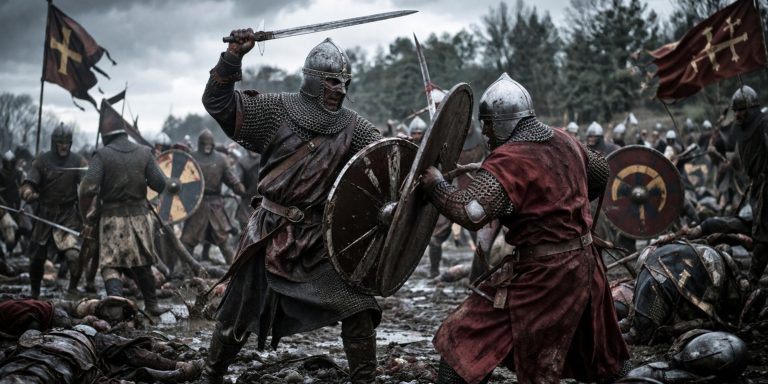
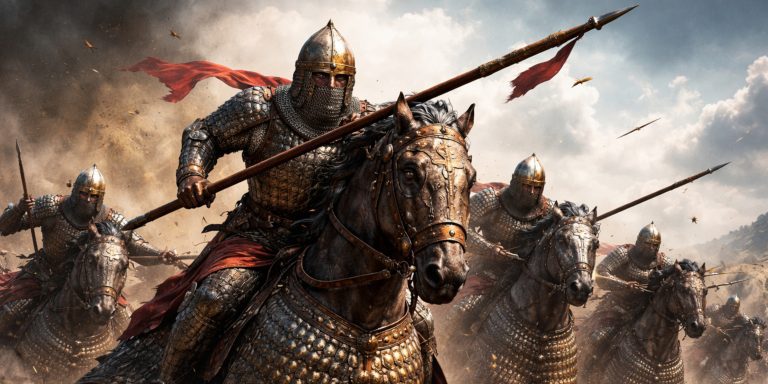
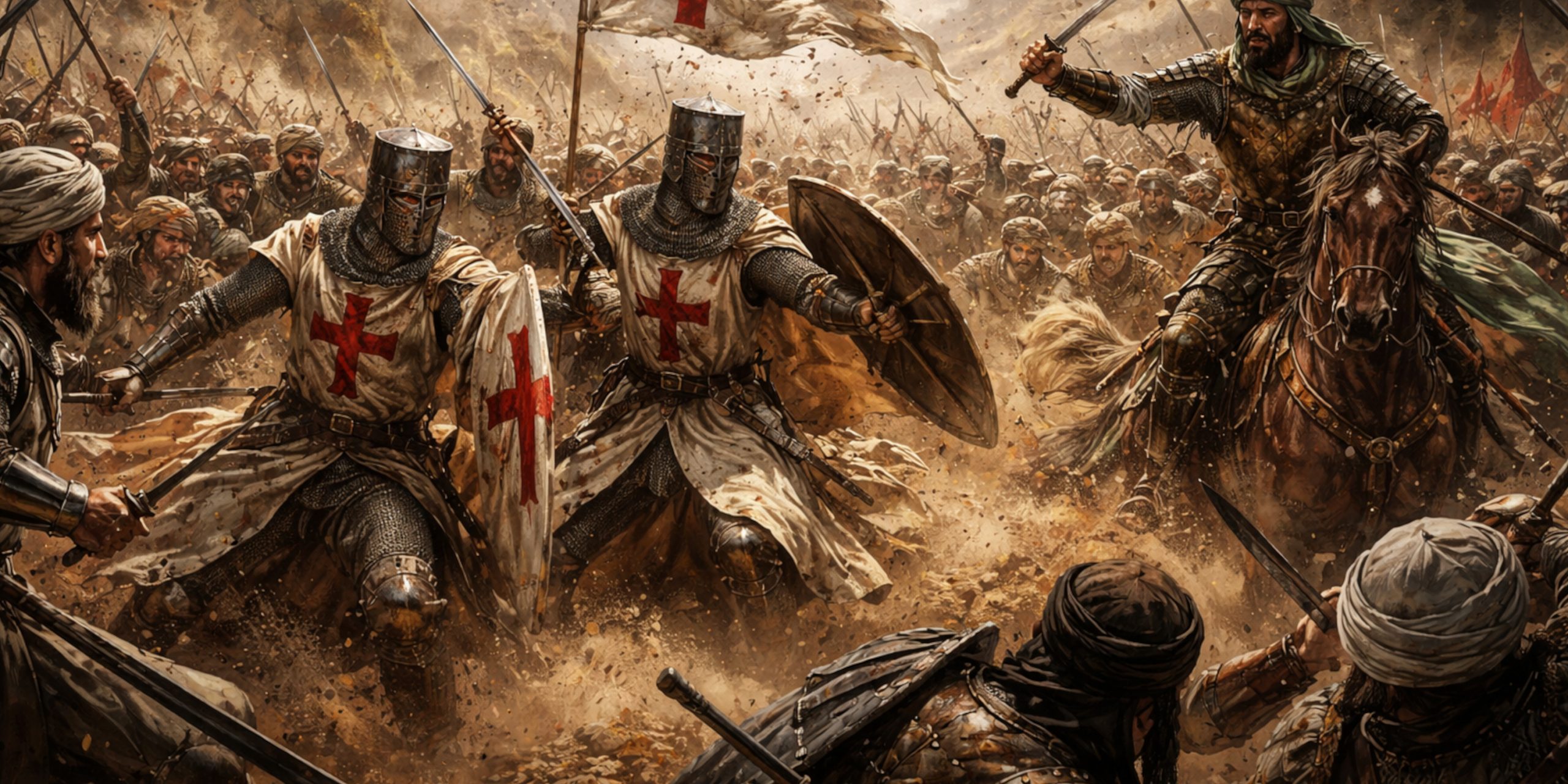
The battle began with a classic Seljuk ambush. Kilij Arslan’s mounted archers swept around the crusader camp and showered it with arrows. Rather than charging straight into the crusader knights, the Turks kept their distance, circling, firing and retreating.
This was deeply frustrating for the crusaders, who preferred a battle in which one rode directly at the enemy with a lance and solved the matter in a straightforward and deeply impractical fashion.
Bohemond reacted with considerable skill. Rather than throwing his knights into a reckless charge, he ordered the camp fortified. Wagons, baggage and infantry were drawn into a defensive line around the non-combatants. Women reportedly carried water to the fighting men and helped tend the wounded.
For several hours the crusaders endured relentless pressure. Horses died, men collapsed from wounds and heat, and Turkish arrows fell continuously. Some knights launched small counterattacks, but these achieved little.
The battle only changed when the second crusader column finally appeared. Godfrey of Bouillon and Hugh of Vermandois arrived first, followed by Raymond of Toulouse and Adhemar.
The Seljuks suddenly found themselves facing not a trapped enemy but a larger force attacking from several directions. Raymond’s troops reportedly struck the Turkish flank while Bohemond’s exhausted men surged forward from the camp.
By late afternoon Kilij Arslan had lost control of the battle. The Seljuks withdrew, leaving the crusaders battered, shaken and astonished to discover that they were still alive.
Arms and Armour
Crusader Arms and Armour
The crusaders relied upon heavily armoured knights supported by infantry.
| Weapon or Armour | Description |
| Mail hauberk | Knee-length interlinked iron rings, often with coif attached |
| Conical helmet with nasal guard | Standard Norman-style helmet |
| Kite shield | Large shield offering protection from arrows and cavalry blows |
| Lance | Main weapon of mounted knights |
| Spear | Used by infantry and mounted retainers |
| Crossbow | Used by some western infantry contingents |
| Axe and mace | Secondary weapons for close combat |
Sword Types Used by the Crusaders
| Sword Type | Description |
| Norman arming sword | Broad, double-edged blade, usually around 75 to 85 cm long |
| Early knightly sword, Oakeshott Type X | Straight cutting sword ideal for use from horseback |
| Frankish longsword | Slightly longer weapon used by wealthier knights |
The most common sword at Dorylaeum would probably have been the classic knightly arming sword of the late eleventh century, broad-bladed, heavy towards the tip and perfectly suited to hacking at an opponent while bouncing alarmingly in a saddle.
Seljuk Arms and Armour
The Seljuks relied on mobility rather than heavy armour.
| Weapon or Armour | Description |
| Composite bow | Laminated horn-and-wood bow with great range and power |
| Sabre | Curved cavalry sword used in close combat |
| Straight Turkic sword | Earlier style of sword still common in the eleventh century |
| Lance | Light cavalry lance for pursuit and shock attacks |
| Lamellar armour | Small plates laced together, worn by wealthier warriors |
| Leather or padded armour | Lighter protection for mounted archers |
| Round shield | Small, fast-moving shield of leather or wood |
Sword Types Used by the Seljuks
| Sword Type | Description |
| Early kilij | Curved cutting sword favoured by Turkish cavalry |
| Straight steppe sword | Double-edged sword descended from Central Asian traditions |
| Persian-style sabre | Slightly curved cavalry blade used by elite horsemen |
Troop Composition
Crusader Troop Composition
- Norman knights from southern Italy under Bohemond and Tancred
- French and Flemish knights under Robert Curthose and Stephen of Blois
- Infantry armed with spears, swords and shields
- Crossbowmen and archers providing limited missile support
- Camp followers, clergy and servants trapped within the defensive camp
Seljuk Troop Composition
- Turkish mounted archers
- Light cavalry armed with lances and sabres
- Horsemen from allied Turkish tribes
- Small numbers of more heavily armoured elite cavalry
Contemporary Quotes
The anonymous author of the Gesta Francorum described the battle in grim terms:
“The Turks, indeed, shouted and yelled with a great clamour, and discharged arrows from every direction.”
Fulcher of Chartres wrote:
“Our men were hemmed in on every side and hardly knew where to turn.”
Raymond of Aguilers, who was present with the crusader army, described the arrival of reinforcements:
“Then at last our men, strengthened by fresh troops, began to advance upon the enemy.”
Anna Komnene, writing later in Constantinople, noted the panic caused by the Turkish attack but praised the crusaders’ stubbornness.
“They fought as men driven beyond fear.”
Archaeology and the Location of the Battlefield
The exact site of the Battle of Dorylaeum remains uncertain. Most historians place it near modern Eskişehir in Turkey, close to the ruins of ancient Dorylaeum.
Archaeological evidence is frustratingly limited. Unlike a siege site, where walls, weapons and graves may remain in one place, a cavalry battle across open ground tends to leave very little behind. Medieval armies also had an irritating habit of carrying off anything valuable, which is excellent for them and less helpful for modern archaeologists.
Excavations around Eskişehir have uncovered remains from the Byzantine and Seljuk periods, including pottery, coins and traces of settlement. However, no large concentration of weapons or graves can yet be securely linked to the battle itself.
Some scholars believe the battlefield lay near a river valley where the crusader camp had access to water. Others suggest the battle spread across a broader area of open plain.
The lack of firm archaeological evidence has made Dorylaeum one of those battles where historians must rely heavily on the surviving chronicles, compare their descriptions carefully and occasionally admit, through gritted teeth, that the chroniclers did not bother to leave a map.
Why the Battle Mattered
Dorylaeum was more than a victory. It transformed the psychology of the First Crusade.
Before the battle, the crusaders still believed they were marching through enemy territory in a rather disorderly but manageable fashion. After Dorylaeum they understood that Anatolia was a vast, dangerous landscape in which water, distance and mounted archers could kill as efficiently as any army.
The victory also weakened Seljuk confidence. Kilij Arslan abandoned hopes of stopping the crusade through a single decisive battle and instead withdrew deeper into Anatolia.
For the crusaders, Dorylaeum opened the road towards Antioch and eventually Jerusalem. It also established a pattern that would appear repeatedly during the crusades: western heavy cavalry surviving disaster largely through stubbornness, luck and the timely arrival of allies.
Legacy
The Battle of Dorylaeum became one of the defining moments of the First Crusade. Medieval chroniclers celebrated it as proof of divine favour, while modern historians tend to see it as a narrow escape brought about by better leadership and fortunate timing.
Bohemond’s cool-headed defence of the camp enhanced his reputation enormously. Godfrey and Raymond also emerged with greater prestige.
Kilij Arslan, though defeated, learned valuable lessons. Later Turkish commanders would become even more cautious, avoiding direct confrontations with crusader heavy cavalry whenever possible.
In many ways Dorylaeum set the tone for the entire crusading venture. The crusaders survived not because everything went according to plan, but because almost nothing did, and they somehow kept going anyway.
Further Reading
- Gesta Francorum
- Fulcher of Chartres, Historia Hierosolymitana
- Raymond of Aguilers, Historia Francorum
- John France, Victory in the East
- Thomas Asbridge, The First Crusade
- Steven Runciman, A History of the Crusades
Seven Swords Takeaway
The Battle of Dorylaeum was one of the First Crusade’s closest calls. It began as a catastrophe and ended as a victory. Had Bohemond panicked, had the second column arrived an hour later, or had Kilij Arslan pressed his advantage more aggressively, the crusade might have collapsed in the Anatolian dust.
Instead, the crusaders survived, bruised and exhausted but still moving east. Medieval chroniclers naturally credited God. Historians, being slightly more awkward people, usually point to discipline, timing and a fortunate inability to know when to give up.