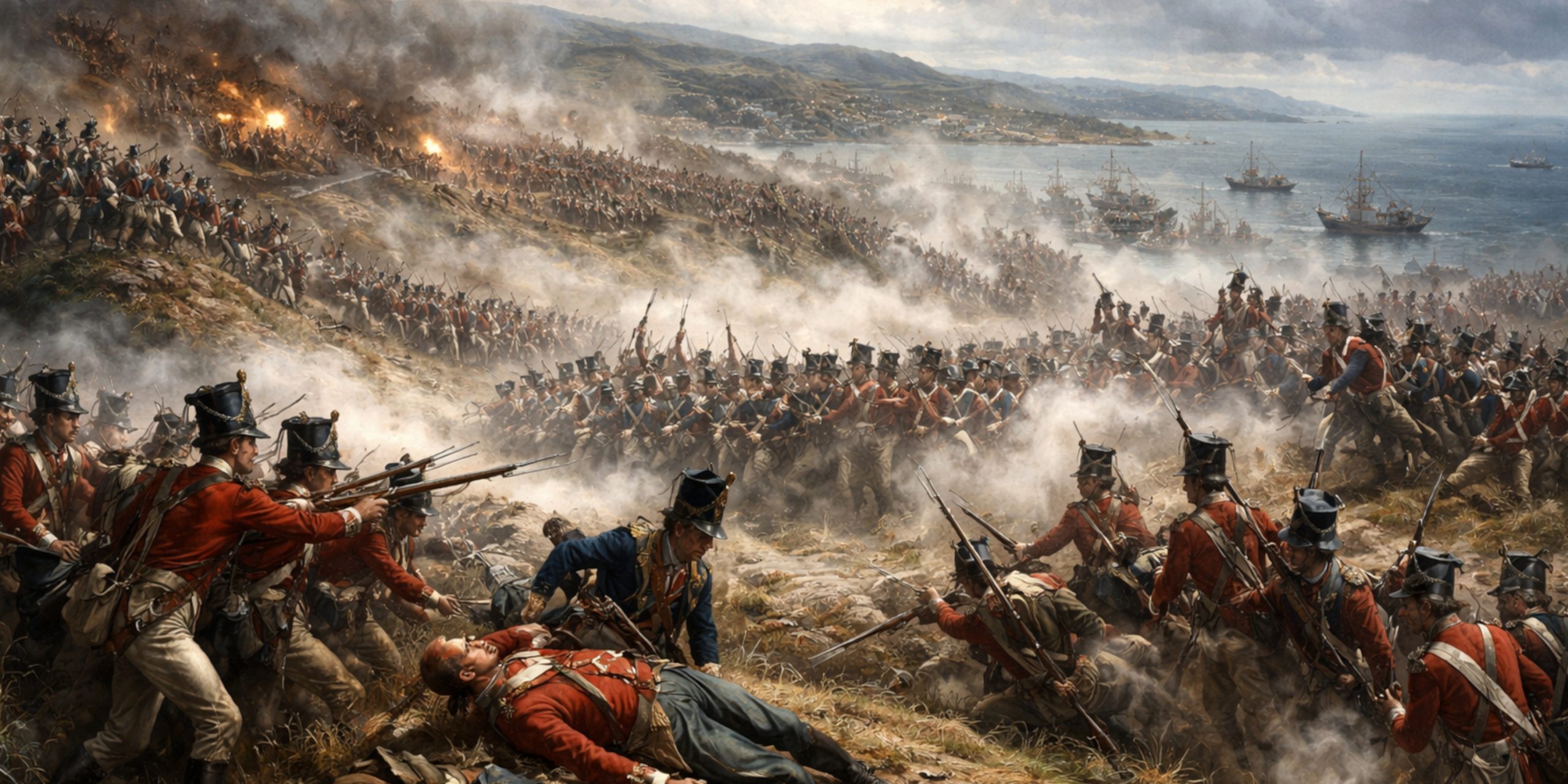
The Battle of Corunna was fought on the Galician coast during the Peninsular War, it was not a battle the British Army set out to fight. It happened because withdrawal sometimes demands a last stand. Sir John Moore’s army, worn down by winter marches and French pursuit, turned to face its enemy so that it could escape by sea. The result was a sharp, disciplined action that saved an army at the cost of its commander.
As a historian, I have always found Corunna quietly compelling. It lacks the grand manoeuvre of Austerlitz or the bloody drama of Waterloo, yet it reveals far more about command under pressure. It is also one of those rare battles where defeat and success sit uncomfortably side by side.
Background and Strategic Context
By late 1808, the British intervention in Spain had turned sour. Napoleon himself entered the Peninsula, sweeping aside Spanish armies and forcing British forces into a fighting retreat towards the Atlantic. Moore chose Corunna as his evacuation point, a bleak winter port backed by rolling hills and stone villages.
The French, under Marshal Soult, closed in with impressive speed. Moore knew that if the Royal Navy was to embark his men safely, the French had to be held at bay. Corunna became less a planned battlefield and more an improvised shield.
Forces
British Army
| Element | Details |
|---|---|
| Commander | Sir John Moore |
| Strength | Approximately 16,000 infantry, 9 guns |
| Composition | Line infantry, light infantry, limited cavalry |
| Condition | Exhausted but disciplined |
French Army
| Element | Details |
|---|---|
| Commander | Jean-de-Dieu Soult |
| Strength | Approximately 20,000 infantry, strong artillery |
| Composition | Line infantry, voltigeurs, cavalry reserve |
| Condition | Pursuing, confident, better supplied |
Arms and Armour
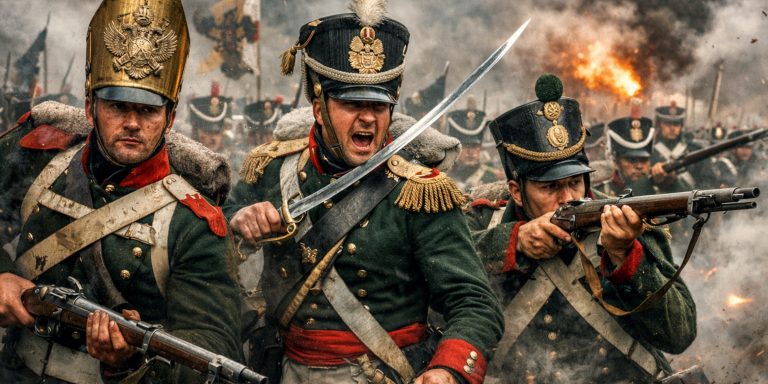
British Equipment
Infantry Weapons
- Brown Bess flintlock musket
- 1796 Infantry Officer’s Sword
- Light Infantry sabres for officers and NCOs
Supporting Arms
- 6 pounder field guns
- Baker rifles among light companies
Protection
- Minimal armour
- Shako or stovepipe hats, heavy greatcoats worn out by winter campaigning
French Equipment
Infantry Weapons
- Charleville Model 1777 musket
- Briquet short sword for infantry
- Light cavalry sabres, including the AN XI pattern
Supporting Arms
- 6 and 8 pounder field guns
- Horse artillery used aggressively
Protection
- Shakos and bearskins for elite units
- No body armour, relying on drill and momentum
The Battlefield
The fighting took place south of Corunna, across low ridges, stone walls, and villages such as Elviña. The terrain favoured defence, with narrow approaches and broken ground limiting French manoeuvre. Moore used this ground well, anchoring his flanks and forcing Soult to attack frontally. It was not elegant, but it was effective.
Battle Timeline
Morning
- British troops take up defensive positions on the ridges
- French skirmishers probe the line
Early Afternoon
- French columns advance against the British right
- Heavy musketry erupts around Elviña village
Mid Afternoon
- British counter attacks regain lost ground
- Sir John Moore is struck by a cannonball while directing troops
Late Afternoon
- French assaults lose momentum
- British line holds firm as darkness approaches
Evening
- British withdraw in good order towards the port
- Embarkation begins under cover of night
Death of Sir John Moore
Moore’s death defines the battle. Struck in the shoulder and chest, he was carried from the field, fully aware of his fate. He lived long enough to know that his army had held.
His burial took place that night, hastily and without ceremony. No drum was beaten, a detail often romanticised but essentially true. War rarely waits for pageantry.
Contemporary Quotes
Sir John Moore, shortly before his death, is reported to have said:
“I hope the people of England will be satisfied. I hope my country will do me justice.”
A French officer later wrote of the British defence:
“They retired in silence and order, as if on parade, and left us nothing but the ground they chose to abandon.”
Even allowing for memoir embellishment, the respect is unmistakable.
Archaeology and Material Evidence
Unlike larger Peninsular battles, Corunna has left a modest archaeological footprint. Musket balls, uniform buttons, and artillery fragments have been recovered in the Elviña area during urban expansion. Moore’s grave remains a focal point, maintained and visited, a rare case where memory has outlasted development.
No mass graves have been identified, suggesting casualties were comparatively light and bodies removed or buried individually. This aligns with accounts of a short, intense engagement rather than prolonged slaughter.
Outcome and Legacy
Tactically, the battle was a draw. Strategically, it was a British success. Moore’s army escaped intact, denying Napoleon a decisive victory and preserving Britain’s ability to continue the war in Iberia. Politically, Moore became a symbol of honourable command, a general who shared the hardship of his men and paid for it with his life.
There is a dry irony here. The retreat that ended at Corunna was widely criticised in London, yet it laid the groundwork for Wellington’s later success. History, like the British Army in January 1809, often moves forward while facing backwards.
Watch the documentary: