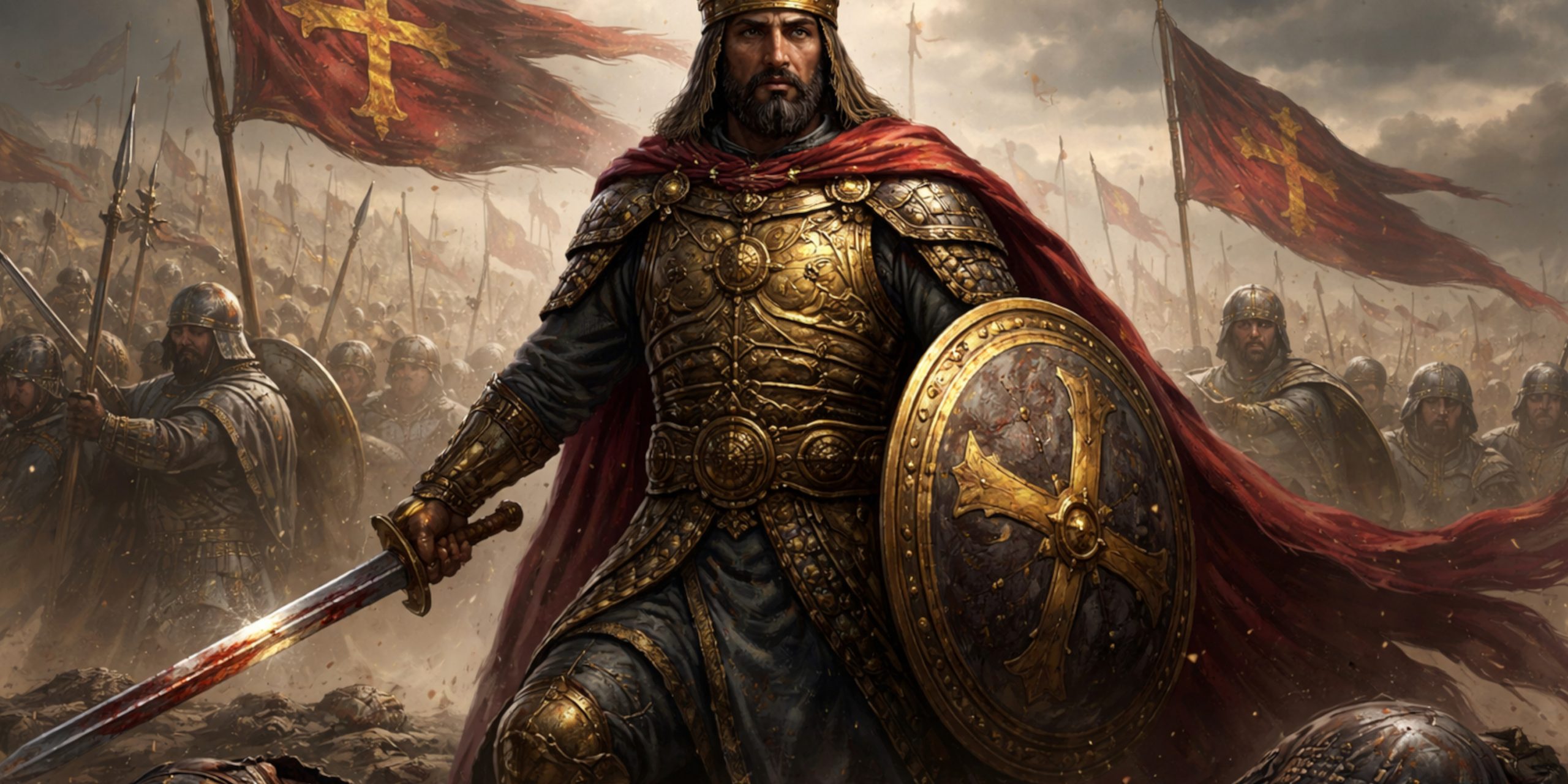
Byzantine history is crowded with dramatic personalities. Court schemers, soldier emperors, saints, and outright disasters. Yet few figures loom quite like Basil II.
He ruled the Byzantine Empire from 976 to 1025 and spent most of that time doing something medieval emperors often promised but rarely managed. Winning wars consistently.
Basil II did not cultivate the glamour of a Roman conqueror or the theatrical charm of a court politician. He dressed simply, trusted very few people, and spent an extraordinary amount of time on campaign. His enemies called him relentless. His soldiers called him dependable. Later generations gave him the nickname that still echoes through history: the Bulgar Slayer.
Behind that reputation sits a ruler who stabilised Byzantium, expanded its borders, and left the empire stronger than it had been for centuries.
Early Life and the Unexpected Path to Power
Basil was born around 958 into the ruling Macedonian dynasty, the dominant imperial house of the tenth century Byzantine world.
His father, Romanos II, died when Basil was still a child. That left the empire in the awkward position of having young heirs but very ambitious generals.
For years, power sat in the hands of military strongmen. Two of the most important were Nikephoros II Phokas and later John I Tzimiskes, both brilliant commanders who effectively ruled as emperors while Basil remained a figurehead.
When Tzimiskes died in 976, Basil finally inherited direct authority. At least in theory.
In practice, the empire immediately erupted into rebellion.
Powerful aristocratic families, particularly the Phokas and Skleros clans, saw the young emperor as an opportunity. They raised armies, declared themselves rightful rulers, and marched on Constantinople.
Basil survived those early years largely because he refused to panic. He built alliances, relied on loyal generals, and slowly crushed the rebellions that threatened his throne.
The experience shaped the rest of his reign. Basil developed a deep distrust of the aristocracy and an equally strong loyalty to the army that had saved him.
The Byzantine Empire Basil Inherited
When Basil II assumed control, Byzantium was powerful but fragile.
The empire stretched across:
- Anatolia
- Greece and the Balkans
- parts of Syria and Armenia
Yet its stability depended on delicate balances between military commanders, landholding elites, and imperial authority.
The greatest external threat came from the Bulgarian Empire, which dominated large areas of the Balkans under the capable ruler Samuel of Bulgaria.
Bulgarian armies repeatedly raided Byzantine territory, threatening the empire’s northern frontier. Basil quickly realised that defeating Samuel would become the defining struggle of his reign.
The Long War Against Bulgaria
The Byzantine Bulgarian wars were not a single dramatic campaign. They were a grinding conflict that lasted decades.
Basil’s early efforts did not go well. In 986 he launched a major expedition into Bulgaria that ended in disaster at the Battle of the Gates of Trajan. Byzantine forces were ambushed during their retreat, and Basil barely escaped alive.
Many rulers might have negotiated peace after such a humiliation.
Basil did the opposite. He reorganised his forces, strengthened frontier defences, and began a systematic campaign to dismantle Bulgarian power.
Year after year Byzantine armies advanced deeper into the Balkans.
They seized fortresses. They cut supply routes. They forced Samuel’s armies into repeated defensive battles.
The decisive moment came in 1014 at the Battle of Kleidion.
Byzantine troops broke through Bulgarian defensive positions and surrounded a large part of Samuel’s army. Thousands were captured.
Basil ordered the prisoners blinded, leaving one man in every hundred with a single eye to guide the rest back to their ruler.
When Samuel saw the returning soldiers, legend claims he collapsed from shock and died shortly afterwards.
The story may have grown in the telling, though the blinding itself is widely recorded. Medieval warfare rarely rewarded mercy, and Basil clearly intended to break Bulgarian resistance once and for all.
Within a few years Bulgaria was absorbed into the Byzantine Empire.
For the first time in centuries, Byzantium controlled most of the Balkans again.
Military Leadership and Campaign Style
Basil II was not the flamboyant type of commander who delivered dramatic speeches before battle.
He preferred persistence.
Most of his campaigns followed a careful pattern:
- securing fortified positions
- controlling mountain passes and supply routes
- avoiding reckless engagements
- wearing enemies down through repeated operations
He also relied heavily on professional troops rather than purely aristocratic levies.
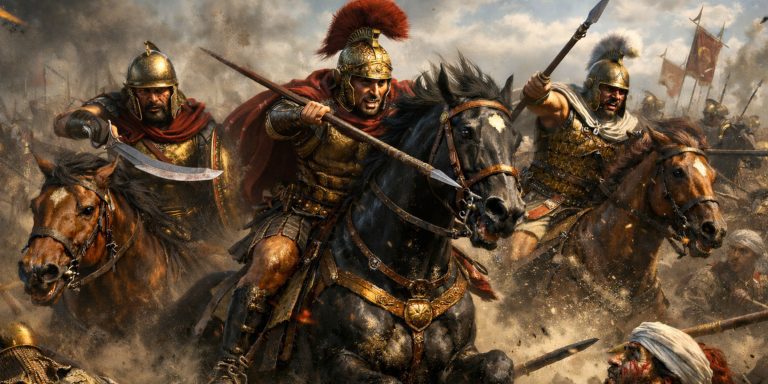
Among the most famous of these forces were the Varangian Guard, an elite unit composed largely of Norse and later Anglo Saxon warriors. Their loyalty to the emperor made them invaluable in a political environment where generals sometimes had imperial ambitions.
Basil’s armies combined traditional Byzantine strengths such as disciplined infantry formations with effective cavalry and siege operations.
Victory often came slowly, though it tended to stick.
Government and Imperial Authority
If Basil showed patience on campaign, he showed something closer to stubbornness in government.
The emperor spent much of his reign pushing back against the powerful landowning aristocracy.
Large estates had been expanding across the empire, absorbing land that once supported small military farmers. Those farmers formed the backbone of the Byzantine army.
Basil believed that trend weakened the state.
He introduced laws designed to limit aristocratic land accumulation and protect smallholders. The aim was straightforward. A stable base of landowning soldiers meant a stronger military and a more resilient empire.
Not surprisingly, many nobles hated these policies.
Basil did not seem particularly concerned about their feelings.
Personal Character and Reputation
Contemporary descriptions paint Basil as an unusual emperor.
He reportedly:
- dressed plainly
- avoided lavish court ceremonies when possible
- rarely indulged in luxury
- remained unmarried throughout his life
The absence of an heir later became a problem for the empire, though during his lifetime it reinforced the impression of a ruler focused almost entirely on governance and war.
One Byzantine writer described him as a man who looked more like a hardened soldier than a monarch.
That reputation suited Basil perfectly.
He preferred the battlefield to palace intrigue and trusted the loyalty of troops more than the promises of courtiers.
Relations With Other Powers
Basil’s attention focused heavily on the Balkans, though his diplomacy extended across the wider medieval world.
The Byzantine Empire maintained complex relationships with neighbouring states including:
- the Holy Roman Empire
- the Fatimid Caliphate in Egypt
- Armenian and Georgian kingdoms
- emerging powers in Eastern Europe
Through a mixture of diplomacy, military pressure, and strategic marriages among allied dynasties, Basil preserved Byzantine influence across these regions.
The empire during his reign was respected, occasionally feared, and rarely ignored.
The Final Years of His Reign
By the early eleventh century Basil II stood at the height of his power.
Bulgaria had been conquered. The eastern frontiers were relatively secure. Imperial authority had been reinforced after decades of aristocratic challenge.
Even in his later years Basil continued preparing new campaigns. One of his final ambitions involved operations against Muslim powers in Sicily and southern Italy.
He never had the chance to pursue them.
Basil II died in 1025 after nearly fifty years on the throne.
His death marked the end of an extraordinary reign.
Legacy of Basil II
Few Byzantine emperors left the empire stronger than they found it.
Basil II did exactly that.
His achievements included:
- the destruction of the Bulgarian Empire
- the restoration of Byzantine authority in the Balkans
- military reforms that strengthened the army
- political measures aimed at limiting aristocratic power
For a brief period after his death Byzantium stood as the dominant power of the eastern Mediterranean.
Unfortunately, later rulers struggled to maintain that balance. Internal politics, weakening military structures, and new external threats slowly eroded Basil’s achievements.
Historians sometimes remark that Basil II was followed by a run of emperors who enjoyed the empire he had built but lacked the discipline required to sustain it.
Even so, his reputation remains formidable.
In a long line of Byzantine rulers, Basil II stands out as something close to the ideal soldier emperor. Determined, pragmatic, occasionally ruthless, and undeniably effective.
If you were a Byzantine soldier serving on the frontier, Basil was exactly the kind of emperor you hoped for.
If you happened to be ruling Bulgaria at the time, the feeling was rather less enthusiastic.