Babur is one of those rare historical figures who feels unusually close. He conquered cities, lost kingdoms, rebuilt his fortunes, and then sat down to write honestly about his failures, his homesickness, his gardens, and his temper. As the founder of the Mughal Empire, his political legacy reshaped South Asia for centuries. As a writer, he left us one of the most candid autobiographies ever produced by a medieval ruler.
What follows is not a victory parade. Babur’s life was messy, often improvised, and occasionally lucky. That is precisely why it is so compelling.
Origins and Early Life
Zahir al Din Muhammad Babur was born in 1483 in Andijan, in the Fergana Valley. He inherited a fragile Timurid legacy on both sides of his family. From his father, he claimed descent from Timur. From his mother, a direct line to Genghis Khan. On paper, this made him formidable. In reality, it meant endless rivalry, land disputes, and ambitious cousins.
Babur became ruler of Fergana at the age of twelve. Within a few years he had lost it, regained it, and lost it again. His early attempts to hold Samarkand ended in frustration. He spent much of his youth on campaign or in retreat, learning hard lessons about loyalty, logistics, and the limits of inherited prestige.
By his early twenties, Babur had abandoned Central Asia entirely and turned south. Kabul became his base, not through grand strategy, but because it was available and defensible. From there, the Indian subcontinent slowly came into view.
Arms and Armour
Babur stood at a crossroads of military cultures. His armies blended Timurid cavalry traditions with emerging gunpowder tactics, creating a force that felt modern compared to many of his opponents.
His core troops were mounted warriors armed with composite bows, sabres, and lances. Mobility mattered more than brute strength. These cavalry units were supported by infantry trained to protect artillery and firearms, still a developing element but used with increasing confidence.
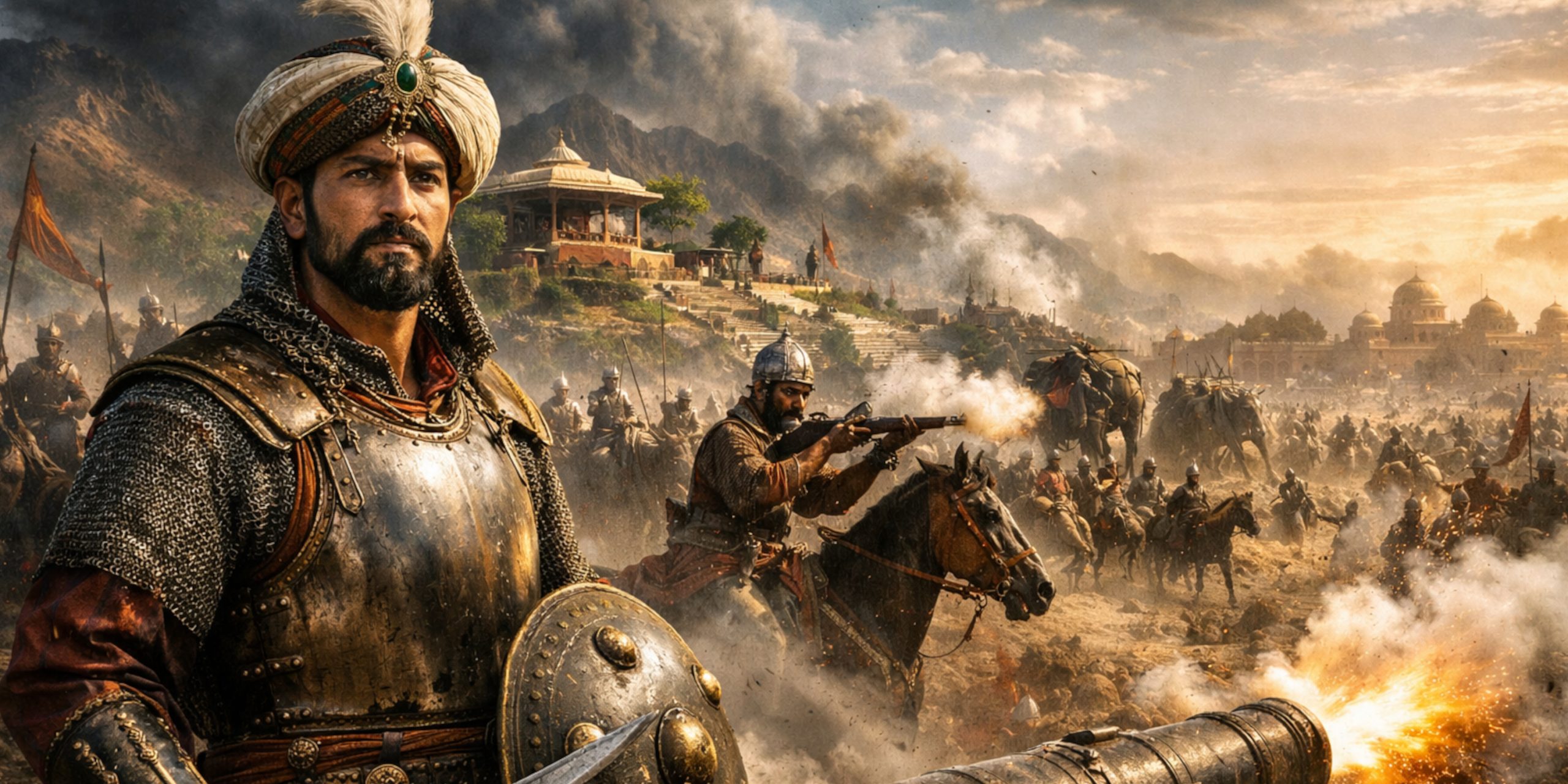
Firearms were Babur’s decisive edge. Matchlock muskets and field artillery, managed by Ottoman-trained gunners, allowed him to dominate set-piece battles. He understood their psychological impact as much as their physical one. The noise, smoke, and discipline of gunpowder warfare unsettled armies that relied on elephants and massed infantry.
Personal armour was practical rather than ornate. Babur favoured mail shirts reinforced with plates, helmets of Central Asian design, and shields suited to mounted combat. Courtly splendour would come later under his successors. Babur’s wars were fought with whatever worked.
Battles and Military Acumen
Babur was not a flawless general. He lost more battles than later Mughal chroniclers liked to admit. What set him apart was adaptability.
His defining victory came in 1526 at the Battle of Panipat against Ibrahim Lodi, Sultan of Delhi. Babur’s army was smaller, but tightly organised. He anchored his line with carts lashed together, protecting artillery and musketeers. Cavalry manoeuvres on the flanks exploited gaps once Lodi’s forces stalled under gunfire. It was controlled, deliberate, and devastating.
Subsequent battles, such as Khanwa in 1527, confirmed Babur’s ability to learn from experience. He improved defensive positioning, coordinated firepower more effectively, and managed morale with surprising emotional intelligence. He wrote openly about fear, fatigue, and doubt, qualities most conquerors pretend never existed.
Strategically, Babur’s greatest strength was knowing when to abandon an idea. He gave up on Samarkand. He stopped chasing legitimacy in Central Asia and built something new in India. That flexibility, more than battlefield brilliance, founded an empire.
Rule and Governance
Babur’s reign in India was short, just four years. Administration was still improvised. He relied on trusted nobles, rewarded loyalty quickly, and punished betrayal without hesitation.
What he truly cared about, perhaps more than governance, was environment. Babur despised the Indian heat and humidity, yet he set about reshaping landscapes to remind him of Central Asia. Gardens became political statements. Order imposed on nature mirrored order imposed on empire.
This love of gardens was not a hobby. It became a Mughal tradition, linking power, aesthetics, and memory.
The Baburnama and Personal Legacy
Babur’s autobiography, the Baburnama, is the reason historians trust him. He recorded defeats as carefully as victories. He admitted cruelty, regret, indulgence, and loneliness. He wrote poetry, complained about bad fruit, and mourned lost friends.
As a historian, I find this unsettling in the best way. Babur does not let us turn him into a symbol. He insists on being human, and that makes his conquests harder to romanticise and easier to understand.
Where to See Artefacts from Babur’s Reign
Physical objects directly tied to Babur are rare, but not absent.
Manuscripts of the Baburnama can be seen in major collections, including illustrated Mughal copies held at the British Library and the National Museum in Delhi. These later versions reflect how his descendants curated his memory.
Early Mughal arms and armour, stylistically linked to Babur’s campaigns, are displayed in institutions such as the National Museum in Delhi and the Metropolitan Museum of Art in New York. While not always directly attributed to Babur himself, they reflect the material culture he introduced.
Babur’s tomb in Kabul remains one of the most important surviving sites from his life. Restored multiple times, it reflects his enduring attachment to the city he chose as a refuge.
Latest Archaeology and Research
Recent archaeological work in Kabul has focused on the restoration and landscaping of Babur’s tomb complex, revealing earlier garden layouts consistent with descriptions in the Baburnama. These findings reinforce how carefully Babur planned his burial environment.
In northern India, ongoing surveys of early Mughal fortifications and artillery positions continue to refine our understanding of Babur’s early campaigns. Advances in battlefield archaeology have helped clarify troop movements at Panipat and Khanwa, supporting written accounts rather than overturning them.
Scholars are also revisiting Babur’s writings through fresh translations, paying closer attention to his emotional language rather than treating the Baburnama as a mere military chronicle.
Sevenswords Takeaway
Babur did not live long enough to see the empire his descendants would build. What he left instead was a foundation and a voice. He was a conqueror who admitted uncertainty, a ruler who missed home, and a warrior who understood change before most of his rivals did.
As far as founders go, he remains unusually readable, unsettlingly honest, and historically indispensable.