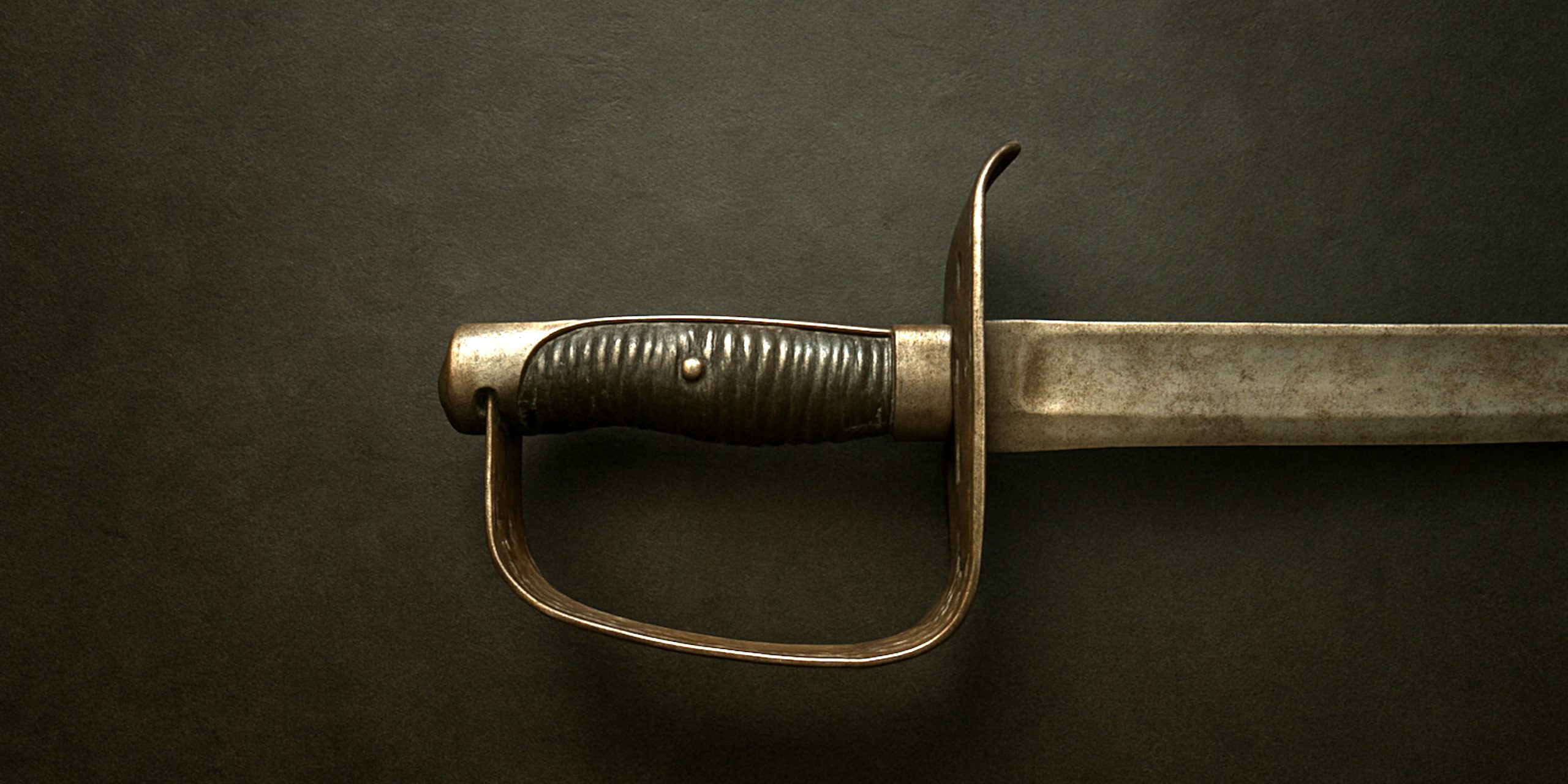
The Austrian 1798 Heavy Cavalry Pallasch sits comfortably among the most uncompromising cavalry swords of the late eighteenth and early nineteenth centuries. It was built for shock action rather than elegance, a tool shaped by the tactics of a monarchy that relied heavily on its mounted arm. Where others experimented with curved blades and pursuit slashing, Austria favoured a rigid straight weapon intended to deliver the decisive thrust during the charge. The result was a sword that looked austere but earned respect from the men who had to trust it at full gallop.
Specification
| Feature | Detail |
|---|---|
| Type | Heavy cavalry pallasch, straight single edged blade |
| Blade length | Usually 90 to 100 cm |
| Blade width | Broad, often 35 to 40 mm at the base |
| Weight | Commonly between 1.3 and 1.6 kg |
| Grip | Ribbed leather or cord over wood with iron backstrap |
| Guard | Iron stirrup guard with large oval pierced plate |
| Scabbard | Iron scabbard with fixed suspension bands |
| Intended use | Thrusting during massed cavalry charges |
History and Evolution
The 1798 pattern emerged at a moment when the Habsburg cavalry was reforming to meet the military challenges of Revolutionary France. Austrian doctrine placed a strong emphasis on tightly ordered heavy cavalry formations. Officers wanted a sword that rewarded discipline and cohesion rather than individual flourish.
The pallasch drew on earlier straight blades used in central Europe. What distinguished the 1798 version was its larger handguard plate, its stout hilt furniture and the consistently heavy blade profile. Production continued well into the Napoleonic Wars, with minor variations in grip materials and scabbard finish. Even after new patterns appeared in the mid nineteenth century, many regiments held on to their 1798s simply because they were difficult to break.
Advantages and Disadvantages
Advantages
- Very strong blade suited to deep thrusts.
- Guard offered reliable hand protection against sabres.
- Sturdy construction allowed long service life.
- Performed well in disciplined formations.
Disadvantages
- Heavier than many contemporary cavalry swords which caused fatigue on long rides.
- Handling felt rigid and slow for slashing work.
- Straight thrusting profile less useful in pursuit or close skirmishing.
- Often considered crude in finish compared with French and British sabres.
Comparison with Similar Weapons
Austrian 1798 Pallasch vs British 1796 Heavy Cavalry Sword
| Feature | 1798 Pallasch | 1796 Heavy Cavalry Sword |
|---|---|---|
| Blade | Straight, single edged, thick | Straight, fullered, slightly lighter |
| Handling | Heavier, thrust focused | Still heavy but somewhat more balanced |
| Use | Massed charges, deep penetration | Charges and cutting strokes |
| Guard | Large pierced plate | Disc guard with less coverage |
Austrian 1798 Pallasch vs French AN XI Cavalry Sabre
| Feature | 1798 Pallasch | French AN XI |
|---|---|---|
| Blade shape | Straight | Curved |
| Primary action | Thrust | Cut and thrust |
| Weight | Generally heavier | More agile in the cut |
| Tactical role | Rigid formations | Flexible cavalry manoeuvres |
The Austrian weapon belongs firmly to the old tradition of the straight cavalry broadsword, while many European powers were already embracing curved blades to increase cutting efficiency. The pallasch prioritised depth and power, sometimes at the cost of finesse.
Legacy
The 1798 Heavy Cavalry Pallasch represents the final flowering of the old Austrian cavalry ethos. Its longevity speaks to a military system that valued reliability above innovation. Surviving examples show how much wear these swords endured which hints at the fierce service they saw during the Revolutionary and Napoleonic conflicts. Today collectors look at the pallasch as an honest, workmanlike piece of heavy cavalry history, less flashy than French or British swords but arguably more faithful to its intended purpose.
Where to See One
- Heeresgeschichtliches Museum, Vienna. Several Austrian cavalry swords from the Napoleonic era are displayed, often including variants of the 1798 pallasch.
- Kunsthistorisches Museum, Vienna. Rotating collections sometimes feature Austrian military edged weapons.
- Royal Armouries, Leeds. Examples of continental pallasches are occasionally shown for comparison with British heavy cavalry swords.
- Smaller regimental museums across central Europe also hold pieces, often adorned with unit marks.
Collectors Guide
What Collectors Look For
- Complete guard plate with no major cracks.
- Original grip covering and wire.
- Blade free of deep corrosion.
- Clear unit markings or inspector stamps.
- Original iron scabbard in good structural condition.
Rarity
The 1798 pallasch is not rare in absolute terms but high condition examples can be surprisingly difficult to find. Many saw rough field service, and a number were stored poorly during the twentieth century.
Typical Auction Prices
Prices vary with condition and provenance.
| Condition | Approximate Price Range |
|---|---|
| Relic or poor | 150 to 250 GBP |
| Average serviceable example | 300 to 450 GBP |
| Good condition with original grip and scabbard | 500 to 750 GBP |
| Excellent or unit marked with provenance | 800 to 1,200 GBP |
Exceptional examples with regiment identification or battlefield associations can exceed these figures, although such sales are infrequent.
Buying Tips
- Inspect the guard for repairs because cracked plates are common.
- Confirm that the scabbard mouthpiece matches the sword and has not been swapped.
- Accept that many grips have been rewrapped and factor this into the price.
- Buy from reputable dealers when possible because authenticity issues mainly arise around later reworks advertised as early versions.