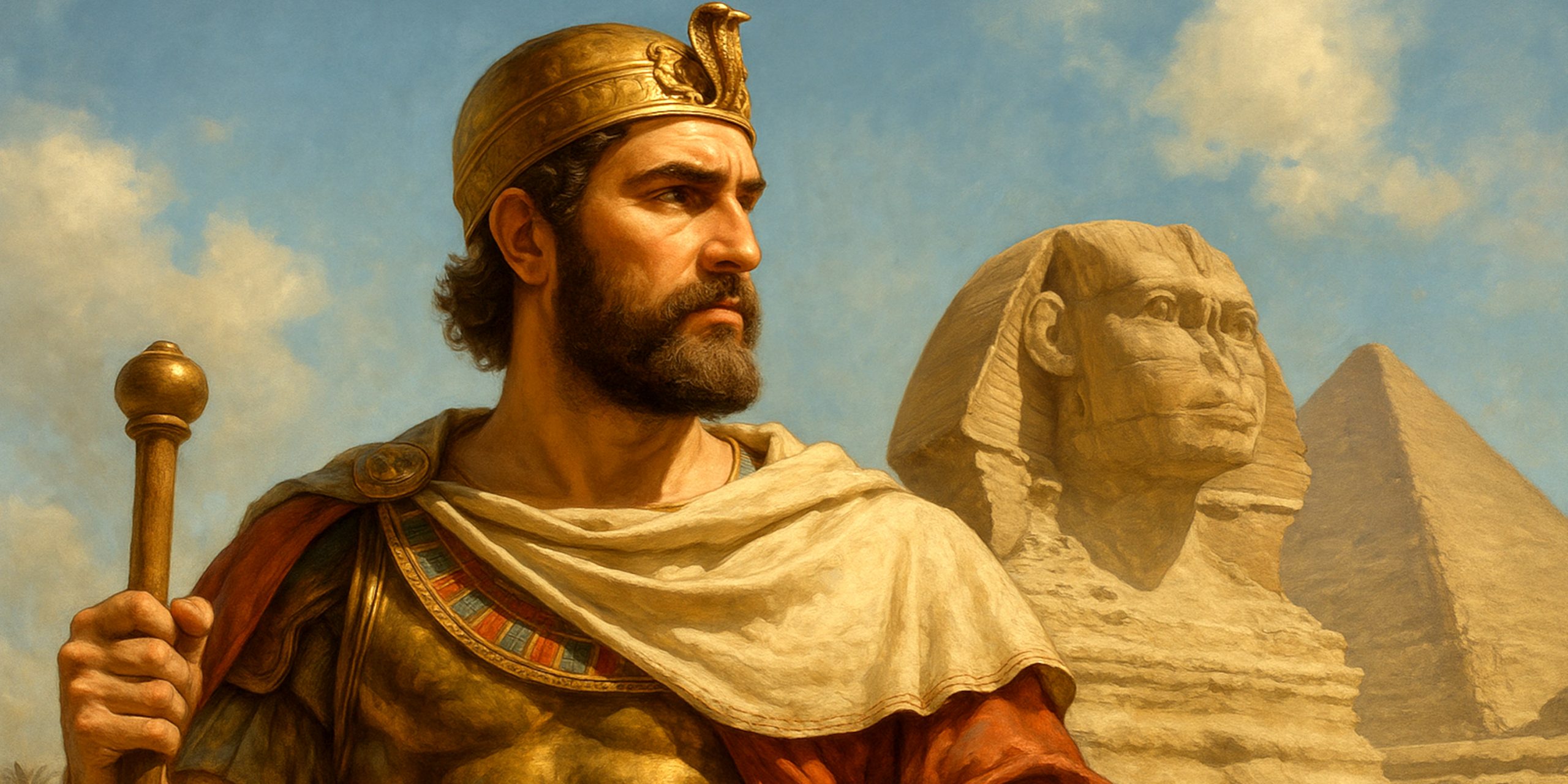
The Ptolemaic Dynasty tends to arrive in popular imagination only at its very end with Cleopatra VII, but the story stretches far beyond her tragic entanglements. It begins with one of Alexander the Great’s most capable companions, Ptolemy son of Lagus, who had the foresight to seize Egypt at the moment when Alexander’s empire began to wobble under its own weight. From there the family built a kingdom that blended Greek ambition with Egyptian tradition. It produced libraries, mathematicians, pharaohs in Macedonian helmets, lavish court rituals, and the occasional spectacular palace intrigue.
The Ptolemies managed to keep hold of Egypt for almost three centuries, which by Hellenistic standards counts as an overachievement.
Origins and Foundation
Ptolemy I secured Egypt after Alexander’s death in 323 BCE, claiming the land not through divine right but through a sturdy mix of military talent, administrative skill, and opportunism. He also took custody of Alexander’s body, which was the Hellenistic equivalent of claiming Excalibur. Anyone wanting the symbolic heart of Alexander’s empire had to wrest it from Ptolemy’s hands and most found it wiser not to try.
The dynasty established Alexandria as its capital, a city designed with the confidence of a conqueror and the orderliness of a mathematician. From the outset it became a magnet for scholars, traders, and ambitious officials who fancied a life in a sunlit metropolis adorned with colonnades and buzzing with multiple languages.
Government and Royal Culture
Ptolemaic rule leaned heavily on the structures of the earlier pharaonic state. The kings styled themselves as pharaohs to the Egyptian population while keeping Greek customs alive within the court. This dual identity worked well enough for stability but created a cultural split that widened as the centuries wore on.
The dynasty excelled in ceremony. Crowns were piled atop crowns, robes shimmered, and the court developed a taste for spectacle that sometimes veered into excess. Yet beneath all this theatre lay a sturdy administrative machine capable of organising irrigation, minting coinage, and extracting taxes with a zeal that future empires would envy.
Military Power and Foreign Ambition
Ptolemaic Egypt commanded wealth that made it a key player in the Hellenistic world. Its navy dominated the eastern Mediterranean for much of the third century BCE, and its armies included both Macedonian settlers and Egyptian recruits who occasionally realised they held more influence than the palace liked to admit.
Conflicts with the Seleucid Empire consumed much of the dynasty’s foreign policy. These wars ebbed and flowed with such regularity that historians sometimes wonder if the two states were locked in a competitive sport rather than a diplomatic dispute.
Cultural and Intellectual Life
Few dynasties can boast a monument quite like the Library of Alexandria. It became a beacon for scholars who wished to measure the world, catalogue its languages, and settle philosophical arguments that no one outside their circle could quite follow. The adjacent Museum functioned as an early research institute, and the environment fostered figures such as Euclid, Eratosthenes, and Herophilus.
This intellectual prominence was not an accident. The Ptolemies invested heavily in scholarship because knowledge carried prestige and because books were easier to manage than generals. Well, most of the time.
Internal Strife and Decline

For all its brilliance, the dynasty suffered from a recurring habit of family quarrels. Brothers fought sisters, uncles intervened, and the throne often changed hands with a velocity that alarmed even seasoned observers of royal politics. Court factions grew influential, foreign advisors meddled, and the kingdom’s resources slowly drained.
By the first century BCE, Rome loomed over the entire Mediterranean. The Ptolemies became increasingly dependent on Roman support, and the kingdom shifted from sovereign state to client realm. Cleopatra VII attempted to reverse this decline with bold alliances and political theatre that still captivates imaginations, but the momentum of Roman expansion proved unstoppable.
Legacy
The Ptolemaic Dynasty left traces across multiple domains. Egypt’s artistic and architectural landscape evolved under their rule, blending Hellenistic styles with native forms. The intellectual tradition of Alexandria shaped later scientific and literary thought. Their multilingual administration preserved a wealth of documents that now allow historians to study daily life with striking detail.
More broadly, the Ptolemies stand as a reminder that cultural fusion can create extraordinary vitality, even if their political experiments sometimes unravelled in spectacular fashion. A historian approaches the dynasty with equal parts admiration and exasperation.
Watch the documentary: