There are few mounted soldiers in late medieval Europe who inspired as much admiration, frustration and sheer narrative chaos as the French Gendarmes. They were the pride of the Valois crown, yet often the doom of whichever poor infantry line they thundered towards. The term conjures images of armoured riders shattering pike formations and then immediately arguing with each other about precedence. As a historian, I find them endlessly entertaining. They represent the moment chivalric tradition met the cold arithmetic of gunpowder and still insisted on arriving dressed for a tournament.
Origins and Evolution
The Gendarmes emerged from the fifteenth century French nobility. Their roots lie in the compagnies d’ordonnance, the standing units created by Charles VII once he accepted that relying on semi freelance knights was about as stable as storing gunpowder next to a cooking fire. The ordonnance companies formed the professional backbone of royal cavalry. Out of these, the Gendarmes grew into an elite corps that blended knightly lineage with a state controlled military structure.
By the early sixteenth century the Gendarmes had become both a battlefield force and a social institution. They embodied French aristocratic identity in steel and horseflesh. There was swagger, certainly, but also discipline when the situation required it. Well, usually. Renaissance chroniclers were not shy about pointing out that enthusiasm and tactical thought did not always travel together.
Battlefield Role
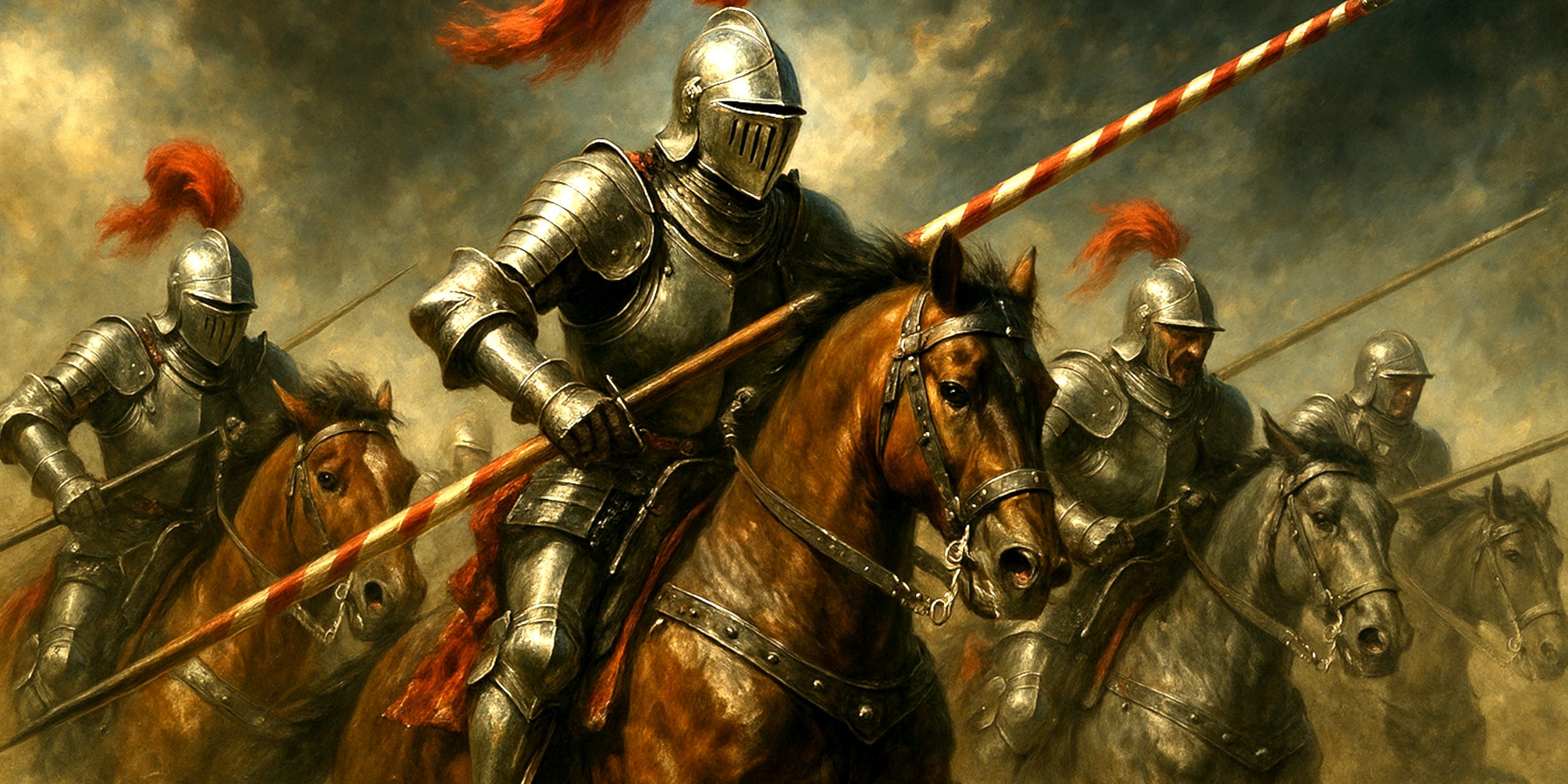
Gendarmes specialised in shock combat. The hallmark of their tactics was the heavy cavalry charge, delivered at speed with long, stout lances aimed at collapsing enemy morale by force of impact. Against wavering troops they were devastating. Against prepared pike blocs they were something closer to brave but misguided. Battles such as Marignano in 1515 show both extremes. The French charge contributed to victory, yet the Swiss pikemen extracted a considerable price for the privilege.
Their organisation often placed them in the first line of French offensive manoeuvres. The Gendarmes were not subtle. They were designed to break whatever stood in front of them, allowing lighter cavalry and infantry to exploit the chaos. When it worked, it worked spectacularly. When it did not, the chronicles suddenly became very quiet on matters of responsibility.
Arms and Armour
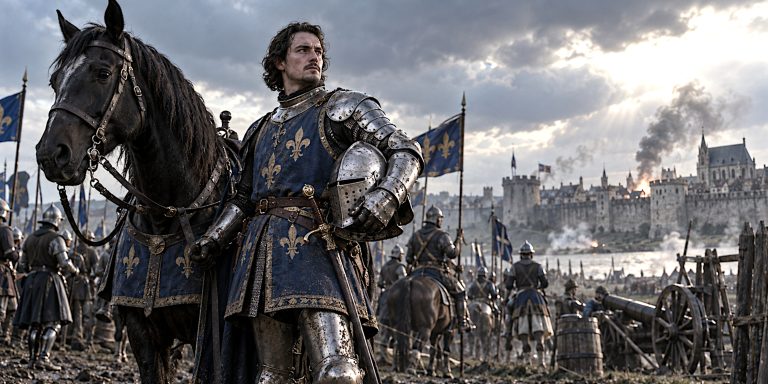
The armour of a French Gendarme is best thought of as the knightly aesthetic translated into late medieval engineering. It was designed to stop points, blades, and the occasional early bullet, although the latter was more optimistic than reliable.
Armour Components
- Close fitted gothic or early renaissance plate harness
- Reinforced cuirass and backplate
- Heavy arm defences with large vamplates
- Plate cuisses and greaves
- Closed helm, often an armet or close helmet with barred visor
- Ornamental crests that must have terrified the horses as much as the enemy
Weapons Most Commonly Used
- Lance. Hollow or solid ash, reinforced with a coronel. The primary weapon for the opening charge.
- Estoc. A stiff, thrusting sword designed for punching through weak points in armour.
- Arming sword. Broad bladed and reliable, carried when the fighting became too tight for lances.
- War hammer or mace. Useful when an opponent refused to fall over after the first three polite stabs.
- Dagger. Often a rondel, for the unpleasant work once both riders were on the ground.
Horses and Protection
The mount was as important as the rider. Gendarmes favoured powerful destriers or coursers. Barding could include chanfrons, peytrals and cruppers, though by the sixteenth century full horse armour became less common due to cost and musketry.
Archaeology
Archaeological finds linked to Gendarmes typically come from battlefields in northern Italy and France. Armour fragments from Marignano and Pavia show the transition from fluted gothic plate to smoother forms suited to pistol proofing. Surviving lance rests on cuirasses tell us much about how heavy the impact weapons had become, often pushing the limits of what a human arm could sensibly manage.
Excavations at Pavia have produced buckled but recognisable visor fragments, pierced in neat circles by arquebus balls. These finds vividly underline why the traditional cavalry charge began to lose its shine in the face of increasingly accurate firearms. Even the most valiant Gendarme could not argue with physics.
Contemporary Quotes
Chroniclers left more than enough commentary on these formidable horsemen. Some flattering, some slightly exasperated.
Philippe de Commynes wrote:
“They came forward with such bravery that the earth itself seemed troubled beneath them.”
A fine line, although one imagines the Swiss were troubled for different reasons.
Francesco Guicciardini observed after Marignano:
“The French cavalry showed both strength and fury, though not always judgement.”
A diplomat’s way of saying what most infantry already suspected.
An anonymous Burgundian soldier recorded:
“Their advance was like a thunder that had decided to wear armour.”
One cannot fault the imagery.
Notable Battles
Marignano, 1515
A showcase of Gendarme power. Repeated charges wore down Swiss resistance, proving that heavy cavalry still had teeth when used with support.
Pavia, 1525
A disaster. Spanish and Imperial firearms shredded the cavalry before they reached effective striking distance. The defeat marked a shift in European warfare. Cavalry shock tactics would never again dominate in the same way.
Ravenna, 1512
A mixed performance. The Gendarmes fought with zeal, although enthusiasm alone could not untangle the wider tactical complexities of the battle.
Culture and Identity
Gendarmes were tied deeply to French noble culture. Service offered prestige, patronage, and the chance to impress the king in the most direct possible way by galloping into a wall of enemy spears. Their prominence also helped France cultivate an image of chivalric might long after such imagery had begun to look nostalgic. There is something rather charming about a society trying to preserve tradition while the rest of Europe experimented with gunpowder like excitable alchemists.
Decline
After Pavia the future of the Gendarmes became increasingly constrained. Firearms, pike and shot formations and the rise of lighter, more flexible cavalry undermined their battlefield relevance. They remained a ceremonial and social institution for some time, although increasingly they belonged to a world that was already fading.
Legacy
French Gendarmes represent a closing chapter in the story of medieval heavy cavalry. They were bold, beautifully equipped, sometimes infuriating and always dramatic. Their image continues to colour how we imagine late medieval warfare. When people picture knights charging across open fields in full plate, part of that mental theatre belongs to these riders.
As a historian, I find that their legacy is not simply about victory or defeat. It is about a culture determined to shine as brightly as possible before the shadows of modern warfare reached across Europe.
Watch the documentary: