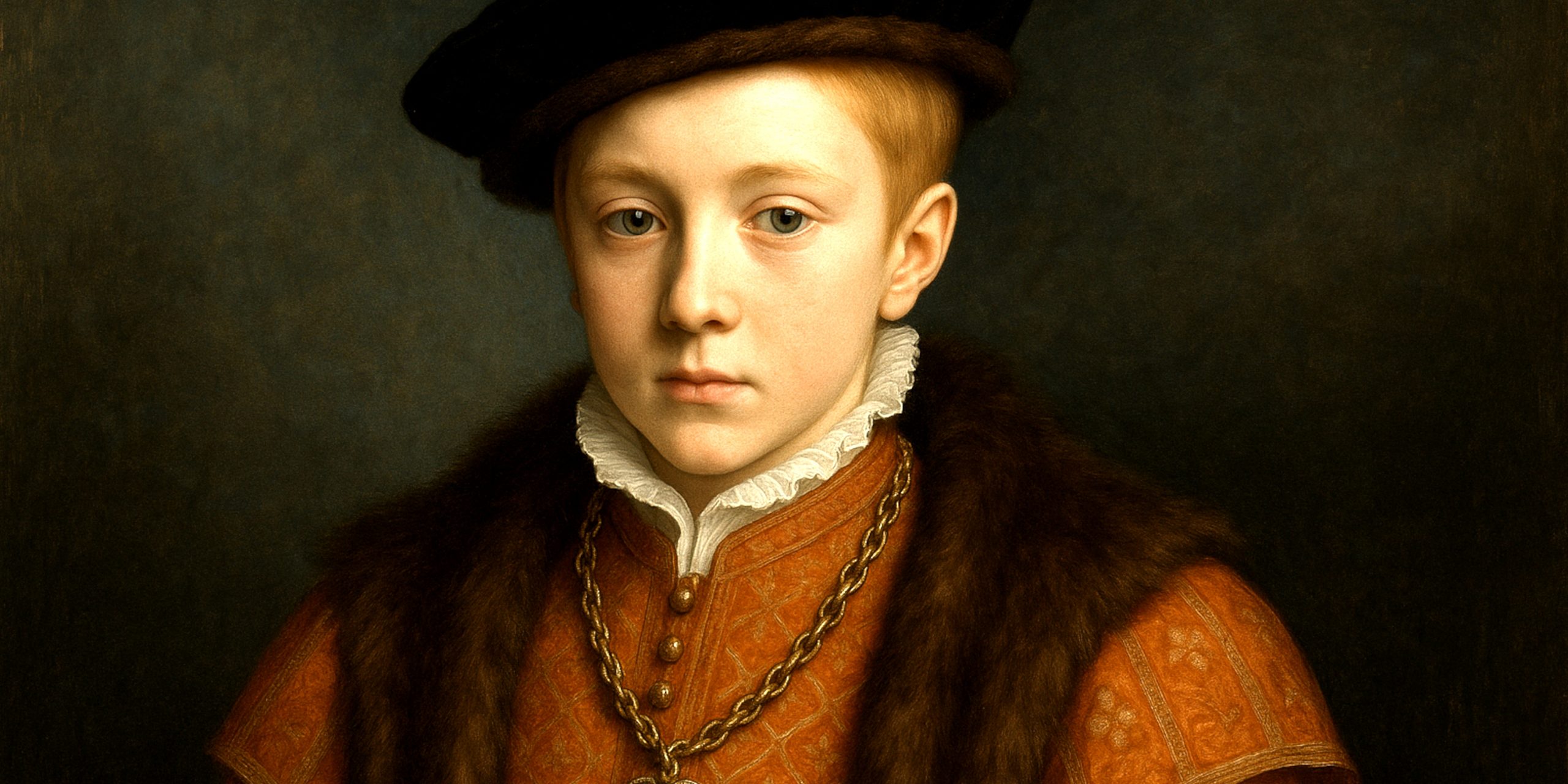
Edward VI is one of those monarchs who feels a bit like a footnote until you look closer. His reign lasted only a few years, yet the policies pushed through in his name helped redraw English religion, politics, and even the rhythm of everyday parish life. When you write about him as a historian, you feel the weight of a lad who never had the chance to grow into the crown he inherited. Still, what happened between 1547 and 1553 shaped England far more than his slight figure and pale portraits suggest.
Early Life and Upbringing
Edward was born in October 1537 at Hampton Court. The joy Henry VIII displayed at receiving a legitimate male heir probably shook the rafters. Edward was raised in a carefully managed environment, complete with tutors who drilled him in humanist scholarship. By all accounts he was bright, dutiful, and at times rather pleased with his own intellect. I cannot really blame him. If I had been declared the hope of a dynasty before I could walk, I might have developed a bit of a scholarly swagger too.
His education placed a heavy emphasis on religion. This mattered more than anyone realised at the time. Edward did not merely inherit the English Reformation. He absorbed it as his intellectual worldview.
The Regency Governments
Edward succeeded in January 1547 at the age of nine. Nobody expected him to rule in practice, so power slipped into the hands of his uncle, Edward Seymour, Duke of Somerset. Somerset styled himself as a reformer, though his policies were a mix of good intentions and rather poor crowd control. His rural reforms irritated landowners, his war in Scotland drained the treasury, and his attempt at soft paternalism towards the commons earned him few friends.
Somerset fell from favour in 1549 and was replaced by John Dudley, later Duke of Northumberland. Dudley lacked Somerset’s idealistic streak but possessed a sharper sense of political management. Under his direction, the government became more stable, more decisive, and rather more willing to pursue religious change at pace.
Religion and Reform
Edward’s reign is often remembered for the pushing forward of Protestantism. Cranmer’s Book of Common Prayer appeared in two editions, each pulling the church further from its Catholic inheritance. The ban on images, the new communion service, and the explicit shift toward reformed doctrine created a very different religious England.
Edward approved enthusiastically. His journal entries read like someone who believed he had a divine responsibility to finish what his father had begun. If you wanted Catholic ceremony, this was a bad decade. If you wanted to reshape the liturgy from the ground up, you would have been in your element.
Foreign Policy
Somerset’s early war in Scotland was bold but ill judged. It secured victories such as Pinkie Cleugh, yet failed to force a union on English terms. France intervened, Scotland rallied, and the dream of marrying Edward to Mary, Queen of Scots sailed away to the French court.
Northumberland took a more pragmatic approach. He sought peace, reduced military spending, and focused on stabilising the crown’s finances. It was not glamorous, but it was necessary. Tudor glamour had already emptied the coffers.
Economy and Social Conditions
Inflation, currency debasement, and enclosure riots coloured the reign. The economic strain was not entirely the fault of Somerset or Edward. Henry VIII had done the financial equivalent of burning the furniture for firewood, and the kingdom now shivered through the consequences.
Kett’s Rebellion in 1549 was the most dramatic expression of rural anger. The rebels complained about land use, rents, and corrupt local governance. They even set up their own orderly camp at Mousehold Heath. It did not end well for them, but their grievances echoed across the countryside.
Edward VI’s Health and Death
The tragedy of Edward VI lies in his final year. Tuberculosis consumed him. Observers described a long, wasting decline. His determination to secure a Protestant succession led to the controversial attempt to instal Lady Jane Grey. It was a clever plan on paper and a catastrophic one in practice. Mary asserted her claim, rallied support with startling speed, and swept Jane aside within days.
Edward died in July 1553 at the age of fifteen. One cannot escape the feeling that the realm had been running on borrowed time throughout his childhood. With his passing, the political and religious settlement he had championed shuddered and shifted again.
Legacy
Edward VI’s reign is brief but not inconsequential. His support for radical religious change marked one of the sharpest turns in English ecclesiastical history. The Prayer Books, the reordering of church interiors, the doctrinal clarity pursued by Cranmer, and the strengthening of a Protestant identity all took root here.
His failure to secure a stable succession left a political mess for Mary and Elizabeth to inherit. Yet the intellectual seeds planted during his short life continued to sprout long after his burial. Even his fiercest critics admitted that the boy had a serious mind and a strong conviction.
From a historian’s perspective, Edward feels like the monarch England never truly got the chance to know. The documents reveal flashes of personality, keen intelligence, and a very Tudor sense of purpose. He simply ran out of time.
Watch the documentary: