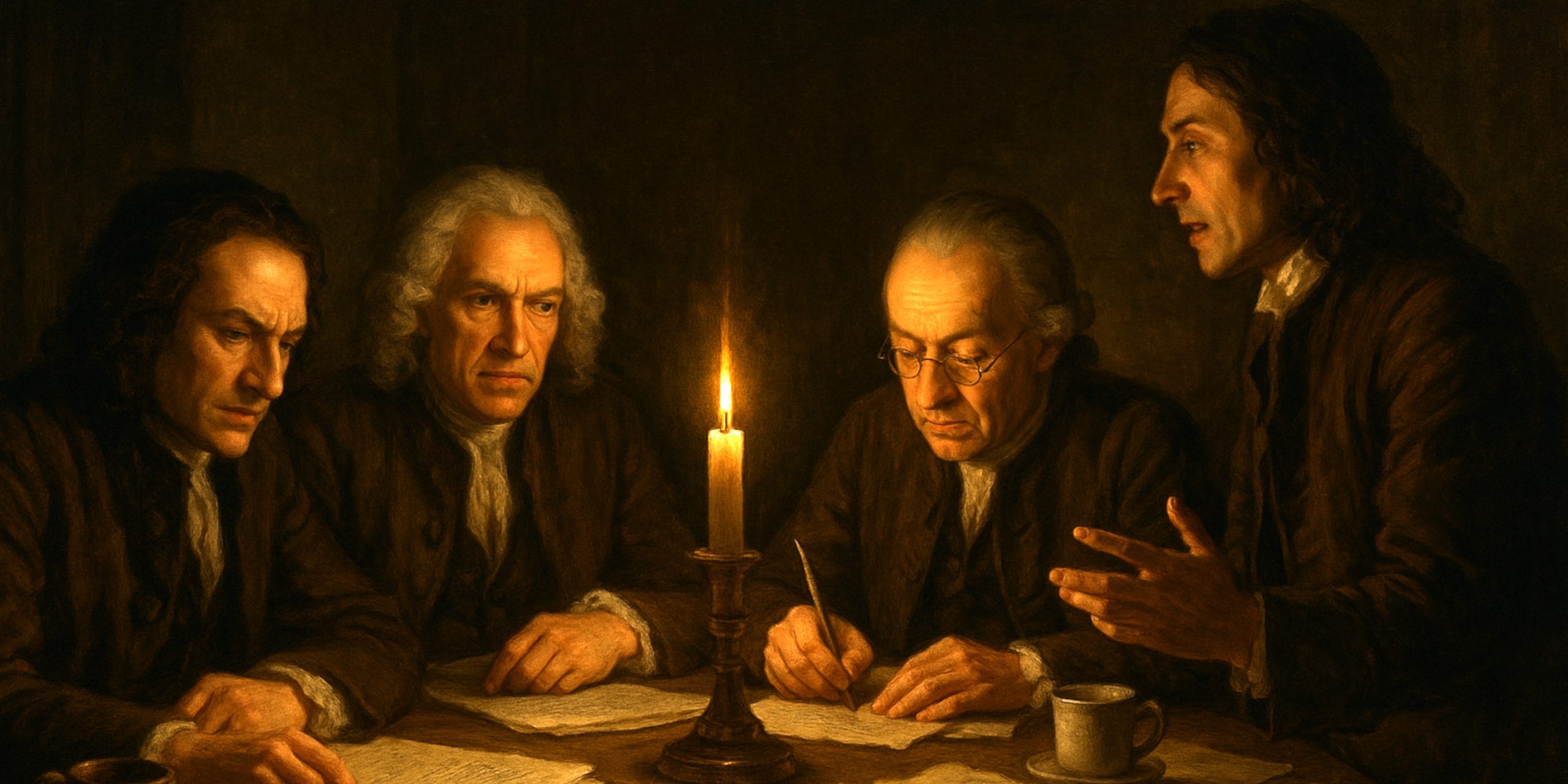
The Enlightenment is often portrayed as a clean, candle-lit age of reason, where powdered wigs nodded wisely over the birth of democracy and the rights of man. The truth, as usual, is rather less tidy. Behind the elegant phrases and philosophical treaties were egos, feuds, failed experiments, and in some cases, rather questionable personal hygiene. The Enlightenment thinkers were human, and in that humanity lies a far more interesting story.
The Coffeehouse Revolution
Forget Parisian salons for a moment. Much of the Enlightenment’s energy came from smoky coffeehouses buzzing with gossip, ink-stained pamphlets, and half-baked ideas. London’s cafés were nicknamed “penny universities” because a single coin bought access to a room full of arguments.
Voltaire, naturally, took things further. He reportedly drank over forty cups of coffee a day, convinced it sharpened his intellect. It likely also sharpened his temper, which may explain the number of duels he narrowly avoided.
Rousseau’s Contradictions
Jean-Jacques Rousseau, the philosopher who preached about natural virtue and the innocence of childhood, famously abandoned all five of his children to a Paris orphanage. His “Confessions” reads like a modern exercise in selective self-awareness. He was loved and loathed in equal measure, inspiring both the French Revolution and many later headaches in moral philosophy.
His belief that humans were naturally good but corrupted by society was powerful, if conveniently detached from his own behaviour. Yet his writings helped fuel the Romantic movement and transformed how people thought about individual freedom.
Kant’s Clockwork Mind
Immanuel Kant lived such a regimented life that his neighbours supposedly set their watches by his afternoon walk. He never travelled more than ten miles from his hometown of Königsberg, preferring to explore the limits of human reason rather than geography.
Kant’s work, particularly Critique of Pure Reason, is famously dense. Many of his contemporaries admitted to not understanding it, but admired the effort. His precision bordered on obsession, yet it shaped the course of Western philosophy. One suspects his greatest fear was not death, but an unscheduled interruption.
Voltaire: The Original Influencer
If Voltaire lived today, he would likely have had millions of followers and several lawsuits pending. Witty, acerbic, and endlessly argumentative, he was a one-man press office for the Enlightenment. He sparred with kings, mocked superstition, and survived imprisonment in the Bastille.
What most people forget is how practical he was. Voltaire invested shrewdly, turning his literary success into a fortune, and championed civil liberties not from a distant idealism but from experience. He once wrote, “I disapprove of what you say, but I will defend to the death your right to say it,” which is something no Twitter debate has yet lived up to.
Mary Wollstonecraft and the Radical Edge
Before feminism had a name, Mary Wollstonecraft was writing it into existence. Her Vindication of the Rights of Woman was an unflinching challenge to the hypocrisy of male philosophers who spoke of liberty while ignoring half of humanity.
Her life was as revolutionary as her writing. She travelled to revolutionary France, defied social convention, and lived on her own terms in a world that would have preferred her silent. Her daughter, Mary Shelley, would later pen Frankenstein, ensuring that the family tradition of shaking up intellectual complacency continued.
Diderot’s Encyclopaedia: The Internet Before the Internet
Denis Diderot’s Encyclopédie was not just a book, it was a declaration of war against ignorance. Compiling over seventy thousand articles, it brought together scientific, political, and philosophical knowledge in one place, challenging clerical control of education.
The French authorities predictably banned it, which of course only made it more popular. Contributors wrote under pseudonyms, smuggling radical ideas between the lines. In a sense, Diderot’s project foreshadowed the modern web, though one suspects he would have been appalled by most of its content.
David Hume and the Power of Doubt
While others pursued certainty, David Hume pursued doubt with a scholar’s patience and a sceptic’s grin. He questioned the very idea of cause and effect, unsettling centuries of philosophy. Religion fared no better under his scrutiny.
Despite this, Hume remained affable and sociable, fond of wine, laughter, and Edinburgh’s company. He once said that “reason is, and ought only to be, the slave of the passions,” which makes him sound more like a poet than a philosopher. In a movement obsessed with rationality, he stood out for his good humour.
The Enlightenment’s Real Legacy
The Enlightenment was not one tidy movement but a clash of egos and ideas that reshaped how humans viewed authority, knowledge, and themselves. It produced geniuses and hypocrites, visionaries and opportunists.
What it truly left behind was the notion that questioning power, tradition, and even oneself was not just permissible but necessary. That, perhaps, is the most rebellious thought of all.
Key Takeaways
- Voltaire turned wit into political weaponry.
- Rousseau wrestled with contradictions that defined modern selfhood.
- Kant built philosophy on punctuality and discipline.
- Wollstonecraft brought equality into philosophical debate.
- Diderot created an encyclopaedia that democratised knowledge.
- Hume taught that doubt can be just as powerful as belief.
The Seven Swords Takeaway
The Enlightenment thinkers were not saints of logic, but explorers of the human condition. Their brilliance was matched only by their flaws, and perhaps it is that contradiction that makes them so enduring. They questioned everything, including themselves, and the world has been arguing about it ever since.