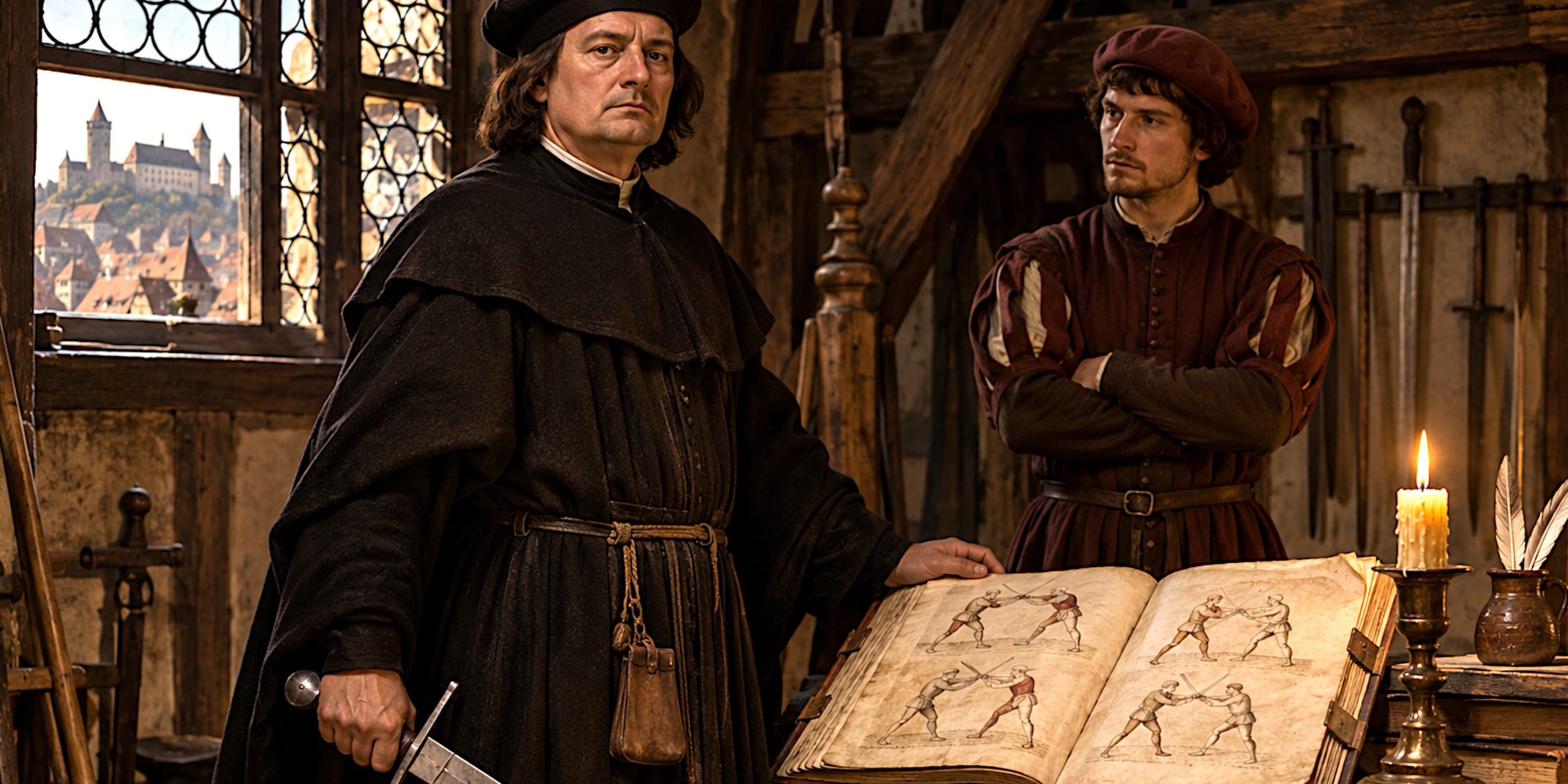
Johannes Lecküchner was a priest from the Nuremberg region who wrote one of the most substantial surviving guides to fighting with the long messer. His subject was a large, single-edged weapon usually wielded in one hand. His treatment of it was anything but brief: cuts, defences, changes of position and close-quarter actions receive the sort of attention that suggests a man determined to leave very little to guesswork.
Two manuscripts anchor what we know about his work. A text version survives in Heidelberg, dating from around 1478. A later Munich manuscript was completed in January 1482 and contains hundreds of illustrations. Together, they offer an unusually detailed view of how a late medieval fencing system was put into words and pictures.
Who Was Johannes Lecküchner?
Lecküchner, also called Hans Lecküchner, identifies himself as being from Nuremberg. Records establish that he was a priest: he enrolled at the University of Heidelberg in June 1478, and the Munich manuscript describes him as parish priest in Herzogenaurach.
The outlines of his career are clearer than the man himself. We have his manuscripts and traces in institutional records, but little evidence of his daily life, pupils or personal reasons for writing. His command of fencing language is plain on the page. Whether he taught regularly, and to whom, is harder to establish.
| Detail | What the evidence tells us |
|---|---|
| Name | Johannes or Hans Lecküchner |
| Region | Associated with Nuremberg and northern Bavaria |
| Occupation | Priest and author of a fencing treatise |
| Heidelberg manuscript | Cod. Pal. germ. 430, around 1478 |
| Munich manuscript | Cgm 582, completed on 19 January 1482 |
| Subject | Fencing with the long messer |
A priest writing at length about blades can sound like a contradiction to modern ears. Fifteenth-century life was less considerate of tidy job descriptions.
What Was the Long Messer?
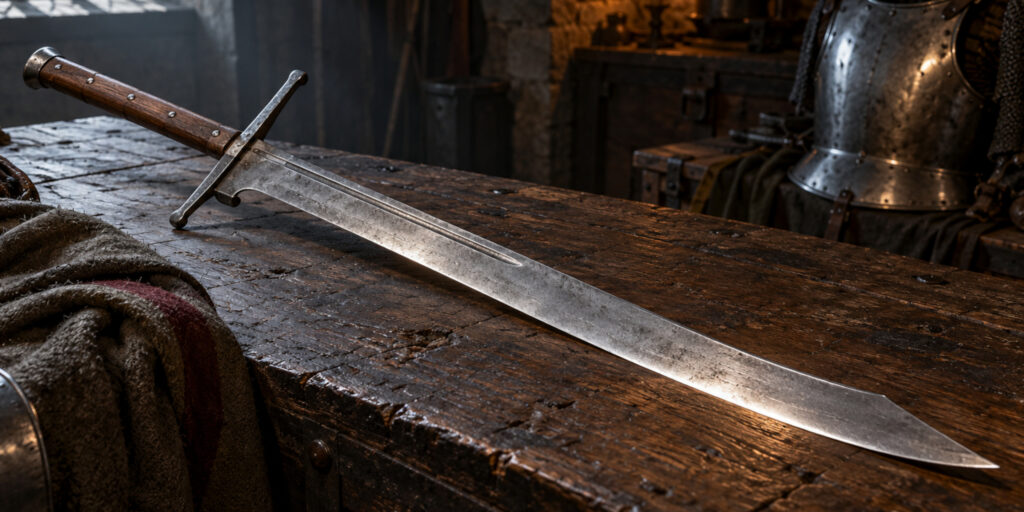
The long messer was a substantial, single-edged blade with a one-handed grip. Surviving examples vary, but a crossguard and a projecting side nail are familiar features. Its construction and handling distinguish it from the double-edged longsword, even where the fencing vocabulary overlaps.
Lecküchner did not write a general handbook covering every weapon in an armoury. He concentrated on what a fighter could do with the messer against another messer. That narrow focus is the source of the work’s depth.
The Two Main Manuscripts
The Heidelberg manuscript, around 1478
Held by Heidelberg University Library as Cod. Pal. germ. 430, this is the earlier surviving version of Lecküchner’s teaching. It presents the fencing material chiefly through verse and explanatory prose. Apart from a dedication image, it does not contain a sequence of fencing illustrations.
That matters when reading the two manuscripts together. The Heidelberg text gives us an early, extensive account of the system; it is not simply a smaller illustrated copy of the Munich book.
The Munich manuscript, 1482
The Bavarian State Library’s Cgm 582 was completed on 19 January 1482. It contains 216 leaves and 414 coloured pen drawings, most showing pairs of fighters with messers. The illustrations sit alongside the written instruction, letting readers compare a described action with a depicted position.
Both manuscripts are connected with Elector Philip of the Palatinate. The Munich book was made for him, although its recorded ownership history indicates that it did not reach its intended recipient. Even a carefully prepared dedication could lose its way.
| Manuscript | Date | Contents | Held by |
|---|---|---|---|
| Cod. Pal. germ. 430 | Around 1478 | Fencing text with a dedication image | Heidelberg University Library |
| Cgm 582 | Completed 1482 | Fencing text with 414 coloured drawings | Bavarian State Library, Munich |
How Lecküchner Taught Fencing
Lecküchner’s work moves from underlying principles to specific encounters. It discusses guards, attacks, responses and what to do when an opponent frustrates the first intention. Its length allows him to follow a fight beyond a single successful strike.
One recurring lesson is that the opponent gets a say. A cut may draw a defence; that defence creates an opening, a bind or a change of distance. Lecküchner’s instructions explore those next moments, including actions at close range where controlling the other fighter becomes as important as controlling the blade.
His writing shares terms and teaching habits with the German fencing tradition associated with Johannes Liechtenauer. That relationship deserves care. Similar vocabulary shows a connection between the traditions, but it does not establish that Lecküchner personally studied under Liechtenauer or copied a longsword system wholesale. His messer treatise has its own scale and organisation.
The manuscripts also have limits as evidence. A drawing can show where two fighters stand, but cannot fully convey speed, pressure or timing. Modern practitioners must interpret those details rather than claim that the book settles every movement.
Why His Work Matters
Many medieval fencing sources preserve brief instructions, selected techniques or images that need substantial interpretation. Lecküchner left an extended account devoted to one weapon. The earlier text and the later illustrated version also let historians examine how practical knowledge was presented in different forms.
His material continued to circulate and appear in later adaptations, though attribution was not always reliable. For historians, the manuscripts are evidence of a sophisticated martial teaching culture in late fifteenth-century Germany. For historical fencers, they provide an unusually rich starting point for reconstructing messer technique.
Neither use makes the work a transparent record of every fight that took place. It tells us what Lecküchner chose to teach and preserve. That is valuable enough without asking the manuscript to report from every street corner in Franconia.
Where Can You See Lecküchner’s Manuscripts?
The original manuscripts are held in Germany, and both institutions provide digital access:
- Heidelberg University Library: Cod. Pal. germ. 430, the earlier text version.
- Bavarian State Library, Munich: Cgm 582, the extensively illustrated manuscript completed in 1482.
Digital copies are the most practical way to study the pages closely. They also allow readers to check how much of a proposed fencing movement appears in the source, and how much comes from a modern interpretation.
Lecküchner’s life remains partly out of reach. His work does not. Nearly five and a half centuries after he finished the Munich manuscript, its patient attention to the messer still gives historians and fencers plenty to argue over, preferably with practice weapons.
Sources
- Heidelberg University Library, catalogue of Cod. Pal. germ. 430 and digitised manuscript.
- Katalog der deutschsprachigen illustrierten Handschriften des Mittelalters, entry for Munich, Bavarian State Library, Cgm 582.
- Katalog der deutschsprachigen illustrierten Handschriften des Mittelalters, overview of Lecküchner’s Kunst des Messerfechtens and its transmission.