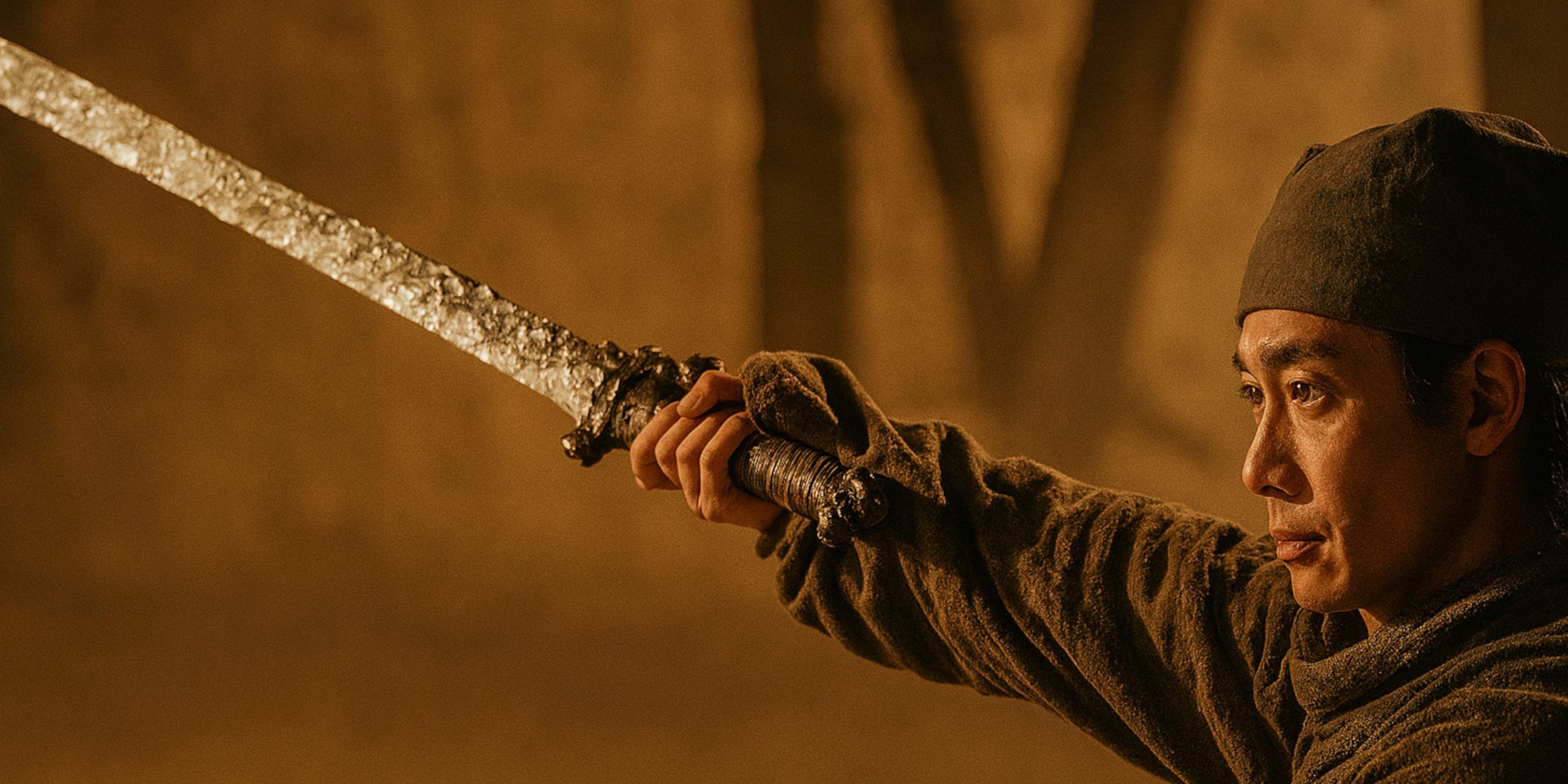
Seven Swords (2005), directed by Tsui Hark, blends wuxia tradition with historical fiction, set in the early Qing Dynasty. At the heart of the story are seven powerful swords, each forged by the reclusive Master Shadow-Glow and wielded by a warrior with a distinct personality and martial style. These weapons are not only unique in construction but symbolically tied to their bearers’ values and fighting philosophies.
Below is a detailed breakdown of each sword, its wielder, design features, and combat style.
1. Dragon (Tian Ren Jian / Heaven’s Fall)
Wielder: Chu Zhaonan
Design: A long, broad blade capable of devastating vertical slashes. Its weight and force are overwhelming.
Combat Use: Best suited for high-impact duels. Chu, a former elite executioner, uses it with fierce precision and heavy swings.
Notable Feature: Emphasises power and ruthlessness. Its shape allows crushing blows, ideal for breaking through armoured opponents.
2. Transience (Qing Gan Jian / Emotionless)
Wielder: Yang Yuncong
Design: Elegant and slender, with a straight, tapering blade ideal for swift, piercing attacks.
Combat Use: Focused on speed and grace. Yang, a skilled martial artist and swordsman, uses it with fluid, dance-like movements.
Notable Feature: Represents restraint and inner peace. It’s a defensive blade with the capacity for counter-attacks and precise thrusts.
3. Unlearnt (Mo Xue Jian / No Learning)
Wielder: Xin Longzi
Design: A short, curved sabre with a single edge, suitable for close-range strikes.
Combat Use: Ideal for agile movements, quick feints, and surprise assaults. Xin favours unconventional tactics and deceptive combat.
Notable Feature: The name suggests mastery through instinct rather than technique. Reflects Xin’s wild and unpredictable style.
4. Celestial Beam (She Shen Jian / Deity’s Light)
Wielder: Mulang
Design: A massive sword with a thick, heavy blade and simple crossguard. Looks unwieldy but can unleash incredible force.
Combat Use: Best for brute strength and raw endurance. Mulang, an ex-slave turned fighter, uses it to block and counterattack with brute impact.
Notable Feature: Symbolises liberation and defiance. It relies more on the wielder’s will than finesse.
5. Heaven’s Wave (Zhan Shui Jian / Flooding Water)
Wielder: Han Zhibang
Design: A long, slender blade with a wave-like pattern etched along its steel. Resembles a jian in form but flexible in use.
Combat Use: Balanced between speed and reach. Han fights with measured rhythm, controlling the battlefield through timing and movement.
Notable Feature: Its form mimics the ebb and flow of water. Emphasises adaptability and tactical positioning.
6. Night Whisper (Yi Hen Jian / Whispering Scar)
Wielder: Wu Yuanying
Design: Double-edged and narrow, crafted for stealth and assassination techniques. Its surface is muted to avoid reflection.
Combat Use: Wu, a skilled female warrior, employs it in shadowed combat, ambushes, and agile manoeuvres.
Notable Feature: Embodies secrecy, vengeance, and internalised pain. The blade is quiet, quick, and lethal.
7. Star Chasers (Ri Yue Jian / Sun and Moon)
Wielder: Fu Qingzhu
Design: Twin swords rather than a single blade. One represents the sun, the other the moon, with complementary shapes.
Combat Use: Used in dual-wielding style, shifting between offence and defence. Fu, a former executioner turned monk, blends technique with restraint.
Notable Feature: Symbolises harmony and duality. The pair allows fluid transitions between attack and retreat.
The Takeaway
The swords in Seven Swords carry philosophical weight, representing the personal journey of its wielder and the broader tension between violence, justice, and redemption. Tsui Hark’s vision gives each sword a distinct identity, grounded in character development rather than fantasy excess.
Together, these swords form a balance of strength, strategy, and symbolism—mirroring the unity of their bearers against tyranny.
Watch the trailer: