The historical Arminius was a Cheruscan aristocrat, a Roman citizen and an equestrian officer. In AD 9, he organised the coalition that destroyed three Roman legions commanded by Publius Quinctilius Varus. He later survived Rome’s campaigns of revenge, fought rival Germanic leaders and was murdered by members of his own extended family.
His victory in the Teutoburg Forest was extraordinary. His political achievements were much less secure. Arminius could destroy an army, but he could not build a lasting state from fiercely independent tribal communities. History is often irritatingly untidy in that way.
Arminius at a Glance
| Detail | Information |
|---|---|
| Born | About 18 or 17 BC |
| People | Cherusci |
| Father | Segimer, a leading Cheruscan aristocrat |
| Roman status | Citizen and member of the equestrian order |
| Roman service | Auxiliary officer, possibly commanding mounted troops |
| Principal enemy | The Roman Empire |
| Greatest victory | Battle of the Teutoburg Forest, AD 9 |
| Wife | Thusnelda |
| Son | Thumelicus |
| Brother | Flavus, who remained loyal to Rome |
| Main rival | Maroboduus of the Marcomanni |
| Died | AD 21 |
| Cause of death | Assassinated by members of his own family |
| Principal ancient sources | Velleius Paterculus, Tacitus, Cassius Dio and Florus |
What Was Arminius’s Real Name?
Arminius is the only name securely recorded in the ancient evidence. It may have been a Romanised form of his original name, or a name adopted when he received Roman citizenship. His birth name, if different, has not survived.
The familiar name Hermann appeared much later. Martin Luther helped popularise the identification during the sixteenth century, partly because the names sounded vaguely similar. There is no ancient evidence that Arminius called himself Hermann.
This matters because the later name carries a great deal of nationalist baggage. Calling him Hermann can quietly turn a first-century Cheruscan nobleman into a nineteenth-century German patriot, which is quite a historical promotion.
Early Life Among the Cherusci
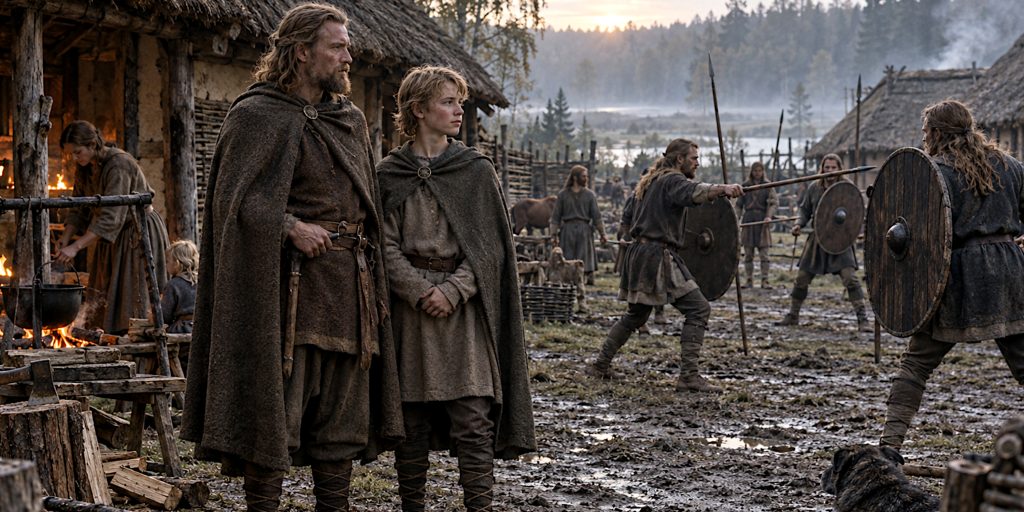
Arminius was born into the Cherusci, a Germanic people living between the Weser and Elbe river systems. Roman authors describe his father, Segimer, as a prince or leading man. These terms should not be mistaken for hereditary kingship in the later medieval sense. Cheruscan politics probably depended upon noble families, assemblies, personal followings and shifting alliances.
Rome expanded deeply into Germania during Arminius’s youth. Drusus campaigned across the Rhine between 12 and 9 BC, while Tiberius continued the work of subduing, negotiating with and recruiting from local communities.
Arminius and his brother Flavus entered Roman service, probably as part of an arrangement between Rome and their family. They are sometimes described as hostages, but the surviving sources do not state this clearly. Rome regularly drew the sons of provincial and allied elites into its military system. It gave them status, education and a personal stake in imperial rule.
Sometimes the arrangement worked beautifully. In the case of Arminius, the return on Rome’s investment was three lost legions.
Arminius in the Roman Army
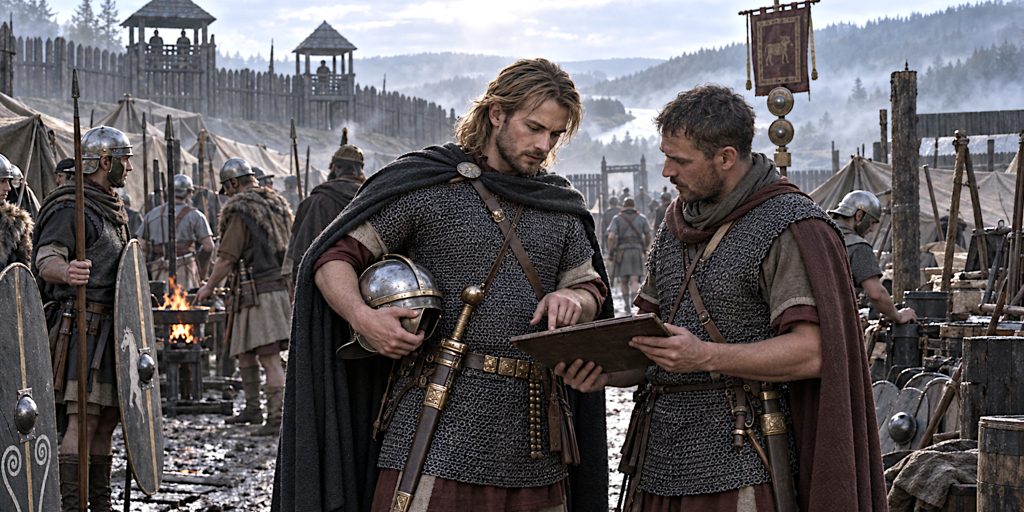
Arminius served with Rome’s auxiliary forces and gained citizenship and equestrian rank. This was not a decorative honour. It placed him within the empire’s privileged order and suggests that Roman commanders considered him capable, useful and loyal.
Velleius Paterculus, a Roman officer who served in Germania during the same broad period, described him as:
“A young man of noble birth, brave in action and alert in mind.”
He added that Arminius possessed an intelligence “beyond the ordinary barbarian”, a phrase that reveals Roman prejudice as clearly as it praises Arminius.
His precise military record is uncertain. He may have served during Roman operations in Pannonia or elsewhere under Tiberius, although the evidence does not permit a detailed reconstruction. What can be said is that he learned how Roman armies marched, camped, communicated and responded to threats.
He also learned how heavily they depended upon order. A Roman legion in formation was brutally effective. A column trapped among woods, wetlands, wagons and frightened civilians was another matter.
Why Did Arminius Turn Against Rome?
No surviving Germanic account explains his motives. Everything comes through Roman writers, each with his own agenda.
Several explanations remain plausible:
- He may have resented Roman taxation, legal control and interference in Cheruscan affairs.
- Roman administration under Varus may have pushed local elites towards rebellion.
- Arminius may have feared that his own family’s power would disappear under permanent Roman rule.
- Personal ambition almost certainly played a part.
- He may have believed that resistance was still possible before Roman control became irreversible.
Arminius should not be turned into a modern freedom fighter. He belonged to a competitive aristocratic world and pursued power within it. Yet dismissing him as merely ambitious is equally unconvincing. Ambition and resistance can occupy the same person without asking permission from later historians.
The Conspiracy Against Varus
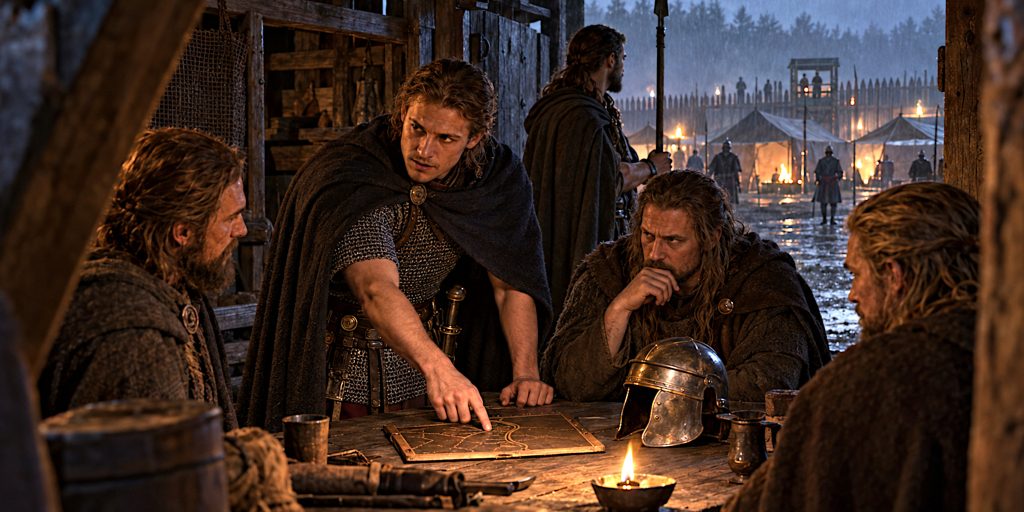
By AD 9, Publius Quinctilius Varus was responsible for Roman authority in Germania. He had previously governed Syria and was accustomed to exercising judicial and administrative power.
Arminius gained Varus’s confidence while secretly organising opposition among several Germanic groups. The exact membership of this coalition remains uncertain, but it probably included elements of the Cherusci, Bructeri, Marsi and other neighbouring peoples.
Not every Cheruscan supported the plan. Segestes, another leading nobleman and the father of Thusnelda, warned Varus that a conspiracy existed. According to Tacitus and Velleius, Varus ignored him.
Cassius Dio described Arminius and his associates as being among Varus’s regular companions. Their familiarity helped make the deception possible. Arminius reportedly persuaded Varus that a local uprising required immediate intervention, then left the Roman column on the pretext of gathering allied forces.
He returned with an army.
The Battle of the Teutoburg Forest
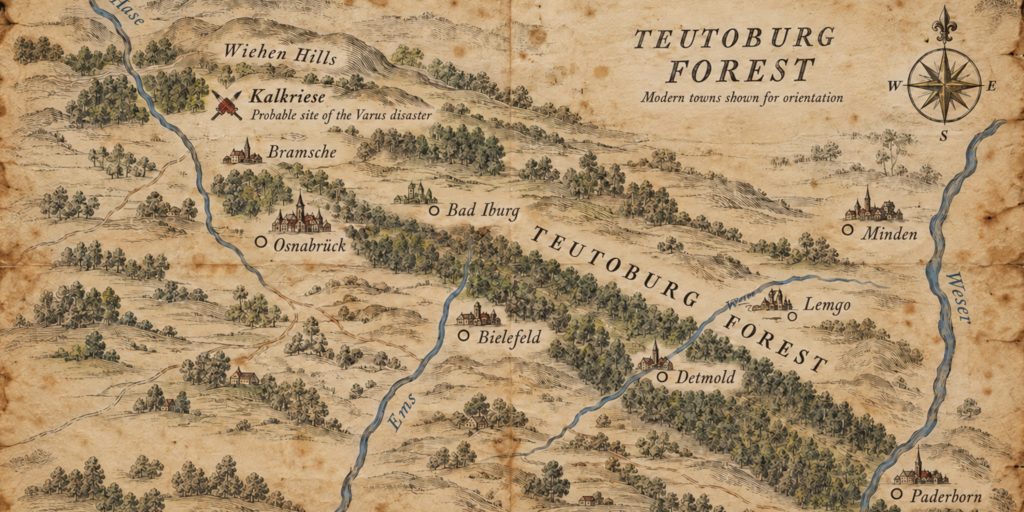
The conventional name suggests one clearly defined battle fought beneath an uninterrupted canopy of trees. The reality was probably a series of ambushes, retreats and defensive actions spread across several days and a considerable distance.
Varus’s army included Legions XVII, XVIII and XIX, six auxiliary cohorts, three cavalry units and an extensive baggage train. Civilians, servants and soldiers’ family members may also have accompanied it. Estimates of the total number of people involved vary considerably, but the fighting force probably numbered between 15,000 and 20,000 men.
Why the Romans Were Vulnerable
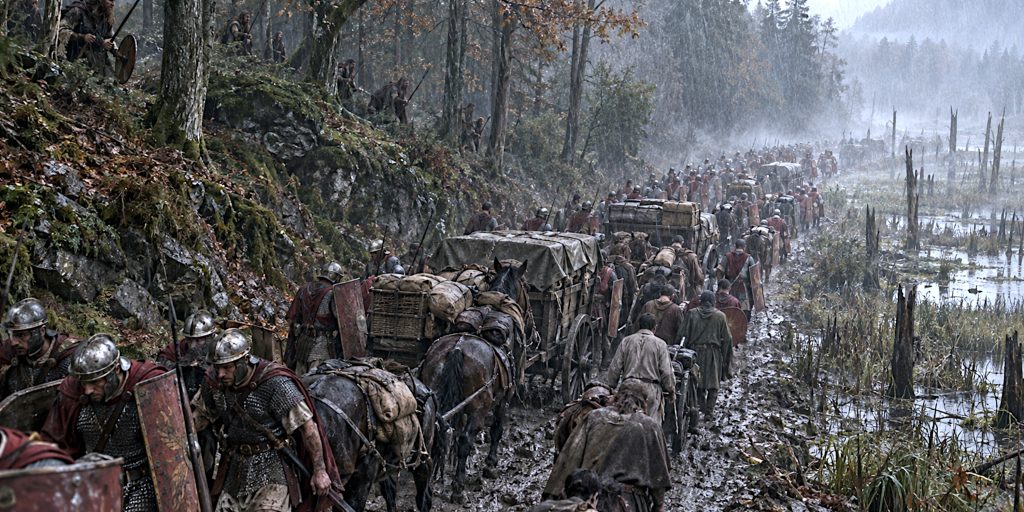
The Roman column was travelling rather than deployed for battle. Its length, baggage and surrounding terrain made coordinated movement difficult.
Arminius exploited several weaknesses:
- The route restricted the Romans’ ability to form a continuous battle line.
- Rain and poor ground affected shields, weapons and movement.
- Germanic warriors could attack isolated sections before withdrawing.
- The baggage train disrupted the marching formation.
- Some auxiliary troops defected or failed to support the legions.
- Varus initially underestimated the scale of the rebellion.
Cassius Dio wrote that the Romans were forced to cut down trees and build roads while facing repeated attacks. He describes wind and rain separating them further and making the ground dangerously slippery.
The account was written about two centuries after the battle, so its dramatic details require caution. Even so, the basic picture is convincing. Arminius prevented the Roman army from fighting the kind of battle it had been trained to win.
The Final Collapse
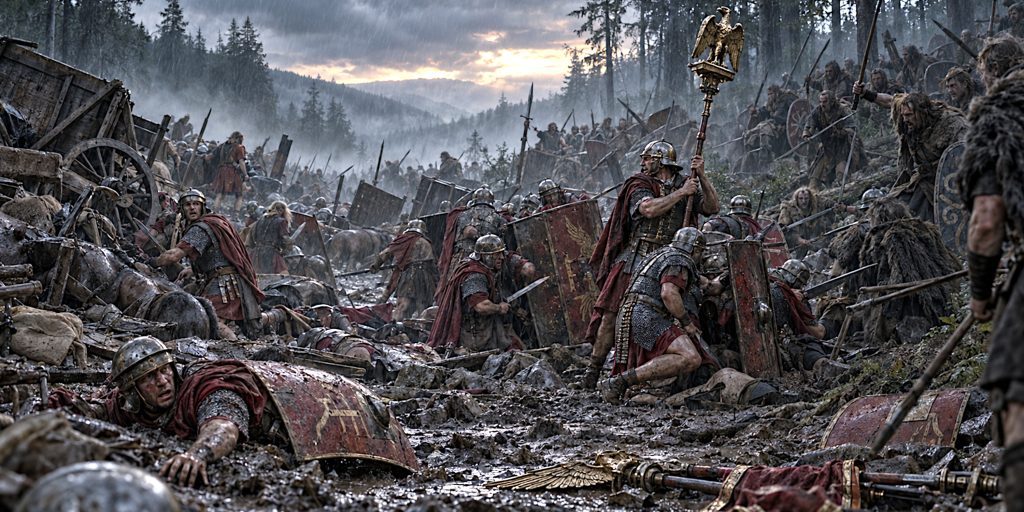
The Romans attempted to establish temporary camps and abandon unnecessary baggage, but their situation continued to deteriorate. Wounded men accumulated, discipline weakened and Germanic forces grew as news of the rebellion spread.
Varus and several senior officers eventually took their own lives. Organised resistance collapsed soon afterwards. Some soldiers were killed while attempting to escape, while others were captured and sacrificed or enslaved.
The legionary standards were seized. The numbers XVII, XVIII and XIX were never used again for Roman legions.
Did Arminius Stop Rome Conquering Germany?
The traditional claim that Arminius permanently stopped Roman expansion at the Rhine is too simple.
Rome did not immediately abandon Germania after AD 9. Tiberius restored stability along the frontier, while Germanicus conducted major campaigns east of the Rhine between AD 14 and 16. Roman forces defeated Germanic armies, recovered two of the lost legionary eagles and revisited the battlefield.
Tacitus describes the soldiers finding:
“Bleaching bones, scattered or in little heaps.”
He also records broken weapons, horse remains and human heads fixed to tree trunks. The passage was written for emotional effect, but it reflects the Roman memory of the defeat as a national trauma.
Germanicus won important battlefield victories, particularly at Idistaviso in AD 16. Arminius was wounded but escaped. Rome therefore retained the ability to invade Germania and defeat large tribal armies.
The eventual decision to limit permanent rule largely to the Rhine was strategic and political. Emperor Tiberius judged that the region could be managed through diplomacy, division and controlled retaliation. The Teutoburg disaster influenced that calculation enormously, but it was not the only reason.
Arminius Against Germanicus
The campaigns of Germanicus reveal that Arminius was more than the architect of a single fortunate ambush.
During the fighting of AD 15 and 16, he repeatedly gathered warriors, resisted Roman advances and survived confrontations with a much larger imperial war machine. Yet he also suffered defeats and struggled to prevent divisions within the Cherusci.
Before one battle, Arminius reportedly confronted his brother Flavus across the River Weser. Flavus had remained in Roman service and had lost an eye while fighting for the empire.
Tacitus presents the brothers arguing over loyalty, family and freedom. Arminius invoked ancestral independence, while Flavus praised Roman rewards and power. Their followers eventually had to restrain them from settling the family disagreement with weapons. It is one of the most revealing scenes in the narrative, even if Tacitus shaped the speeches himself.
The episode shows that the conflict was not simply Romans against Germans. Germanic warriors served Rome, Roman-trained leaders opposed it and families divided over which course offered greater security.
Thusnelda, Segestes and Thumelicus
Arminius’s private life became entangled with Cheruscan politics.
He married Thusnelda, the daughter of Segestes. Tacitus suggests that Arminius abducted her, although she may have willingly chosen him against her father’s wishes. Segestes remained aligned with Rome and opposed his son-in-law.
In AD 15, Segestes handed the pregnant Thusnelda over to Germanicus. She was taken to Rome and displayed in the triumph of Germanicus in AD 17. Her father watched from the audience.
Tacitus admired her composure, noting that she showed no tears and made no appeals for mercy. His account turns her into a dignified symbol of defeated resistance, although her own voice is entirely absent.
Thusnelda gave birth in captivity to a son, Thumelicus. Tacitus says that the boy was raised at Ravenna and later suffered a fate that he intended to describe elsewhere. That section of the Annals has not survived. Later claims that Thumelicus became a gladiator remain speculative.
Arms and Armour
No weapon or piece of equipment can be personally associated with Arminius. His Roman service and later leadership allow only a careful reconstruction of what he may have used.
Equipment Arminius May Have Used in Roman Service
| Item | Likely form and purpose |
|---|---|
| Sword | A gladius suitable for close combat |
| Spear or javelins | Common among auxiliary infantry and cavalry |
| Shield | Depended upon unit type, with oval or flat shields common among auxiliaries |
| Body armour | Mail armour was widely used and more plausible than assigning him one particular legionary cuirass |
| Helmet | An early imperial Roman military helmet appropriate to his unit and rank |
| Horse equipment | Probable if he commanded mounted auxiliaries, though his exact role is uncertain |
Germanic Weapons in the Period
| Weapon | Use |
|---|---|
| Spear | The most widespread Germanic weapon, used for thrusting or throwing |
| Javelin | Useful for disrupting Roman formations before close combat |
| Sword | A prestigious and comparatively uncommon weapon, often influenced by Roman forms |
| Short blade | Utility and secondary weapon, although the later large seax should not be projected casually into AD 9 |
| Shield | Usually wooden, fitted with an iron boss and designed for active defence |
| Bow and sling | Present in Germanic warfare, though less prominent in the surviving accounts |
Germanic warriors were not necessarily almost naked mobs armed with sharpened sticks, despite the enthusiasm of Roman art for presenting them that way. Archaeology reveals access to iron weapons, Roman imports and captured equipment. Wealthier warriors could possess mail, helmets and high-quality swords, while most relied upon spear and shield.
Arminius may have worn Roman equipment, Germanic equipment or a mixture of both. Anyone claiming to know the precise colour of his cloak is enjoying themselves rather more than the evidence permits.
Arminius and Maroboduus
After Rome reduced its major operations east of the Rhine, Arminius turned against Maroboduus, ruler of the Marcomanni.
Maroboduus had created a powerful political and military coalition in Bohemia. He refused to support Arminius after the victory over Varus and later accepted the severed head of Varus before sending it to Rome for burial.
War broke out between their coalitions in AD 17. The resulting battle appears to have been indecisive, although Maroboduus soon lost support and fled into Roman territory. Rome granted him asylum at Ravenna, where he lived for many years.
Arminius had removed a major rival, but he could not convert victory into secure authority.
Death of Arminius
Arminius died in AD 21, aged about 37. Tacitus states that relatives murdered him after he began seeking kingship.
This accusation requires some caution. Roman writers frequently described powerful non-Roman leaders as aspiring kings, particularly when explaining internal opposition to them. Nevertheless, Arminius probably was attempting to turn military prestige into more permanent political authority.
His own coalition resisted him. The man who had united warriors against Varus could not persuade them to accept his supremacy in peacetime.
Tacitus delivered the most famous ancient judgement:
“He was without doubt the liberator of Germany.”
Tacitus also observed that Arminius challenged Rome at the height of its power, fought with mixed results and remained undefeated in the wider war. Coming from a Roman senator, it is a remarkable tribute.
What the Ancient Sources Tell Us
Arminius left no writings. The surviving portrait is entirely Roman.
| Source | Value | Limitations |
|---|---|---|
| Velleius Paterculus | Near-contemporary account by a Roman officer familiar with the German frontier | Hostile to Arminius and eager to defend Roman honour |
| Tacitus | Rich account of Germanicus’s campaigns, Arminius’s family and his legacy | Written about a century later and shaped by literary themes |
| Cassius Dio | Detailed narrative of the ambush and Roman collapse | Written around two centuries after the battle |
| Florus | Preserves the Roman memory of the disaster | Highly rhetorical and compressed |
| Strabo | Provides evidence concerning Thusnelda’s captivity and triumph | Offers little detail about Arminius himself |
The sources agree that Arminius possessed unusual intelligence, status and military ability. They disagree, or remain silent, on many details modern readers would most like to know.
We do not have his version of the rebellion. We have the version written by the empire he defeated.
Archaeology at Kalkriese
Kalkriese, north of Osnabrück in Lower Saxony, is widely regarded as a central location associated with the Varus disaster. Archaeological investigation began in earnest after British officer and amateur archaeologist Tony Clunn discovered Roman coins and sling bullets there in 1987.
Excavations have uncovered thousands of objects, including:
- Roman coins that fit a date around AD 9
- Military fittings and belt components
- Spearheads, arrowheads and sling ammunition
- Fragments of armour
- Tools, medical instruments and personal possessions
- Human and animal remains
- Sections of an earth-and-turf barrier
- A remarkably well-preserved Roman articulated plate cuirass
The distribution of finds suggests intense fighting along a narrow corridor between Kalkriese Hill and areas of wet ground. The barrier may have channelled or obstructed the Roman column, although its precise construction and use remain debated.
Kalkriese probably represents one important phase of the disaster rather than the entire battlefield. The Roman army’s destruction unfolded across a wider landscape, parts of which have yet to be identified conclusively.
The archaeology confirms the presence and violent defeat of a substantial Roman force. It does not reveal where Arminius stood, what orders he gave or whether every dramatic detail in Cassius Dio should be accepted.
Arminius in German Nationalism
Interest in Arminius grew after the rediscovery of Tacitus’s works during the Renaissance. He gradually became Hermann, a symbol of resistance to Rome and later of German unity.
During the nineteenth century, writers and political movements presented him as the founder of the German nation. The Hermannsdenkmal near Detmold, completed in 1875, embodies this interpretation. Its enormous figure faces towards France, holding a raised sword over a newly unified Germany.
The symbolism says more about nineteenth-century Europe than first-century Germania.
Arminius did not lead a German nation. The concept did not exist in his lifetime. He led a temporary coalition drawn from communities with their own interests and rivalries. Some Germanic groups opposed him, while others served Rome.
His image was later used by nationalist and militarist movements, including elements of Nazi propaganda, although his importance under the Third Reich was more complicated and less central than is sometimes claimed.
Modern scholarship has moved away from presenting him as a national founder. He is better understood as an elite frontier figure who operated between Roman and Germanic political worlds.
Where to See Arminius Sites and Artefacts
Museum und Park Kalkriese
The most important destination for understanding the Varus disaster. The museum displays weapons, armour, coins and personal objects recovered from the site. Visitors can also explore part of the battlefield landscape.
Hermannsdenkmal, Detmold
The monumental statue presents Arminius through the lens of nineteenth-century German nationalism. It is historically significant, though not as a reliable visual reconstruction of a Cheruscan commander.
Lippisches Landesmuseum, Detmold
Its collections provide archaeological context for the region and the communities living there during the Roman period.
LVR-RömerMuseum, Xanten
This museum reconstructs life on Rome’s Rhine frontier and helps explain the military system in which Arminius served.
Landesmuseum Hannover
The museum holds archaeological material from Lower Saxony, including objects relevant to Roman and Germanic contact.
How Important Was Arminius?
Arminius deserves recognition as an exceptional military and political operator. He understood both sides of the frontier, deceived an experienced Roman governor and created the conditions in which Rome’s disciplined army became dangerously fragmented.
His later career introduces necessary balance. Germanicus defeated his forces in open battle. His coalition remained unstable. His attempt to dominate regional politics ended in assassination.
Even so, very few enemies of Rome destroyed three complete legions and survived the retaliation. Arminius forced the empire to reconsider the price of holding territory east of the Rhine. He also exposed a recurring weakness in Roman expansion: the system depended upon local allies whose cooperation could never be taken entirely for granted.
His achievement was not the creation of Germany. It was the defeat of Roman rule in a contested frontier region at the moment when that rule seemed close to becoming permanent. That is impressive enough without lending him a nineteenth-century flag.
Frequently Asked Questions
Was Arminius a Roman citizen?
Yes. Velleius Paterculus states that Arminius received Roman citizenship and equestrian rank after serving with Rome’s auxiliary forces.
Was Arminius called Hermann?
There is no ancient evidence for this. Hermann was a much later name associated with him in German cultural and nationalist traditions.
How many Roman legions did Arminius destroy?
Three legions, XVII, XVIII and XIX, were destroyed during the Varus disaster of AD 9. Their numerical titles were never used again.
Did Arminius defeat Germanicus?
Arminius survived Germanicus’s campaigns and preserved resistance east of the Rhine, but Germanicus defeated his forces in major engagements. The wider conflict did not produce a simple battlefield victor.
Where was the Battle of the Teutoburg Forest fought?
Kalkriese in Lower Saxony is widely accepted as a major battlefield location. The disaster probably unfolded over several days and across a broader area.
How did Arminius die?
Members of his own family assassinated him in AD 21, reportedly because they believed he was seeking kingship.
The Seven Swords View
Arminius is most interesting when removed from the patriotic monument. He was neither a simple barbarian rebel nor the founding father of Germany. He was a Roman-trained Cheruscan aristocrat who understood imperial power from the inside and recognised that it could be defeated under the right conditions.
At Teutoburg, he combined deception, intelligence and terrain with ruthless precision. After Teutoburg, he discovered that defeating Rome was easier than governing his allies.
That contradiction gives him a more convincing place in history than the heroic mythology ever could.