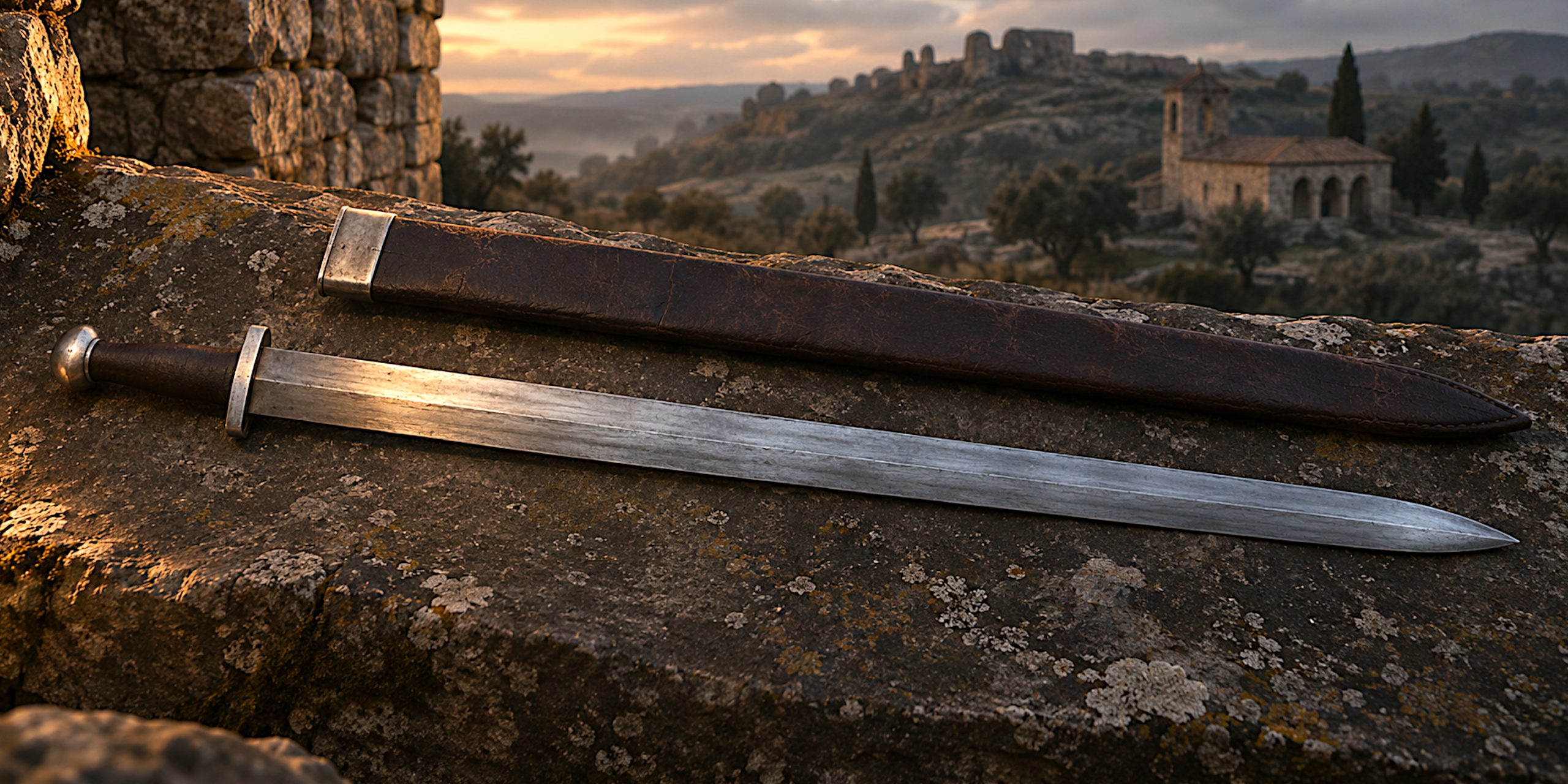
A Visigothic sword belongs to a world in which Roman military traditions survived alongside new kingdoms, shifting loyalties and remarkably persistent habits of warfare. The empire might lose a province. A useful sword design was harder to dislodge.
The weapon usually described as a Visigoth sword was a straight, double-edged, single-handed sword within the broader spatha tradition. However, the term needs care. It does not identify one standard pattern with fixed dimensions or a uniquely Visigothic hilt. Archaeological context matters more than a blade’s resemblance to a modern reconstruction.
One especially valuable example comes from Daganzo de Arriba, near Madrid. Dated to the later fifth or first half of the sixth century, it demonstrates how closely swords from Visigothic contexts remained connected to the weaponry of the late Roman world. Ayuntamiento de Madrid
What Is a Visigoth Sword?

“Visigoth sword” is best understood as a convenient description for swords associated with the Visigoths or recovered from contexts within their kingdoms.
These weapons belonged to a much wider European family. Similar blades circulated across political and cultural boundaries, making it difficult to identify their owners from shape alone.
Three distinctions are useful:
- Spatha describes the broad sword tradition.
- Visigothic-period sword identifies an approximate historical setting.
- Sword from a Visigothic archaeological context connects an object to a documented find.
The last description is generally the most informative. A sword can resemble examples from several regions without proving the ancestry, allegiance or language of its owner.
The Daganzo sword, for instance, is classified as a Straubing/Nydam-type spatha, a designation that places it within a broader archaeological typology rather than an exclusively Visigothic category.
Specification and Physical Characteristics

There is no securely established specification covering every sword used in the Visigothic kingdoms. The following table describes the broader spatha form, with uncertainties made explicit.
| Feature | Characteristics | Qualification |
|---|---|---|
| Weapon type | Single-handed sword | Part of the spatha tradition |
| Blade | Straight and double-edged | Profiles varied between examples |
| Blade outline | Often broadly parallel-sided before the point | Surviving tips may be incomplete |
| Length | Long-bladed, with considerable variation | No reliable Visigothic standard |
| Weight | Cannot be standardised securely | Corrosion and missing fittings distort surviving weights |
| Construction | Ferrous blade, potentially combining iron and steel | Metallurgical examination is needed |
| Grip | Short, intended for one hand | Original organic components often disappear |
| Guard and pommel | Relatively compact fittings | Reconstruction must follow individual evidence |
| Scabbard | Organic body with possible metal fittings | Preservation varies greatly |
For comparison, a sixth-century Merovingian sword in the Metropolitan Museum of Art measures 81.9 cm overall, with a 66.7 cm blade. These are measurements of that surviving object, not a template for Visigothic swords. The Metropolitan Museum of Art
Were Visigothic swords pattern-welded?
Pattern-welding was practised within the wider world of Migration Period swordmaking. It involved forge-welding prepared iron and steel elements into a composite blade, sometimes producing visible patterns.
It should not be assumed for every sword labelled Visigothic. Nor does the presence of a pattern automatically establish exceptional quality. Construction, heat treatment and the condition of the welds all matter.
The State Museum of Prehistory in Halle discusses this craftsmanship through a reconstructed spatha based on a Thuringian burial dated approximately 490–531 CE. It provides a useful contemporary comparison, rather than evidence for a uniform Visigothic manufacturing method.
History and Evolution
The late Roman inheritance
The spatha was already established in Roman military use before the emergence of the Visigothic kingdoms. Initially associated particularly with cavalry, long swords also became important infantry weapons.
Gothic participation in Roman warfare makes a simple division between “Roman” and “Germanic” equipment misleading. Weapons, craftsmen and military experience moved between communities. The Visigoths inherited an existing sword tradition and participated in its continued development.
From Gaul to Hispania
The Visigothic kingdom developed in south-western Gaul during the fifth century. Following defeat by the Franks at Vouillé in 507 CE, its political centre shifted increasingly towards Iberia, with Toledo becoming the royal seat during the sixth century.
This changing geography did not produce an immediate, recognisable national sword pattern. Swords belonged to networks of manufacture, exchange and military service that extended beyond royal frontiers.
The sixth and seventh centuries
The kingdom of Toledo brought together populations with different regional and cultural backgrounds. Its surviving objects reveal connections across the Mediterranean and continental Europe.
Military equipment also extended well beyond swords. Research on Sant Julià de Ramis and Puig Rom, in north-eastern Iberia, identifies early eighth-century assemblages containing spearheads, javelin heads, arrowheads, axes, knives, shield components and horse equipment. A sword-centred picture of Visigothic warfare leaves much of the army outside the frame.
After the conquest
The conquest beginning in 711 CE broke up the Visigothic kingdom over the following years. It did not make existing weapons or metalworking knowledge vanish.
Nevertheless, claims that a particular later Iberian sword descended directly from a distinct “Visigoth sword” require specific evidence. General continuity in straight, double-edged weapons is easier to demonstrate than an uninterrupted lineage between individual types.
Archaeology: What Survives?
The archaeological record is limited partly because burial with weapons was unusual in Visigothic cemeteries. A shortage of excavated swords therefore cannot be treated as a straightforward count of swords used in life.
The Daganzo example came from grave 11, excavated in 1930. Its associated finds included two spearheads. The sword preserves a straight blade, traces of its leather scabbard and silver fittings, although its point and most of its hilt are lost.
This is precisely why individual finds matter. They allow discussion of actual construction and deposition, rather than a composite weapon assembled from attractive features found across several centuries.
Archaeological interpretation must also distinguish between:
- A surviving original component.
- A modern restoration.
- A proposed reconstruction.
- A comparison drawn from another region.
A complete-looking museum sword can contain more reconstruction than a photograph immediately suggests. The label deserves as much attention as the blade.
Advantages and Disadvantages
These are practical implications of the broader spatha design. They should not be mistaken for findings from a surviving Visigothic fencing manual.
Advantages
- Useful reach: A long blade offered greater reach than a short sword or fighting knife.
- Effective cutting geometry: Broad, double-edged blades provided substantial cutting edges.
- One-handed handling: The weapon allowed the other hand to carry a shield or manage reins.
- Versatility: Depending on its point and blade geometry, a spatha could deliver thrusts as well as cuts.
- Adaptability: Variations in hilt fittings and scabbards allowed functional weapons to carry personal or social distinction.
Disadvantages
- Less reach than a spear: A sword did not remove the problem of approaching an opponent armed with a longer weapon.
- Limited hand coverage: Compact guards offered less protection than later enclosed hilts.
- Restricted space: A long blade could be awkward where movement was tightly constrained.
- Dependence on craftsmanship: Poor welds or unsuitable heat treatment could compromise performance.
- Limits against armour: Cutting effectiveness depended heavily on the protection struck, the angle and the force delivered.
Two common criticisms deserve retiring. Organic grips deteriorating after centuries underground tells us little about their usefulness during a warrior’s lifetime. Equally, silver fittings did not automatically turn a serviceable sword into an impractical ornament.
Comparison with Similar Weapons
| Weapon | Relationship to the Visigothic sword | Main distinction |
|---|---|---|
| Late Roman spatha | Closest underlying tradition | Predates and overlaps Visigothic use |
| Merovingian sword | Contemporary European comparison | Regional fittings and burial contexts aid identification |
| Viking Age sword | Later member of the wider European sword tradition | Later hilt typologies and manufacturing developments |
| Seax | Alternative single-edged weapon | Knife-derived form, varying greatly in size |
The boundaries between late Roman and early medieval swords are often less tidy than modern labels imply. A sixth-century Merovingian sword can be a more useful comparison for a Visigothic-period find than a much later Iberian weapon.
Viking Age swords should not automatically be described as heavier or more powerful. Their dimensions and construction varied, and some were imported from the Frankish world.
The seax presents a clearer structural difference: it was single-edged. Surviving examples include fighting and hunting knives, rather than one standard sword-sized weapon.
Legacy and Historical Importance
The importance of the Visigothic sword lies in what it reveals about continuity.
Political authority changed dramatically between the late Roman Empire and the kingdom of Toledo. Weapon design developed within that changing world, drawing on established forms and shared technical knowledge.
There is also a useful caution here. Modern national histories often prefer objects with unmistakable identities. Early medieval swords are rarely so obliging. Their forms can reveal contact and exchange more readily than clear cultural boundaries.
The strongest account of their legacy therefore rests on documented objects, manufacturing evidence and find contexts. Broad claims about a uniquely Visigothic blade shaping every later Spanish sword go beyond what the surviving material can support.
Where to See Visigothic Swords and Related Objects
Check individual display arrangements before travelling, particularly for archaeological ironwork.
| Institution | Relevant material | What to bear in mind |
|---|---|---|
| Museo de San Isidro, Madrid | Daganzo de Arriba spatha, inventory CE1974/124/57 | A documented Visigothic-context example |
| Museo Arqueológico Nacional, Madrid | Visigothic collections, including metalwork and funerary material | Valuable context; check for specific sword displays |
| Metropolitan Museum of Art, New York | Sixth-century Merovingian sword, object 17.191.363 | Comparative example; currently listed as not on view |
| State Museum of Prehistory, Halle | Reconstructed spatha based on the Theißen burial | Comparative Thuringian reconstruction |
The Daganzo sword is documented by Madrid’s municipal museum service. The Museo Arqueológico Nacional’s Visigothic collections provide broader context for the societies that used such weapons. The Met and Halle examples help explain contemporary sword forms without presenting them as Visigothic originals.
Collector’s Guide and Auction Prices
What does “Visigothic” mean in a sale catalogue?
A cultural attribution needs an explanation. A long, corroded, double-edged blade is not securely Visigothic simply because it resembles a published example.
Before buying, ask for:
- Ownership history: Dated records, earlier catalogues, invoices or collection photographs.
- Attribution evidence: The reasoning behind the proposed date and cultural identification.
- Condition report: Details of corrosion, stabilisation, repairs and replacement parts.
- Assembly history: Confirmation of whether the blade, hilt and scabbard fittings originally belonged together.
- Independent assessment: Specialist advice appropriate to the object and its claimed importance.
An auction catalogue is evidence of how an object was described and sold. It is not, by itself, the final archaeological verdict.
Documented auction results
The following are Migration Period comparisons, not securely identified Visigothic swords.
| Auction lot | Sale details | Published result |
|---|---|---|
| Migration Period Pattern-Welded Spatha Sword, lot 341 | TimeLine Auctions, 24 May 2022 | £8,450, including buyer’s premium |
| Migration Period Sword with Gold and Garnet Fittings, lot 340 | TimeLine Auctions, 24 May 2022 | £12,350, including buyer’s premium |
TimeLine’s published results record both prices. The gold-and-garnet lot comprised a blade and a group of fittings, making its composition particularly relevant when comparing values. These are historical sale results, not current valuations.
There is insufficient verified evidence here to support a dependable price range specifically for authentic Visigothic swords. Provenance, preservation, restoration and confidence in attribution can alter value substantially.
Choosing a reproduction
For handling or display, a carefully researched reproduction offers a more accessible route.
Look for a maker who identifies the archaeological basis of the design, explains reconstructed elements and provides clear information about materials and intended use. A label saying “Visigothic” is less useful than a reference to a particular find.
Historical accuracy begins with a source. An ambitious pommel can come later.