Parliament’s thunderbolt in the north
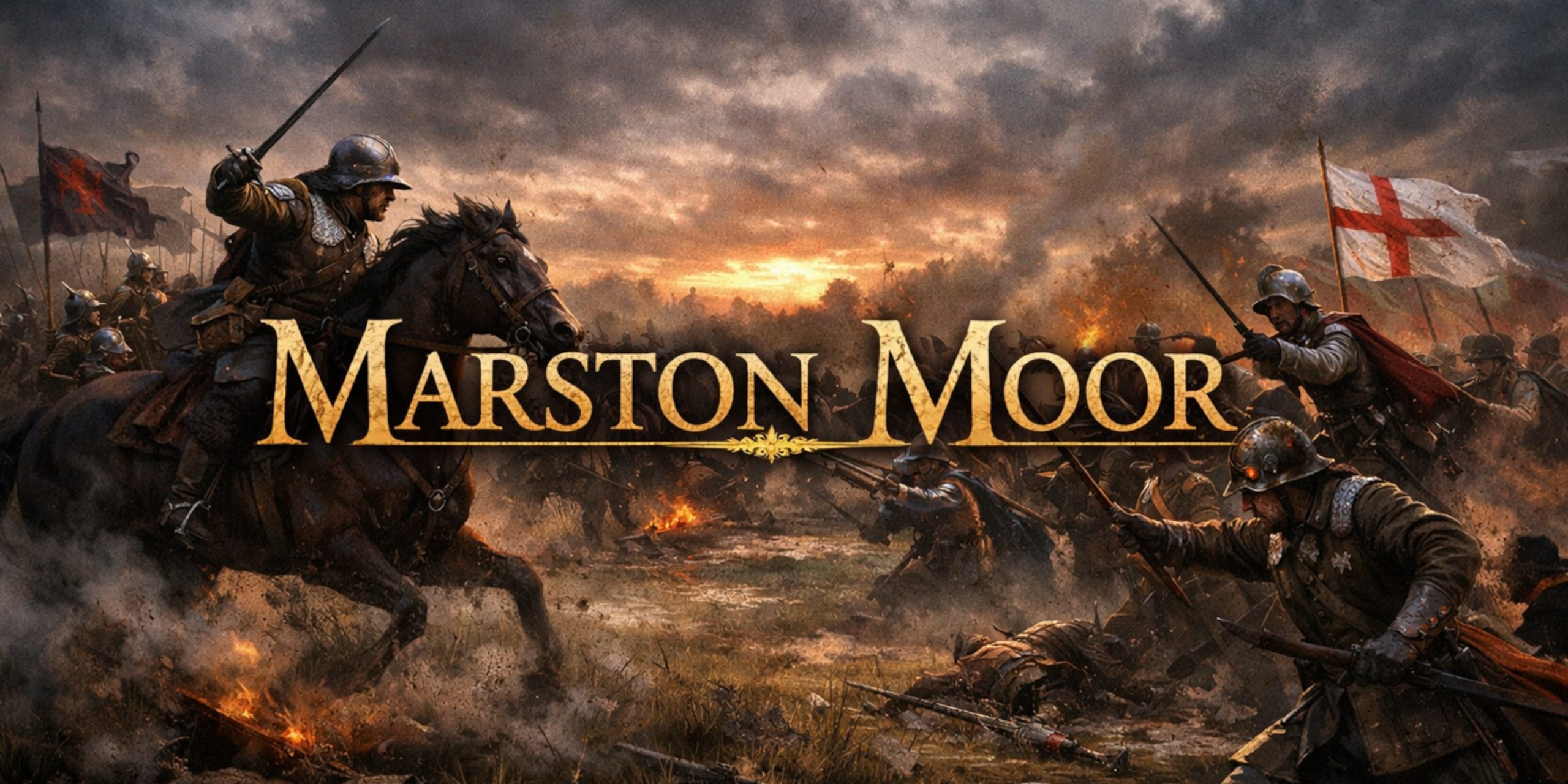
Few battles of the English Civil War carry the sheer drama of Marston Moor. It was fought on a wet summer evening outside York and it ended with the northern Royalist cause shattered in a matter of hours.
The battle is remembered for many things. The largest clash of the Civil Wars. The sudden cavalry charge led by Oliver Cromwell. The moment when the Royalist army of Prince Rupert, widely feared across the kingdom, met a force that could finally beat it in the field.
Standing on Marston Moor today, just west of York, the ground looks deceptively gentle. Fields roll quietly between hedgerows and farm tracks. Yet in July 1644 the same ground was thick with muskets, pikes, cannon smoke and several thousand cavalrymen thundering across the moor. The result changed the balance of the war and removed Royalist power from the north of England.
Background
By 1644 the English Civil War had split the country into competing zones of power.
The Royalists held strong positions in the north, centred on the great city of York. Parliament’s allies, particularly the Scottish Covenanters, had marched south to break this power and link up with Parliamentarian forces operating in Yorkshire.
York became the focal point.
Prince Rupert of the Rhine, nephew of King Charles I and arguably the most aggressive Royalist commander of the war, was ordered to relieve the city. Rupert marched rapidly across northern England and entered York in early July.
His arrival forced the allied armies to lift their siege and fall back onto the open ground of Marston Moor.
What followed was one of the largest and most decisive engagements ever fought on English soil.
Forces
The battle involved a vast combined army. Contemporary accounts suggest between 40,000 and 50,000 men fought that evening.
| Side | Commanders | Estimated Strength |
|---|---|---|
| Parliamentarian and Scottish Covenanter Army | Lord Fairfax, Earl of Manchester, Earl of Leven, Oliver Cromwell | ~27,000 |
| Royalist Army | Prince Rupert of the Rhine, Marquis of Newcastle | ~18,000 |
Composition of the Allied Army
• English Parliamentarian infantry and cavalry
• Scottish Covenanter infantry brigades
• Experienced cavalry under Oliver Cromwell
• Artillery drawn from both English and Scottish forces
Composition of the Royalist Army
• Veteran cavalry under Prince Rupert
• Northern Royalist infantry loyal to the Marquis of Newcastle
• Elite cavalry units known as the “gentlemen troopers”
• Field artillery defending the Royalist line
The Royalist army had an excellent reputation, particularly its cavalry. Rupert’s horsemen had repeatedly routed Parliamentarian forces earlier in the war.
Marston Moor would test that reputation severely.
Leaders and Troop Composition
| Commander | Side | Role |
|---|---|---|
| Prince Rupert of the Rhine | Royalist | Overall commander of the relief army |
| William Cavendish, Marquis of Newcastle | Royalist | Commander of northern Royalist infantry |
| Alexander Leslie, Earl of Leven | Parliamentarian/Scottish | Commander of the allied army |
| Edward Montagu, Earl of Manchester | Parliamentarian | Senior Parliamentarian general |
| Lord Fairfax | Parliamentarian | Yorkshire commander |
| Oliver Cromwell | Parliamentarian | Cavalry commander on the left wing |
Oliver Cromwell’s cavalry would become the most famous element of the battle. His disciplined regiments were already gaining a reputation for order and steadiness in combat.
Rupert’s cavalry, by contrast, was famed for speed and shock. Battles between the two styles were almost inevitable.
Arms and Armour
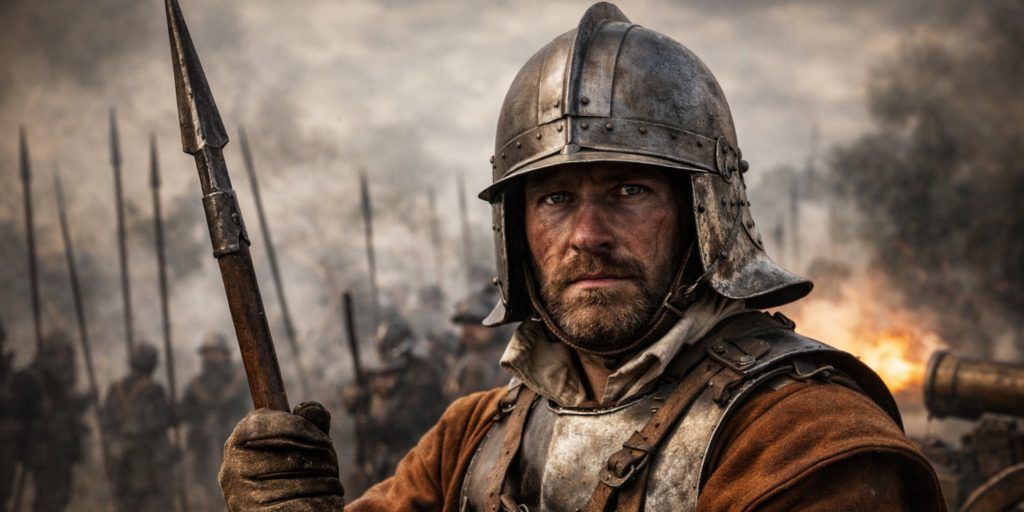
The English Civil War still relied heavily on traditional melee weapons, although firearms increasingly dominated the battlefield.
Infantry Equipment
| Weapon | Description |
|---|---|
| Pike | Long spear roughly 4 to 5 metres used to defend against cavalry |
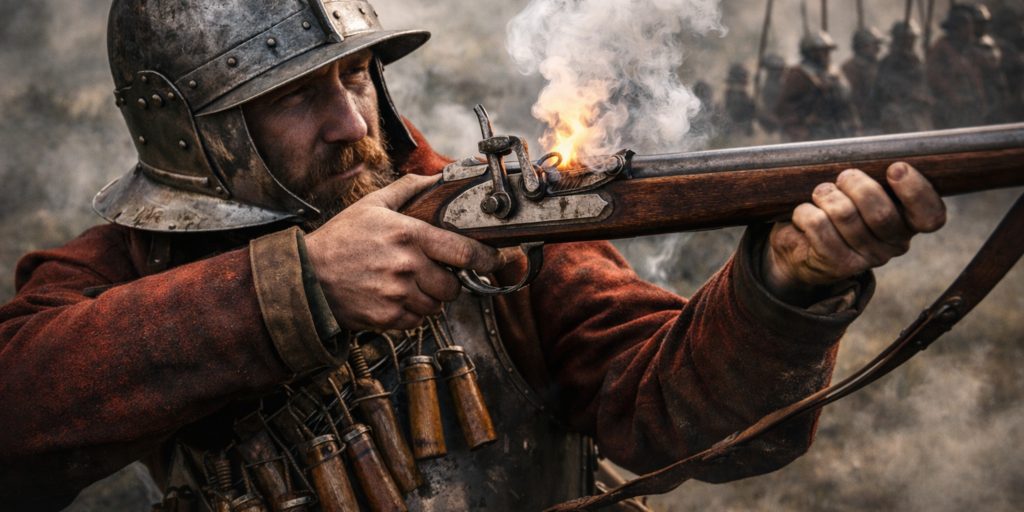
| Matchlock musket | Main firearm of infantry, slow but powerful |
| Basket-hilt broadsword | Common sidearm for officers and infantry |
Cavalry Weapons
| Weapon | Description |
|---|---|
| Backsword | Straight single edged sword suited to mounted combat |
| Mortuary sword | Basket-hilt sword popular with Parliamentarian officers |
| Rapier or cut-and-thrust sword | Sometimes carried by Royalist officers |
| Wheel-lock pistols | Fired at close range during cavalry charges |
Armour
Although armour was declining by this period, many cavalry still wore protective equipment.
• Breastplates and backplates
• Iron helmets such as the lobster pot helmet
• Buff leather coats offering partial protection
• Cavalry gauntlets and riding boots
The Scots infantry on the Parliamentarian side were particularly well equipped with pikes, forming dense defensive formations.
The Battlefield

Marston Moor lies roughly seven miles west of York.
The terrain in 1644 consisted largely of open moorland with patches of hedges and drainage ditches. One such ditch, known as White Syke Ditch, would play a small but notable role during the fighting.
The Royalists formed a defensive line across the moor, placing their artillery forward and infantry behind.
The allied army deployed opposite them but initially hesitated. Both sides spent hours staring across the fields as rain clouds gathered.
Prince Rupert believed the enemy would not attack that evening.
He was mistaken.
The Battle
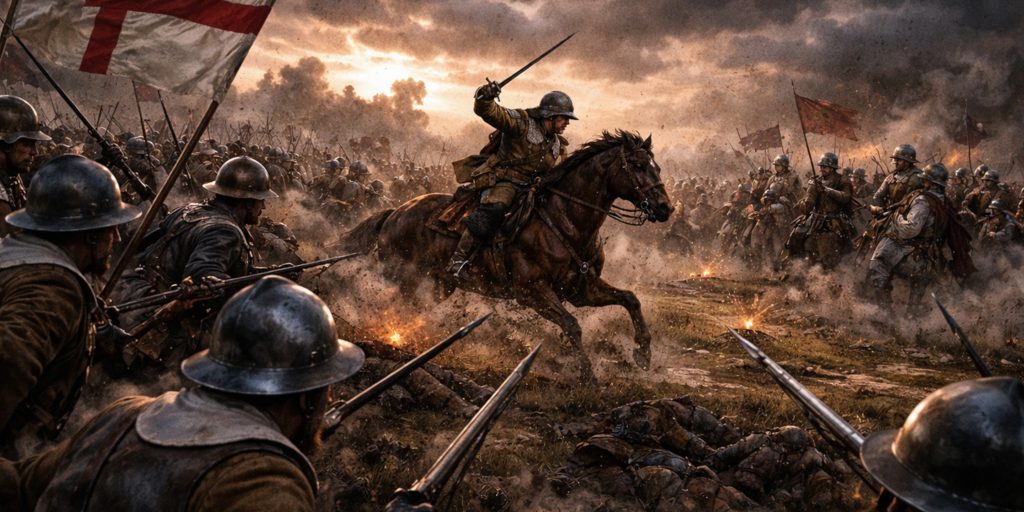
Late in the afternoon of 2 July 1644 the allied army suddenly advanced.
Key Phases
Opening artillery exchange
Cannons opened the battle with a short bombardment. The guns were loud but not especially decisive.
Cromwell’s cavalry attack
On the allied left wing, Oliver Cromwell launched a powerful cavalry charge against the Royalist horse under Lord Byron.
The Parliamentarian cavalry advanced in disciplined ranks rather than scattered gallops. The Royalist line collapsed after heavy fighting.
Royalist success on the opposite flank
Prince Rupert’s cavalry smashed the Parliamentarian right wing. For a moment it looked as if the Royalists might win the day.
This was a familiar pattern in the war. Rupert’s cavalry often charged brilliantly but then pursued fleeing enemies too far.
Cromwell returns to the field
After routing Byron’s cavalry, Cromwell regrouped his men and wheeled across the battlefield.
They struck the Royalist infantry and cavalry from the flank, tipping the battle decisively.
Within a short time the Royalist army disintegrated.
Battle Timeline
| Time | Event |
|---|---|
| Afternoon, 2 July 1644 | Armies deploy across Marston Moor |
| Early evening | Allied artillery opens fire |
| Shortly after | Cromwell launches cavalry charge |
| Mid battle | Royalists break Parliamentarian right wing |
| Later evening | Cromwell reforms cavalry and attacks Royalist centre |
| Nightfall | Royalist army collapses and retreats toward York |
The entire battle lasted only a few hours, though the consequences echoed across England.
Archaeology and the Battlefield Today
Marston Moor remains one of the best known Civil War battlefields in England.
Modern archaeological work has uncovered:
• Musket balls scattered across the fields
• Cannon shot fragments
• Buckles and pieces of military equipment
• Possible locations of artillery lines
Metal detector surveys have helped confirm parts of the battle line described in contemporary sources.
The site is now largely farmland, though several memorial markers identify key locations. The most prominent monument commemorates the Parliamentarian victory.
Standing there today one quickly realises how vast the armies must have looked. Thousands of soldiers advancing across open ground would have been an intimidating sight.
Casualties and Aftermath
Royalist losses were severe.
| Side | Estimated Casualties |
|---|---|
| Royalists | ~4,000 killed, thousands captured |
| Parliamentarians and Allies | ~300 killed |
The Marquis of Newcastle fled England shortly after the defeat, reportedly declaring that the cause in the north was hopeless.
Prince Rupert managed to escape but his aura of invincibility suffered badly.
York soon surrendered, removing the last major Royalist stronghold in northern England.
Contemporary Quotes
Civil War chroniclers left vivid descriptions of the battle.
A Parliamentarian account praised Cromwell’s cavalry discipline:
“The enemy’s horse were utterly broken by Lieutenant General Cromwell.”
Prince Rupert himself reportedly admitted the scale of the defeat, writing that the army had suffered a “very great loss”.
Another contemporary observer wrote of the aftermath:
“The field was covered with arms, armour and dead men, and the moor ran red where the horse had charged.”
It is not the most cheerful description, but Civil War battlefields rarely were.
Legacy
Marston Moor changed the strategic map of the English Civil War.
With the Royalist north destroyed, Parliament gained control of a huge region stretching from Yorkshire to the Scottish border.
The battle also elevated Oliver Cromwell’s reputation dramatically. His cavalry tactics demonstrated the value of discipline over reckless charges, an approach that later shaped the famous New Model Army.
Historians often note that while battles such as Naseby receive greater fame, Marston Moor was arguably just as decisive.
From a northern perspective, it certainly was.
And as someone writing from York, it is hard not to notice that this was the moment when the city ceased to be a Royalist bastion and quietly stepped back into Parliament’s orbit.
Watch the documentary: