Jean-Louis Michel became one of the most celebrated fencing masters of nineteenth-century France. His reputation rests on a long career as a soldier and teacher, the school he established in Montpellier, and a spectacular story about a mass duel in Spain.
That last episode needs careful handling. It made Michel famous, but its details come through later retellings and have been questioned by modern research. The documented career is impressive enough without turning uncertain history into a certain body count.
Early life in Saint-Domingue
Michel was born at Cap-Français, now Cap-Haïtien, on the French colony of Saint-Domingue. His birth year is uncertain. His gravestone gives 1785, while later records point to 1787. The surviving evidence does not settle the matter, so the responsible answer is that he was born sometime in the mid-1780s.
A Montpellier cemetery biography identifies his mother as Adélaïde, a free Black woman, and his father as unknown. The records of his childhood and journey to France are incomplete. Accounts say he arrived in France as a child and entered military service with the 32nd Line Infantry. Precisely who arranged his passage, and what happened to his family, remain unclear.
That uncertainty matters. Michel’s later fame encouraged biographers to tell a neat story of hardship, talent and triumph. The outline is plausible, but some of its details cannot be confirmed.
A soldier who became a fencing master
Michel joined the 32nd Line Infantry as a child of the regiment and served through the Revolutionary and Napoleonic period. His military records list him first as a drummer, then as a drum major. In practice, he also worked as a fencing instructor, eventually becoming master-at-arms.
His military service continued after Napoleon’s fall. He served in the restored French army and later joined the 3rd Regiment of Engineers, which was stationed in Montpellier. He retired from the army in 1829 and made the city his home.
Michel’s career joined two worlds that are sometimes separated in modern accounts: military training and civilian fencing. In his lifetime, learning the sword was useful for officers, soldiers and civilians who might find themselves drawn into a duel. The social ritual of the duel was dangerous; fencing instruction could make it less so, though it could not make the custom sensible.
The Spanish duel: reputation and uncertainty
The most famous story about Michel places him in Spain during the Peninsular War. In the familiar version, a quarrel between French and Italian soldiers escalated until fencing masters from both sides were ordered to fight. Michel supposedly faced a succession of Italian opponents, including the celebrated Giacomo Ferrari, and prevailed through a series of bouts.
The numbers vary between accounts. One version has Michel fighting thirteen men in forty minutes, landing twenty-seven blows, three of them fatal. It is a striking tale. It is also a tale that grew in the telling.
Historian Guy Laurans, writing on the history of fencing in Montpellier, notes that the details do not fit comfortably with the known movements and circumstances of the regiments. The episode survives through later accounts rather than a clear contemporary record. Laurans does not dismiss the possibility that Michel took part in a duel or inter-regimental clash, but concludes that the famous version cannot be treated as established fact.
That distinction does not diminish Michel’s ability. His skill was recognised beyond the story. But the mass duel should be presented as a legend attached to his reputation, not as a verified event.
Montpellier and the salle d’armes
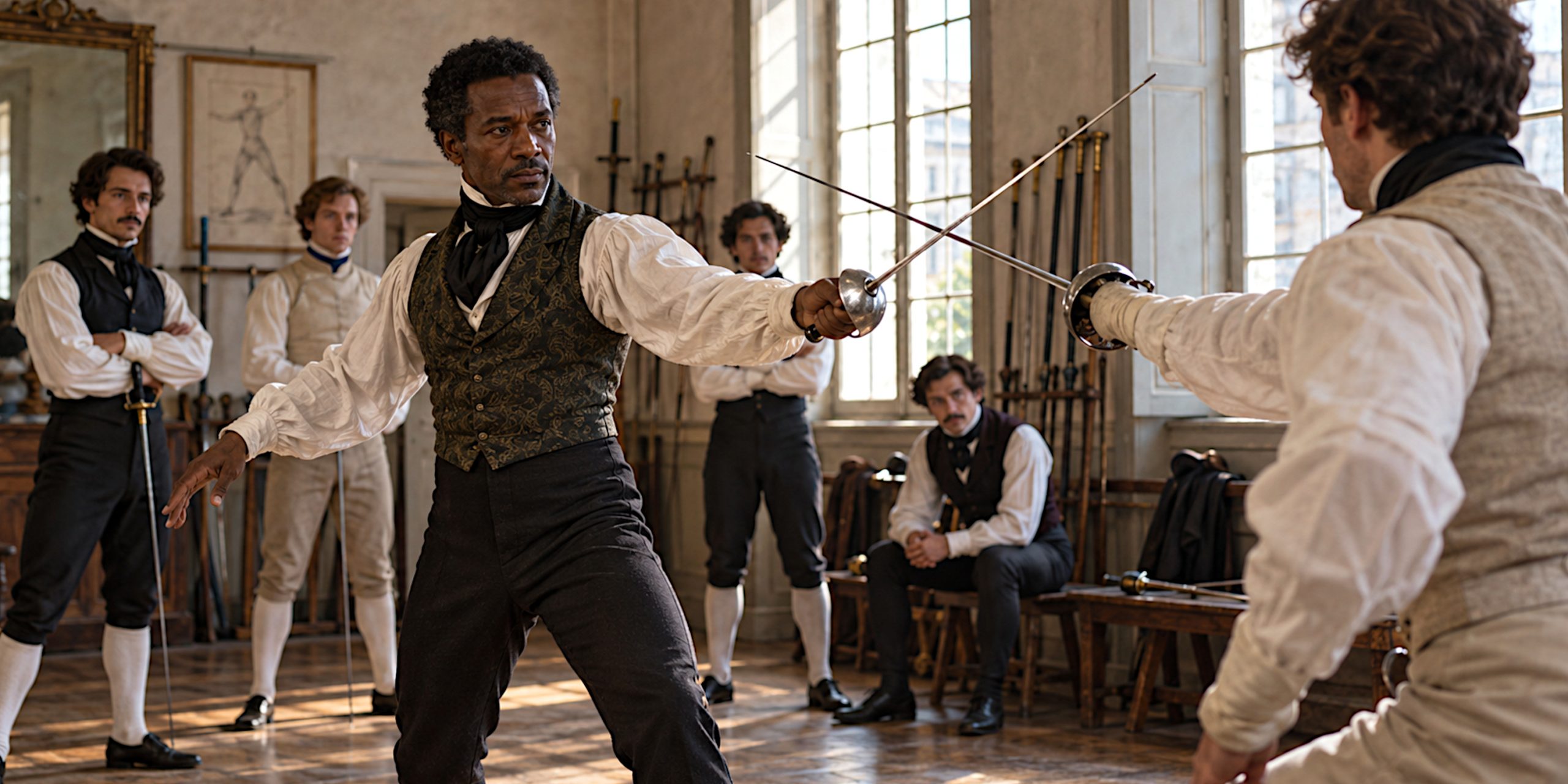
Michel’s most enduring work took place in Montpellier. He opened a salle d’armes, or fencing room, where he taught soldiers and civilians. The school became well known, drawing pupils from beyond the city and helping establish Montpellier as a centre of French fencing.
A certificate awarded to Michel in 1815 gives a glimpse of how fellow masters regarded his teaching. It praised his fencing as “good and agreeable” and said he “can only produce very good pupils.” The endorsement is modest in wording, but it is contemporary evidence of professional respect.
Michel’s school was not a modern sports club. It belonged to a culture in which fencing served practical, social and professional purposes. A lesson could prepare a soldier for military service, a civilian for an encounter of honour, or an aspiring instructor for a career. Michel’s reputation as an arbiter and teacher suggests that his influence extended beyond winning bouts.
A later Montpellier account attributes to him the view that “the duel to the death is a scourge on society” and “fencing is the art of conciliation.” These words suit the role Michel is said to have played in preparing and arbitrating encounters, but they are preserved through later biography rather than a surviving statement in his own hand.
His fencing and its influence
Michel’s importance lies less in a single named technique than in his standing as a teacher and the reach of his school. Pupils and later fencing masters helped carry his reputation forward. The salle continued under successors after his death, and Montpellier fencing traditions later produced prominent competitors.
The original article calls Michel an “Olympic pioneer.” That claim needs narrowing. He died in 1865, decades before fencing appeared at the first modern Olympic Games in 1896. His school formed part of the longer history of French fencing, but the evidence does not show that he directly shaped the Olympic programme or its rules. “Influential fencing master” is a stronger description because it says what the records support.
A life between record and legend
Michel died in Montpellier on 17 November 1865 and was buried at Saint-Lazare cemetery. His life is unusually difficult to reconstruct in places: the birth date is disputed, his early years are obscure, and his most dramatic duel survives in versions shaped by later writers.
The secure outline is still substantial. A boy from Saint-Domingue entered the French army, became a respected master-at-arms and built a celebrated fencing school in Montpellier. His story also shows how a real reputation can gather legend around it. The historian’s job is not to strip away every dramatic detail, but to keep the evidence and the embellishment in view at the same time.
Timeline
| Date | Event |
|---|---|
| c. 1785–1787 | Born at Cap-Français in Saint-Domingue; the exact year is uncertain. |
| 1790s | Arrived in France and entered the 32nd Line Infantry as a child of the regiment, according to later accounts. |
| 1800 | Military records list him as a drummer in the 32nd Line. |
| 1812 | Promoted to drum major; likely serving as a fencing instructor by this stage. |
| 1815 | Received a certificate of merit from fellow fencing masters. |
| 1816 onward | Served with the 3rd Regiment of Engineers, which had a long connection with Montpellier. |
| 1829 | Retired from military service and settled in Montpellier. |
| 1865 | Died in Montpellier on 17 November. |
Further reading
- Guy Laurans on Jean-Louis Michel and Montpellier fencing
- Montpellier cemeteries biography of Jean-Louis Michel