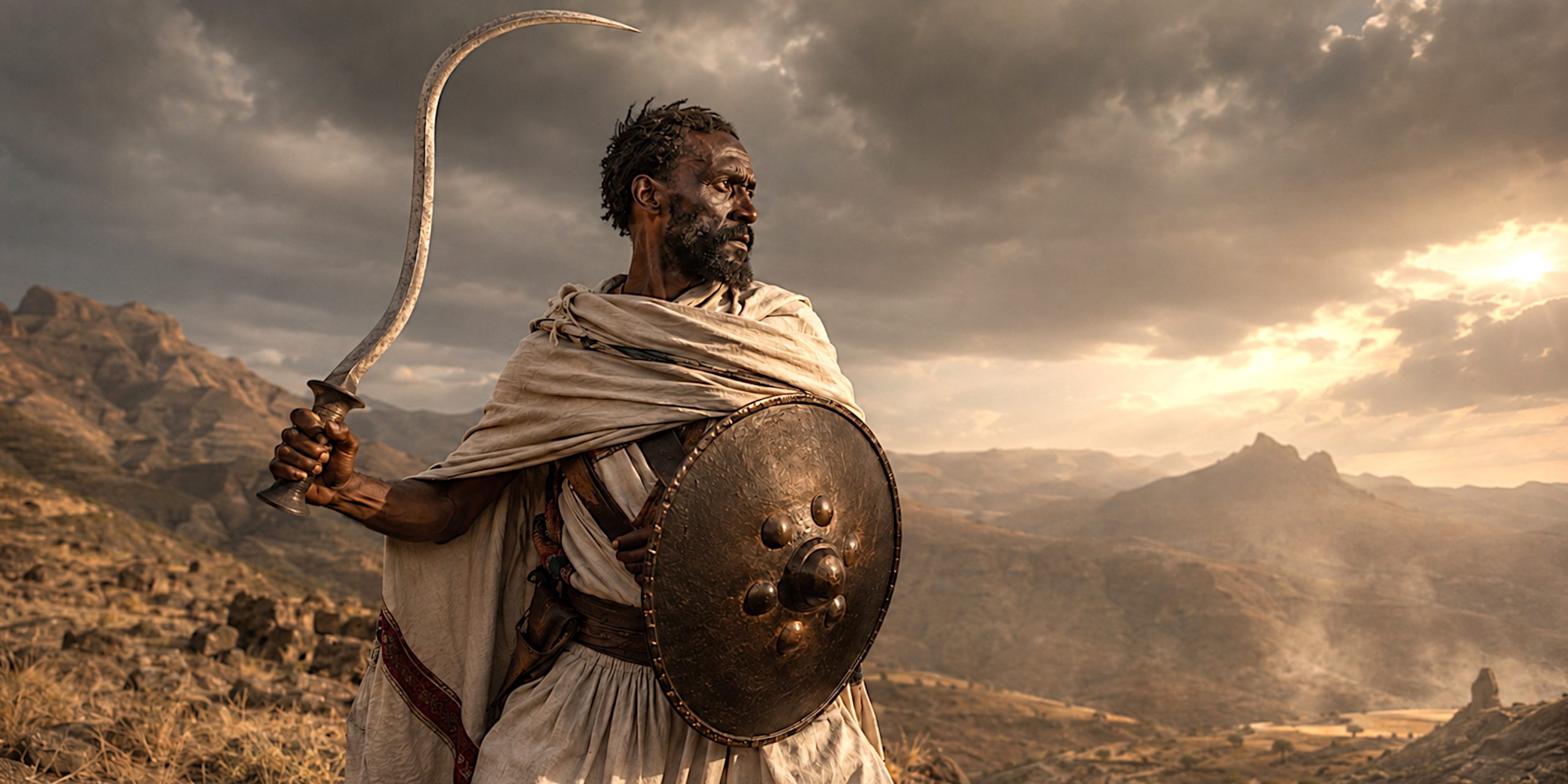
The shotel is one of the most recognisable swords produced in Africa. Its deeply curved blade sometimes approaches a semicircle, giving it the appearance of an agricultural sickle enlarged for war. That resemblance has encouraged some rather imaginative explanations, but the shotel was a carefully forged weapon associated with the northern Ethiopian and Eritrean highlands.
Most surviving examples date from the eighteenth to early twentieth centuries. They vary considerably. Some have severe, almost circular curves and two functional edges; others are gentler, single-edged swords made with imported European blades. Their hilts may be fashioned from wood, horn or, on later pieces, synthetic material. Silver mounts and Amharic inscriptions appear on prestigious examples.
The shotel was both a weapon and a statement of position. European visitors to nineteenth-century Ethiopia observed swords worn by soldiers, nobles and civilians. It could accompany a warrior into battle, complete formal dress or quietly remind everyone at a feast that its owner was not entirely ornamental.
Shotel Specifications
There was no regulated military pattern, so dimensions differ between surviving swords. Modern summaries that assign a single standard length or weight should be treated with caution.
| Feature | Typical characteristics |
|---|---|
| Place of origin | Northern and central Ethiopian highlands, with related traditions in present-day Eritrea |
| Period most commonly encountered | Eighteenth to early twentieth century |
| Overall length | Usually about 75 to 105 cm |
| Blade length | Commonly 60 to 85 cm |
| Weight | Often around 0.8 to 1.5 kg, depending on the blade and fittings |
| Blade form | Strongly curved or sickle-shaped |
| Edges | Frequently double-edged, although single-edged examples survive |
| Cross-section | Flat, ridged or fullered |
| Point | Narrow and acute on many fighting examples |
| Hilt | Wood, horn or later synthetic material |
| Guard | Usually absent |
| Pommel | Broad disc, domed cap or decorative metal fitting |
| Scabbard | Fitted leather sheath, often sharply curved |
| Method of wear | Suspended at the waist, generally on a leather belt |
| Primary actions | Cutting, hooking and thrusting with the inner or outer point |
The most dramatic shotels have a narrow blade curving through almost half a circle. Their scabbards had to follow this unusual profile, producing one of the more awkward sword-and-sheath combinations ever carried with confidence.
Names, Forms and Classification
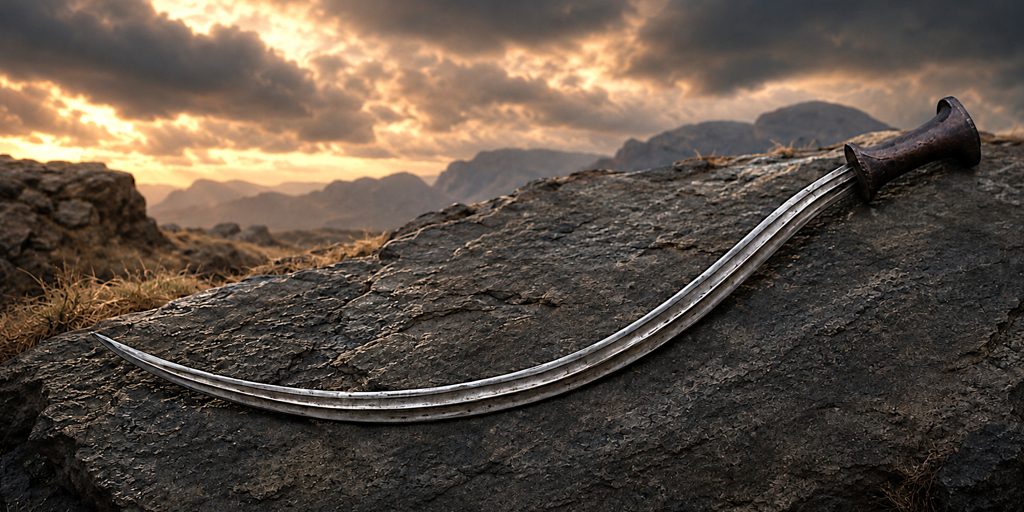
The word shotel is sometimes applied rather casually to almost any Ethiopian curved sword. This creates problems for both historians and collectors.
A useful distinction can be made between:
- Shotel: A deeply curved sword, often double-edged and sickle-shaped.
- Gurade or gorade: A more moderately curved Ethiopian sabre, frequently fitted with an imported European blade.
- Seif: A broader Amharic term for a sword, particularly a straight or conventional double-edged form.
- Ceremonial sword: A weapon made primarily for presentation, court dress or political display, although it may still possess a sharpened blade.
Historic terminology was not perfectly consistent. Dealers now compound the difficulty by using shotel because the name is more familiar and, rather conveniently, more marketable.
The History of the Shotel
Uncertain beginnings
The shotel is frequently described as an ancient weapon inherited directly from the Kingdom of Aksum. That claim is appealing, but the evidence is thin. Ancient and medieval Ethiopia certainly possessed an established metalworking tradition, yet securely dated archaeological shotels from the Aksumite period are lacking.
The weapon’s precise date of development is therefore uncertain. It may have evolved gradually from curved knives, agricultural tools or earlier regional swords. Similarity of shape does not, by itself, prove descent. A sickle-shaped blade can arise independently wherever a smith and customer agree that a more ordinary sword is insufficiently alarming.
Written and visual evidence becomes firmer during the early modern period. By the eighteenth and nineteenth centuries, curved swords were well established in the Ethiopian highlands.
The Gondarine period
Ethiopian religious paintings and manuscripts from the Gondarine period depict nobles, soldiers and biblical figures carrying swords. These images are valuable, although artists were not preparing technical catalogues. Blade shapes can be stylised and some weapons resemble straight seif or kaskara-type swords rather than fully developed shotels.
Nevertheless, the paintings demonstrate the cultural importance of the sword. It could signify rank, military authority, masculine status and royal favour. Swords appear beside shields, spears and firearms, placing them within a mixed military tradition rather than presenting them as the sole weapon of Ethiopian soldiers.
Eighteenth and nineteenth-century warfare
During the Zemene Mesafint, or Era of the Princes, regional rulers competed for control across the Ethiopian highlands. Cavalry, spearmen, swordsmen and increasing numbers of firearm-equipped troops served in armies raised through personal, regional and feudal obligations.
The shotel was used alongside:
- Long spears and lances
- Round hide shields known as gasha
- Straight swords
- Curved sabres
- Matchlock and flintlock firearms
- Imported percussion rifles during the nineteenth century
A swordsman could cut around the side of an opponent’s shield or use the inward curve to hook at the shield, arm or body. This interpretation is mechanically plausible and widely repeated. However, detailed Ethiopian fencing manuals from the period have not survived, so confident claims about a single formalised anti-shield system go beyond the evidence.
The reign of Tewodros II
Emperor Tewodros II, who ruled from 1855 to 1868, attempted to reunify and centralise Ethiopia. Swords remained emblems of authority even as firearms became more important on the battlefield.
Several shotels now held by the British Museum were taken from Maqdala following the British expedition of 1868. Their presence in Britain carries an uncomfortable history. They are not merely examples of African arms manufacture; they are also material evidence of an imperial campaign and the organised dispersal of Ethiopian royal and religious property.
One British Museum sword has a sickle-shaped iron blade, carved wooden hilt and circular pommel. Its provenance connects it directly with Tewodros and the seizure of objects at Maqdala.
Imported blades and changing tastes
European trade had a considerable effect on Ethiopian sword manufacture. Blades from Britain, Germany and elsewhere entered the country during the nineteenth and early twentieth centuries. Some were locally hilted and given Ethiopian scabbards, inscriptions and decorative mounts.
British makers such as Wilkinson supplied blades that could be adapted for Ethiopian patrons. These imported products were generally straighter or less dramatically curved than traditional shotels. The resulting swords are often classified as gurade, although auction descriptions do not always respect the distinction.
Imported blades offered several advantages:
- More consistent industrial steel
- Regular fullering and blade geometry
- Prestige attached to a recognised foreign maker
- Space for etched portraits, inscriptions and imperial symbols
- Easier replacement and standardisation
By the late nineteenth century, the extreme shotel curve was becoming less common in military use. Firearms dominated combat, while European-style sabres and locally mounted trade blades increasingly served as sidearms and status pieces.
Adwa and the twentieth century
At the Battle of Adwa in 1896, Ethiopian forces defeated an invading Italian army. Swords were present, but rifles, artillery, logistics and the scale of Menelik II’s mobilisation decided the campaign. The popular image of sword-wielding warriors overwhelming modern Europeans is stirring but incomplete.
Shotels and gurades continued to appear in ceremonial dress, local warfare and personal arms into the twentieth century. Their military value declined as repeating rifles and machine guns transformed combat. Their symbolic value proved considerably more durable.
How Was the Shotel Used?
A deeply curved shotel permits several possible attacks:
- Draw cuts: The curve keeps the edge in contact with the target as the blade is pulled.
- Hooking attacks: The inner edge or point can reach around a shield or catch a limb.
- Reverse cuts: A change of wrist position brings the inner edge into play.
- Thrusts around a guard: The curved point can approach from an unexpected angle.
- Shield disruption: The blade may be used to pull or turn the rim of a hide shield.
These actions require good control. The curve changes the relationship between hand, edge and point. A movement familiar to someone trained with a straight sword may send the tip of a shotel somewhere quite different. That was useful against an opponent and occasionally educational for the wielder.
The absence of a substantial guard allowed freedom of wrist movement but left the hand exposed. Ethiopian round shields provided the principal defence. A combatant’s survival depended upon coordination between sword, shield, footwork and judgement, not on the blade possessing some mysterious ability to ignore armour.
Advantages of the Shotel
- The severe curve could reach around the edge of a round shield.
- A double-edged blade allowed attacks with either side.
- Its point could be presented from deceptive angles.
- The inward curve was useful for trapping, pulling or controlling.
- Draw cuts concentrated force along a relatively narrow section of edge.
- Its unusual geometry made its movement difficult for an unfamiliar opponent to read.
- It carried considerable social and ceremonial prestige.
Disadvantages of the Shotel
- The extreme curve reduced reach when compared with a straight sword of similar blade length.
- Conventional thrusting was more difficult.
- Drawing the weapon from a close-fitting curved scabbard could be awkward.
- The lack of a guard left the fingers and hand vulnerable.
- It demanded specialised familiarity and careful edge alignment.
- The narrow tip could be damaged if used against hard armour or bone.
- Manufacture and scabbard fitting required more work than for a simple straight blade.
- It was less convenient to wear, especially in confined spaces or on horseback.
- Against firearms, its visual distinction offered remarkably little consolation.
Shotel Compared with Similar Weapons
| Weapon | Region | Blade form | Principal difference |
|---|---|---|---|
| Shotel | Ethiopia and Eritrea | Deeply curved, often double-edged | Designed for cutting, hooking and attacks around a shield |
| Gurade | Ethiopia | Moderately curved sabre blade | Often uses an imported European blade and is less severely curved |
| Shamshir | Persia and neighbouring regions | Deeply curved, usually single-edged | Longer cutting arc but no hooked inner edge |
| Kilij | Ottoman world | Curved single edge, often with a widened yelman | More conventional cavalry sabre optimised for powerful cuts |
| Kopis | Ancient Greece | Forward-curving single-edged blade | Concentrates weight near the tip rather than forming a sickle |
| Falx | Dacia and Thrace | Inward-curving single-edged blade | Usually longer, sometimes two-handed, and designed for forceful chopping |
| Khopesh | Ancient Egypt and Near East | Hooked bronze blade with sharpened outer curve | An ancient bronze weapon with very different construction |
| Kaskara | Sudan, Chad and Eritrea | Straight, double-edged blade | Better suited to direct cuts and thrusts, with a crossguard |
| Mambeli | Central Africa | Curved sickle-like blade | Belongs to separate Central African weapon traditions |
The falx is probably the closest comparison in terms of functional curvature, but it was generally a more forceful chopping weapon. The shotel is lighter, more compact and closely associated with combat using a round shield.
The khopesh comparison is largely visual. The Egyptian weapon was normally sharpened along the convex outer section, while the classic shotel could employ both the inner and outer edges.
Construction and Materials
Traditional shotel blades were forged from iron or steel. Surviving examples may have:
- A pronounced central ridge
- One or more fullers
- Flat blade faces
- Locally engraved lines or geometric decoration
- Amharic inscriptions
- Religious phrases or crosses
- Imported maker’s marks
- Etched imperial symbols
The characteristic hilt lacks a crossguard. It is commonly assembled from several sections, with a waisted grip between broader collar and pommel elements. Historic materials include wood and horn. High-status pieces may carry silver caps, filigree, coins or other metal ornament.
Some nineteenth and early twentieth-century hilts were made from rhinoceros horn. This creates serious ethical and legal issues for modern collectors. Ownership, sale, export and import may be restricted even when a sword is genuinely antique. A vague assurance from a seller that an object is “pre-ban” is not documentation.
Scabbards were usually made from leather shaped around the blade. Decorative tooling, stitching and extended finials are common. Original scabbards add considerably to historical and financial value, but their tight curves also make them vulnerable to splitting, shrinkage and poor repairs.
The Shotel’s Cultural Legacy
The shotel endures as an emblem of Ethiopian martial history. It appears in museum collections, paintings, photographs, family heirlooms and modern representations of highland warriors.
Its legacy includes:
- Association with the Ethiopian imperial court
- Connection with regional nobility and military service
- Representation in Ethiopian religious and historical art
- Survival as a ceremonial and prestige weapon
- Increasing recognition among collectors of African arms
- Debate concerning objects removed during the Maqdala expedition
- Use in games and fantasy art, where the curve is often exaggerated further
The weapon should not be reduced to an exotic curiosity. Its form developed within a military culture where shields remained important, cavalry operated across difficult highland terrain and swords expressed social standing as well as combat readiness.
Nor should every Ethiopian sword be called a shotel. Doing so erases the considerable variety of regional blade forms, local terminology and imported influences.
Where to See a Shotel
British Museum, London
The British Museum holds several Ethiopian shotels, including swords associated with the 1868 expedition to Maqdala. Its online catalogue records their materials and provenance, although individual objects may not always be on public display.
National Museum of Ethiopia, Addis Ababa
The National Museum’s wider collections provide essential context for Ethiopian history, state formation and material culture. Displays can change, so visitors should confirm whether arms are currently exhibited.
Ethnological Museum, Addis Ababa
Located within the former palace of Emperor Haile Selassie at Addis Ababa University, the museum holds extensive ethnographic and imperial material. It is one of the strongest places to understand weapons as part of Ethiopian social life rather than as isolated objects.
Royal Armouries, Leeds
The Royal Armouries holds a broad collection of African arms. Availability on display varies, and advance checking is sensible.
Pitt Rivers Museum, Oxford
The Pitt Rivers Museum possesses a substantial collection of African weapons and related material. Its historic method of display is interesting in its own right, although some older labels require the sort of caution one might extend to any confident Victorian.
Online museum collections
Digital catalogues are valuable for comparing blade curvature, hilt construction and provenance. The British Museum’s Maqdala shotel is particularly useful because its acquisition history is recorded.
Collector’s Guide to Antique Shotels
What to examine
- Blade geometry: Traditional shotels normally have a purposeful, continuous curve rather than an uneven bend.
- Edges: Check whether the blade was made double-edged or has been sharpened recently.
- Fullers and ridges: These should follow the blade consistently and show convincing hand or machine manufacture.
- Hilt construction: Look for age, wear and movement between separate sections.
- Scabbard fit: An original scabbard should correspond closely with the unusual blade profile.
- Inscriptions: Amharic text should be translated before it is used to justify a royal attribution.
- Maker’s marks: Wilkinson and other European markings can be researched, but marks are sometimes copied.
- Provenance: Old collection labels, photographs, invoices and catalogue entries are more useful than family stories repeated without paperwork.
- Condition: Pitting is common. Active rust, cracked horn and failing leather require professional attention.
- Restoration: Replaced grips, shortened blades and newly made scabbards should be disclosed.
- Material legality: Horn must be identified correctly and accompanied by any documentation required for sale or movement.
Warning signs
- Artificially blackened blades combined with bright new scratches
- Modern leather treated to resemble age
- Freshly cut inscriptions
- Perfectly matching “ancient” blade and scabbard with no wear
- Royal or battlefield claims unsupported by documentation
- Sellers who describe every Ethiopian sabre as a rare shotel
- Undocumented rhinoceros horn offered for unrestricted international shipping
- Prices justified entirely by resemblance to an object in a museum
Condition and preservation
Do not polish an antique blade to a mirror finish. Surface oxidation can often be stabilised, but aggressive cleaning removes inscriptions, tool marks and evidence of age.
Leather scabbards should be kept away from excessive heat and low humidity. Organic hilts can split as they dry. Store the sword separately from the scabbard if the leather is damp or chemically unstable, since trapped moisture encourages corrosion.
A qualified arms conservator should handle substantial repairs. Household oil, wire wool and enthusiasm are an unreliable conservation team.
Shotel Auction Prices
Prices vary sharply according to age, condition, curvature, inscriptions, scabbard, provenance and hilt material. The table below uses documented public auction results rather than broad dealer asking prices.
| Description | Auction house | Sale date | Recorded result |
|---|---|---|---|
| Late nineteenth or early twentieth-century shotel, 31-inch recurved blade | Bonhams | 2018 | US$188.80 including premium |
| Mid-nineteenth-century shotel, ridged and fullered blade, horn grip | Auctions Imperial | 2021 | US$275 before stated premium |
| Ethiopian shotel sold with three Arabian jambiyas | Bonhams | 2018 | £600 including premium for the group |
| Early twentieth-century sword, etched blade and rhinoceros-horn hilt | Olympia Auctions | 2019 | £1,000 hammer price |
| Curved nickel-plated blade and decorative mounts | Bonhams | 2013 | £1,250 including premium |
| Extravagantly curved double-edged blade | Bonhams | 2013 | US$1,287 including premium |
| Second half of the nineteenth-century example | Bonhams | 2014 | US$2,106 including premium |
These results show why a single “average shotel price” is not very helpful. Ordinary or damaged examples may sell for a few hundred pounds. Attractive swords with original scabbards generally occupy the middle hundreds to low thousands. Exceptional provenance, decoration or royal associations can take a piece beyond that range.
A sensible working guide is:
| Collector category | Approximate market range |
|---|---|
| Modern decorative reproduction | £75 to £250 |
| Incomplete, damaged or poorly attributed antique example | £200 to £500 |
| Sound nineteenth or early twentieth-century sword | £500 to £1,200 |
| Strong example with original scabbard and decoration | £1,000 to £2,500 |
| Exceptional documented or historically important piece | £2,500 upwards |
Auction premiums, taxes, export permits and shipping charges sit on top of the hammer price. Organic materials may make international transport difficult or impossible. Establish that a sword can be legally purchased and delivered before bidding, not while explaining the situation to customs.
Is a Shotel a Good Sword to Collect?
The shotel is a rewarding field for collectors interested in African arms, Ethiopian history and unusual blade design. Its visual appeal is obvious, while the variation between locally forged, imported and ceremonial examples leaves considerable room for study.
It is not an ideal purchase for someone who wants an easy, standardised collecting category. Terminology is inconsistent, provenance can be weak and horn identification presents legal complications. Yet those difficulties are also why careful research matters.
The best purchase is rarely the sword with the most elaborate sales description. Look instead for coherent construction, honest condition, a credible date and paperwork that existed before the auction catalogue required something exciting to say.
Takeaway
The shotel’s shape encourages extravagant claims. It is regularly described as an ancient armour-piercing weapon capable of reaching magically around any shield. The historical reality is more interesting.
This was a specialised sword from the Ethiopian and Eritrean highlands, designed within a culture of round shields, close combat, mounted movement and personal military display. Its deep curve offered genuine tactical possibilities, but also imposed awkward handling and reduced reach. It demanded skill rather than supplying it.
By the nineteenth century, the shotel stood at the meeting point of local craftsmanship and international trade. Traditional forms survived beside imported European blades, firearms and changing military organisation. That combination makes the weapon valuable to historians. It reveals adaptation without surrendering identity, which is rather more impressive than simply having a memorable silhouette.