A medieval commander could possess an excellent sword, an impressive pedigree and enough confidence to alarm everyone around him, yet still lose an army before lunchtime. Courage mattered. Knowing where to find water usually mattered more.
The greatest medieval commanders understood the relationship between fighting and everything that made fighting possible: supplies, intelligence, discipline, political loyalty and the willingness of exhausted people to keep moving.
Saladin, Richard the Lionheart, Subutai, Robert the Bruce and Edward the Black Prince approached these problems in different ways. Their careers offer five revealing studies in command, spanning the crusading eastern Mediterranean, the Eurasian steppe, Scotland and France.
This is a comparative selection rather than a definitive world ranking. Medieval warfare covers too many centuries and military cultures for any short list to settle the matter honestly. What interests me is how these commanders won, what their victories achieved and where their reputations need a little less polishing.
What Made a Great Medieval Commander?
Winning a battle is evidence of ability, but it is an incomplete measure. An excellent position could be inherited. An opponent could make a spectacular mistake. A victorious army might emerge too damaged to continue its campaign.
A more useful assessment considers several connected qualities:
- Battlefield judgement: choosing positions, committing reserves and recognising when an opportunity had passed.
- Campaign management: moving, supplying and preserving an army over weeks or months.
- Adaptability: responding to different enemies, landscapes and forms of warfare.
- Leadership: maintaining cooperation among contingents with competing interests.
- Strategic results: turning military success into something that lasted.
Military effectiveness also deserves to be distinguished from moral admiration. These commanders operated in societies where devastation, enslavement and the killing of prisoners could serve deliberate military purposes. Their skill does not make those consequences incidental.
The Commanders at a Glance
| Commander | Principal theatre | Defining achievement | Particular strength | Important qualification |
|---|---|---|---|---|
| Saladin, c. 1137/1138–1193 | Egypt, Syria and the Levant | Hattin and the recovery of Jerusalem, 1187 | Coalition building and sustained pressure | His campaigns also included defeats and failed sieges |
| Richard I, 1157–1199 | France and the eastern Mediterranean | Arsuf, 1191, and the defence of Jaffa, 1192 | Combined arms and leadership under pressure | Jerusalem remained beyond his grasp |
| Subutai, c. 1175/1176–1248 | Central Asia, Rus’ and Central Europe | Major roles at the Kalka River and Mohi | Reconnaissance and operational manoeuvre | Credit must be shared with other Mongol commanders |
| Robert the Bruce, 1274–1329 | Scotland and northern England | Bannockburn, 1314 | Recovery from defeat and disciplined use of terrain | Independence required years of further warfare |
| Edward the Black Prince, 1330–1376 | France and Iberia | Poitiers, 1356 | Tactical coordination and counterattack | Battlefield victories did not guarantee stable government |
Saladin: Building the Coalition That Won at Hattin

Saladin’s greatest achievement began before his army reached Hattin. He established a power base across Egypt and much of Syria, bringing substantial resources into a struggle previously weakened by rival Muslim dynasties and competing ambitions.
That political work made his military opportunities possible.
At Hattin on 4 July 1187, Saladin exploited the Frankish army’s movement away from reliable water. Harassment slowed its progress, heat exhausted men and horses, and pressure prevented an orderly recovery. The eventual collapse was the culmination of worsening conditions rather than a single irresistible charge. Accounts disagree over details, but thirst and the breakdown of cohesion are central to the surviving narratives.
The victory opened the way to the recovery of Jerusalem later that year. Yet Saladin’s reputation for generosity needs qualification. The city avoided the mass slaughter associated with its capture in 1099, but surrender involved ransom, and some inhabitants who could not secure their freedom were enslaved.
Nor was Saladin invincible. Richard defeated his army at Arsuf, and the Third Crusade preserved a substantial Frankish coastal presence.
My assessment: Saladin belongs here because he connected political consolidation with decisive military opportunity. His achievement was larger than Hattin, although Hattin made it visible.
Richard the Lionheart: Discipline Behind the Reputation

Richard’s personal bravery has received so much attention that his practical competence sometimes disappears behind it.
During the march south from Acre in 1191, his army needed to withstand persistent attacks while keeping its infantry, cavalry and baggage together. The coast offered access to naval support, while careful marching arrangements helped protect the horses on which the army’s striking power depended.
At Arsuf on 7 September, Richard’s forces survived sustained pressure and delivered cavalry counterattacks that drove Saladin’s army from the field. The action was less tidily controlled than later heroic accounts can suggest. The Hospitallers’ initial charge forced a response, and Richard’s achievement included exploiting a developing situation rather than executing an entirely obedient plan.
His intervention at Jaffa in 1192 demonstrated the same capacity for rapid action. Nevertheless, Jerusalem remained in Saladin’s hands. Richard’s reluctance to undertake an operation his army might struggle to sustain deserves serious consideration. Capturing a city and holding it were separate problems, however inconvenient that distinction proved for crusading expectations.
His record also includes the killing of Muslim prisoners outside Acre. Tactical competence should not be allowed to soften that decision.
My assessment: Richard was an unusually effective battlefield commander whose reputation for aggression can obscure his understanding of restraint.
Subutai: Campaigning Across Continents

Subutai presents a different kind of command problem. His campaigns unfolded across distances that make most western European operations look rather local.
Working within the Mongol military system, he helped combine reconnaissance, widely separated movements, mounted archery and concentrated attacks. With Jebe, he played a leading role in the campaign culminating in the defeat of a Rus’ and Cuman coalition at the Kalka River in 1223.
At Mohi in Hungary in April 1241, Subutai and Batu helped overcome an army positioned near the Sajó River. Operations against the principal crossing, combined with an additional crossing elsewhere, placed the Hungarian force under pressure from different directions. The surviving evidence does not justify treating every movement as precisely reconstructable.
Subutai’s strength lay in making movement serve a larger purpose. Withdrawal could invite pursuit. Separate columns could confuse an opponent before concentrating. Intelligence gathered during one expedition could support later conquest.
He did not invent these methods, and he did not command alone. Mongol success depended on experienced officers, disciplined troops, remounts, communications and expertise drawn from conquered populations.
The destruction accompanying these campaigns also belongs in the assessment. Operational sophistication could produce appalling human consequences.
My assessment: Among these five, Subutai has the strongest claim for the scale and complexity of his campaign planning.
Robert the Bruce: Learning How to Survive

Bruce’s career is particularly instructive because it began with serious reverses. His later success grew from adaptation, political persistence and an increasingly careful approach to military risk.
By 1314, he had recovered control over much of Scotland and reduced the English network of strongholds. The siege of Stirling Castle created the circumstances that brought Edward II north with a larger army.
At Bannockburn on 23 and 24 June, Bruce’s soldiers made effective use of close formations of spearmen, conventionally called schiltrons. These were disciplined bodies capable of movement. Their effectiveness depended on cohesion and leadership as much as the length of their weapons.
Terrain restricted English deployment and helped turn numerical strength into congestion. However, the familiar image of an entire army obligingly charging into a swamp is too simple. The relationship between the fighting, waterways, roads and available ground remains a subject of historical and archaeological investigation.
Bruce’s achievement also belonged to subordinate commanders, including Thomas Randolph, whose men checked an English cavalry movement on the first day.
My assessment: Bruce’s distinction lies in recovery. He learned how to preserve a vulnerable cause, then recognised when his army could risk a decisive battle.
Edward the Black Prince: Victory and Its Limits

Edward of Woodstock’s reputation rests most securely on Poitiers in 1356, where his army defeated the French and captured King John II.
His forces combined archers with men-at-arms, used the available ground and maintained enough cohesion to turn defensive resistance into counterattack. He benefited from experienced officers and a military tradition already developing under Edward III.
He did not invent English longbow tactics. Giving him that distinction removes the experience of earlier campaigns and the contribution of the soldiers who made the system work.
His victory at Nájera in 1367 further demonstrated his battlefield ability. Yet his subsequent difficulties in Aquitaine show how limited victory could be as a foundation for government. Financial pressure, political hostility and serious illness eroded his position.
His destructive raids also require attention. The chevauchée attacked an enemy’s resources and authority by devastating the countryside. For those living along its route, the distinction between strategic pressure and catastrophe was understandably slight.
My assessment: The Black Prince was an outstanding war captain. His career is less convincing as evidence that tactical brilliance naturally produces successful rule.
Arms and Armour: The Weapons Behind Their Armies
These commanders operated across more than two centuries and several military cultures. Their equipment should reflect those differences.
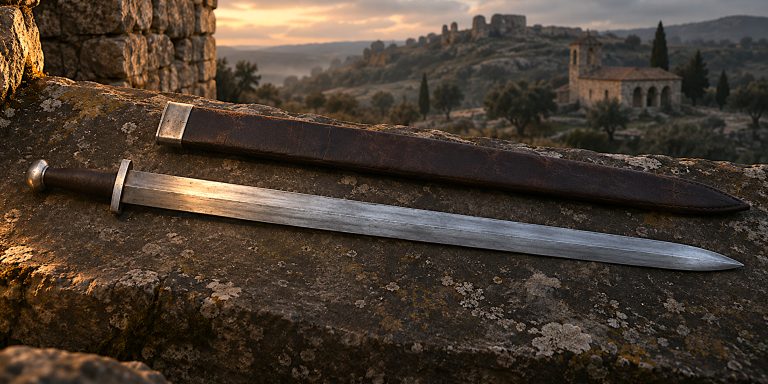
The sword types below describe weapons appropriate to their armies and periods. They are not securely identified personal swords belonging to each commander. Oakeshott classifications are modern tools for describing European blades, rather than names medieval soldiers used.
| Commander and army | Specific sword types appropriate to the period | Other important weapons | Typical protection |
|---|---|---|---|
| Saladin’s Ayyubid forces | Straight, double-edged Islamic swords, alongside curved sabres among some mounted contingents | Composite bows, lances, spears and maces | Mail, helmets and some lamellar protection, varying by contingent and wealth |
| Richard’s crusading army | Single-handed cruciform swords, including blades broadly corresponding to Oakeshott Types XI and XII | Cavalry lances, crossbows and infantry spears | Mail hauberks, coifs, helmets, padded garments and shields |
| Subutai’s Mongol forces | Single-edged steppe sabres with modest curvature; equipment varied across the expanding empire | Composite bows, lances and maces | Lamellar armour among better-equipped troops; lighter protection among others |
| Bruce’s Scottish army | Single-handed arming swords of Types XII, XIIIb and XIV; larger war swords also existed | Long infantry spears, axes and bows | Padded armour, mail and helmets, with additional plate protection among wealthier men |
| The Black Prince’s Anglo-Gascon army | Arming swords and longer swords, including Types XIV, XV and XVI | Longbows, lances, spears and daggers | Bascinets, mail aventails, coats of plates and increasing limb protection |
Surviving weapons support a more varied picture than the usual visual shorthand. An auction-catalogued Fatimid or Ayyubid example has a straight, double-edged blade. Saladin’s army should therefore not be illustrated as though every soldier carried an exaggerated curved scimitar.
For Mongol forces, the Royal Armouries identifies the composite bow, lamellar armour and single-edged swords as important elements of their equipment, while stressing the scarcity of surviving objects from the conquest period.
European museum collections also demonstrate the coexistence of different sword forms. Château de Penne’s collection includes a Type XVI sword dated approximately 1300–1350 and a larger Type XIIa/XIIIa war sword of the same broad period. Equipment developed unevenly, rather than changing everywhere on a convenient anniversary.
Swords mattered as weapons, possessions and symbols of authority. Nevertheless, the formations of spears, bows and lances usually explain these victories more effectively than any commander’s individual blade.
Contemporary Voices: What the Sources Actually Say
Medieval quotations need context. Chroniclers reconstructed speeches, praised patrons and interpreted defeat through religious or political loyalties. A passage can reveal contemporary attitudes without preserving anyone’s exact spoken words.
In the account known as De Expugnatione Terrae Sanctae per Saladinum, Raymond of Tripoli is represented warning before Hattin:
“We and the King, however, should not move away from water, food, and other necessities”
The speech is a literary reconstruction, but its concern is practical and entirely relevant to the disaster that followed.
Chandos Herald, writing in the later fourteenth century, praised the Black Prince as:
“the perfect root of all honour and nobleness, of wisdom, valour and largesse”
This tells us something about the prince’s cultivated reputation. It also tells us that his biographer was unlikely to submit a particularly hostile performance review.
For material detail, the thirteenth-century traveller John of Plano Carpini described Mongol armour construction:
“They make a strap out of these plates and then join them together to make sections of armour”
Such observations help explain how military equipment worked. They provide a useful counterweight to chronicles preoccupied with kings, divine favour and magnificent deaths.
Archaeology: Testing the Stories Against the Ground
Archaeology rarely produces a complete medieval battle plan. It can, however, challenge the confidence with which one has been drawn.
Bannockburn offers a particularly useful example. The Bannockburn 700 project recovered and assessed more than 5,000 artefacts. A study published in 2025 identified three attributable to the fourteenth century, presenting them as the clearest archaeological evidence yet found for the location of part of the battle. That is a significant advance, though it does not settle the position of every formation or reconstruct both days of fighting.
The small number of relevant finds also illustrates the difficulty of battlefield research. Weapons were recovered, valuable equipment was stripped, iron corroded and later development altered the landscape.
Surviving objects require a different caution. The Black Prince’s funeral achievements include a helm, shield, jupon, gauntlets and sword scabbard. They illuminate aristocratic display and commemoration, but their survival does not establish that each object was worn or carried at Poitiers.
Human remains reveal another side of command. Towton, fought in 1461, lies beyond these five careers, but its excavated mass grave provides an important comparison. It reminds us that a battlefield was a place of bodily injury and death before it became a diagram of arrows and distinguished surnames. Historic England identifies the grave as the first battlefield mass burial subjected to controlled archaeological excavation.
The strongest interpretations bring chronicles, objects, landscape and excavation together. None can answer every question alone.
Who Was the Greatest Medieval Commander?
Among these five, Subutai has the strongest claim for operational reach, while Saladin stands out for connecting coalition building with strategic success.
Richard was exceptional at maintaining fighting effectiveness under pressure. Bruce demonstrated an unusually impressive capacity to recover from weakness and build towards a favourable confrontation. The Black Prince’s victories show the power of experienced troops, coordinated weapons and sound tactical judgement.
I find Bruce’s career especially revealing because it makes room for learning. Subutai’s campaigns remain the most remarkable in scale. Saladin’s achievements are difficult to separate from the political structure that sustained them.
A single winner would conceal those differences. Their careers become more interesting when we ask what each commander understood, what resources made his decisions possible and what happened after the celebrated victory.
The people who supplied the horses, held the spears and carried the wounded deserve a place in that answer too.