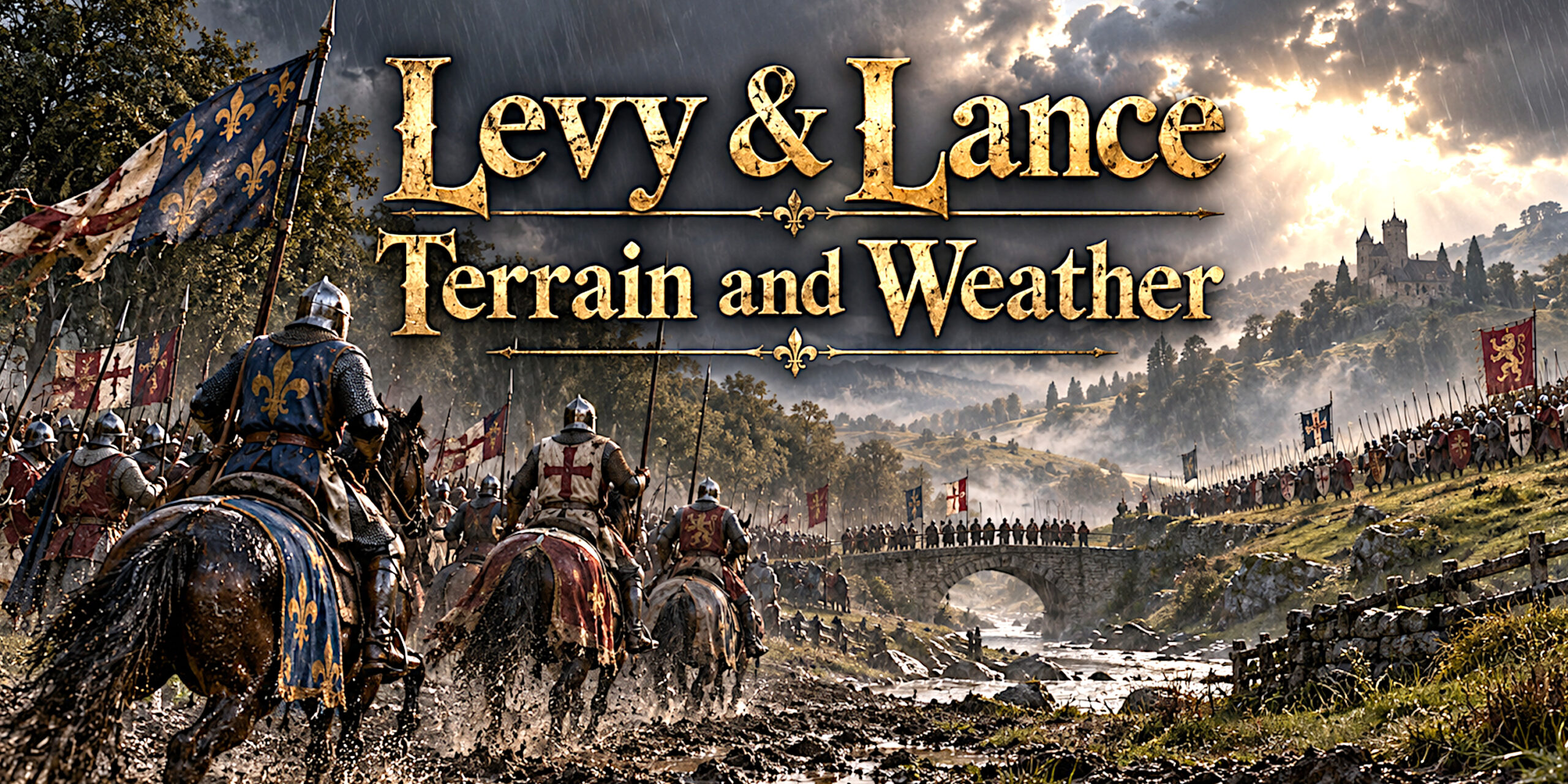
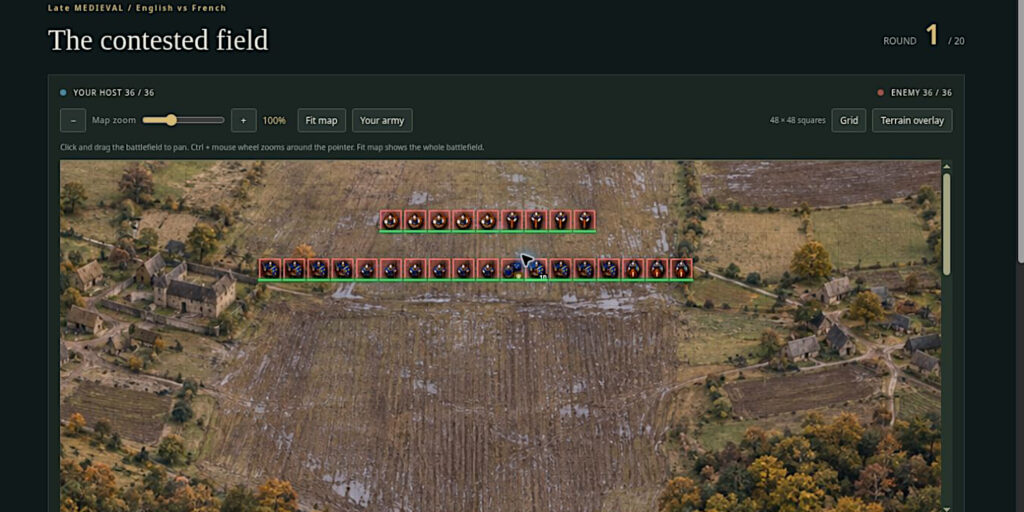
An expensive cavalry company, a clear target and a very confident plan. Then you notice the ploughed field between them.
That is where Levy & Lance becomes interesting. Terrain and weather change movement, protection, shooting and the value of a charge. The best place for a unit depends on what it needs to do, what stands in its way and whether the conditions allow it to get there.
I like that this makes reading the battlefield part of commanding an army. Before admiring your knights, inspect their route. The horses have several valid concerns.
How Terrain and Weather Work
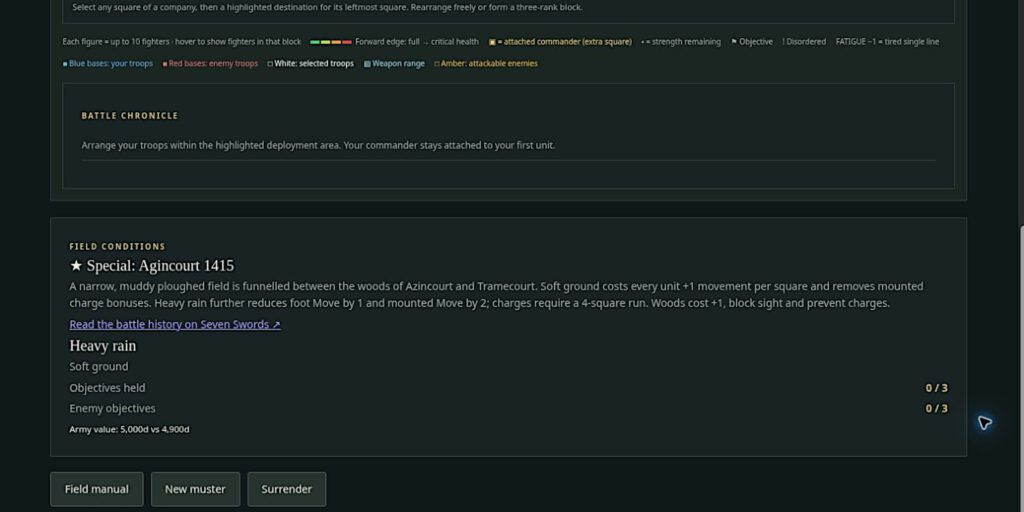
Three things deserve separate attention: terrain features, ground conditions and weather. A wooded approach can obstruct sight, a soft field can increase movement costs and heavy rain can slow troops further.
The current field manual gives the following rules. Levy & Lance is in beta, so check the in-game manual as updates arrive.
| Feature or condition | Current effect | Tactical implication |
|---|---|---|
| Hills and villages | Improve foot troops’ armour saves by one step, to a maximum of 2+ | Useful defensive positions for infantry |
| Woods and villages | Block sight | Check firing lanes before deploying missile troops |
| Difficult terrain | Costs one extra movement point | Plan routes around the movement available |
| Deep rivers | Impassable except at scenario bridge squares | Crossings concentrate movement |
| Ploughed earth and crops | Cost mounted troops one extra movement point | Mounted approaches take more movement |
| Soft ground | Costs everyone one extra movement point | Even infantry advances become slower |
| Heath | Costs foot troops one extra movement point | Account for slower infantry support |
| Stubble, ploughed earth, soft ground and heath | Cancel horse charge bonuses | Reconsider where cavalry should attack |
| Short grass | Adds a horse charge bonus of +1 with a four-square run | Look for a sufficiently long, clear approach |
| Crops | Penalise shooting beyond two squares | Reassess longer firing lanes |
A position can offer one advantage while creating another problem. A village protects infantry, but also blocks sight. A bridge provides a route across a deep river, but makes the point of passage predictable.
Why Hills and Villages Matter to Infantry
Hills and villages improve foot troops’ saves by one step. A normal 4+ save becomes 3+, while armoured troops with a 3+ save can improve to 2+. The maximum is 2+.
That gives infantry a concrete reason to hold favourable ground. If you are choosing where to receive an attack, protection deserves a place in the decision.
It does not make the position invulnerable. Flanking, morale and access still matter. A strong company can become awkwardly isolated if the rest of the army cannot support it.
My first question would be whether the position helps the wider battle. A beautifully defended hill is less impressive if the enemy can win while ignoring it.
Woods Can Disrupt Your Shooting Plan
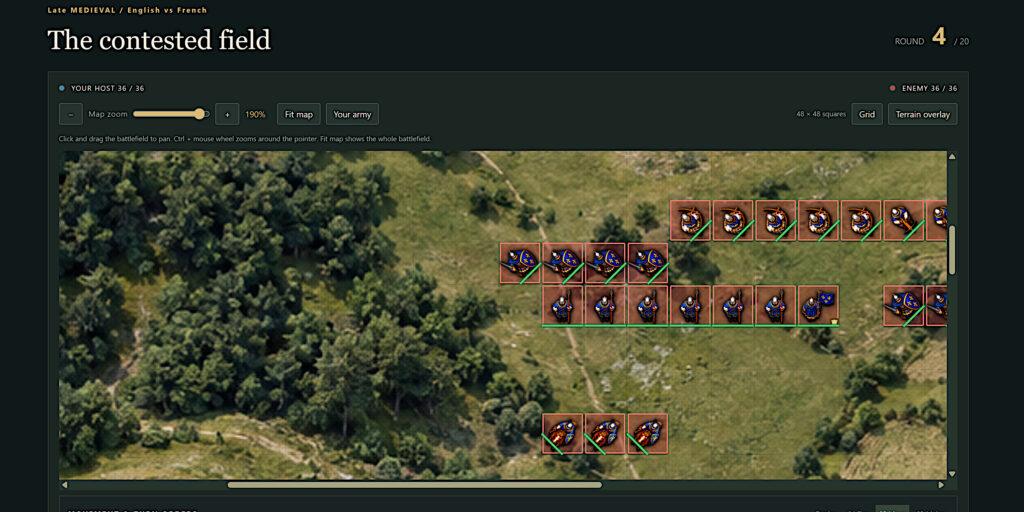
Woods and villages block sight. That makes deployment more demanding than putting archers somewhere behind the infantry and hoping the arrows understand the assignment.
Before committing missile troops, examine the route between their position and likely targets. A seemingly sheltered location may leave them unable to shoot into the area you need to control.
The useful distinction is between protection and a productive firing position. Your archers need opportunities to shoot, as well as a plan for what happens when the enemy gets close.
Woods can also shape approaches by obstructing sight across parts of the battlefield. Do not assume that an attractive view of the map means every unit has the same view.
Rivers and Bridges Shape the Battle
Deep river squares are impassable. Units can cross only where the scenario provides bridge squares.
That makes a crossing strategically significant before anyone attacks. If your force must use a bridge, the order in which companies approach matters. You need room for troops to reach the crossing, pass through it and operate beyond it.
For a defender, the narrow approach offers a chance to concentrate attention on a restricted frontage. For an attacker, it creates a planning problem: how do you get enough force across without leaving the first arrivals unsupported?
Avoid treating the bridge as the entire battlefield. Check what waits beyond it, which positions overlook the approach and where missile troops can actually see.
Getting across is a movement problem. Surviving on the other side is the next one.
Ground Conditions Can Undermine Cavalry Charges
Cavalry needs a suitable approach, and several ground types directly cancel horse charge bonuses.
Stubble, ploughed earth, soft ground and heath all do this. Ploughed earth and crops also cost mounted troops an extra movement point, while soft ground increases movement costs for everyone.
That distinction matters. Movement penalties affect whether you can reach a target. Losing a charge bonus affects the benefit of arriving with a charge.
Short grass offers a more favourable opportunity: it adds +1 to a horse charge with a four-square run. A normal charge requires a straight run of at least three squares, while heavy rain raises that requirement to four. Disorder prevents charges altogether.
Before ordering mounted troops forward, check:
- Whether the approach is straight and long enough.
- Whether the ground cancels the horse charge bonus.
- Whether the weather leaves enough movement available.
- Whether the company is disordered.
- Whether the target is worth committing cavalry against.
An enemy unit being nearby is a location, not a compelling argument.
How Rain, Snow and Wind Affect Battles
Weather changes which plans are practical. The current manual lists these effects:
| Weather | Current effect | What to reconsider |
|---|---|---|
| Light rain | Horse movement reduced by one; horse charge bonus capped at +1 | Mounted reach and expected charge benefit |
| Heavy rain | Foot movement reduced by one; horse movement reduced by two; charges require a four-square straight run | Advance timing, support distances and charge routes |
| Snow | All movement reduced by one; charges can cause disorder | Whether a charge is worth the risk |
| Wind | Penalises long-range shooting | How much your plan depends on distant volleys |
Rain does not affect every troop type equally. In light rain, the listed movement penalty applies to horse. In heavy rain, both foot and mounted troops slow, with the larger reduction affecting horse.
Snow creates another decision because charging can disorder troops. Since disorder prevents charges and reduces Attack, the consequences can extend beyond the initial approach.
Wind makes reliance on long-range shooting less attractive. It does not mean missile troops have no use. It means you should reconsider how much you expect them to achieve at distance.
Terrain and Weather Need to Be Read Together
The most useful question is often how conditions interact along a particular route.
Mounted troops approaching across ploughed earth in heavy rain face several problems: slower horse movement from the weather, an additional movement cost from the ground, a longer run-up requirement and ground that cancels horse charge bonuses.
That is a considerable amount of opposition from a field.
Infantry can face similar timing problems on soft ground in snow. Even if the enemy is within an appealing distance on the map, movement costs may prevent supporting companies from arriving together.
Assess each route using the movement and rules shown in the game. Counting empty squares alone will not tell you whether an attack is achievable.
Build Your Army Around the Battlefield
A cavalry-heavy force wants opportunities to manoeuvre and make useful mounted attacks. Restricted crossings and ground that cancels charge bonuses can reduce those opportunities.
Infantry can exploit the save improvements offered by hills and villages, although reaching those positions and supporting them remain separate tasks.
Missile troops need sight lines. Woods, villages, crops and wind can all complicate the shooting plan in different ways.
I would choose the battlefield and conditions before settling on an army. Then ask what jobs the force must perform: hold a crossing, contest an objective, protect archers or create a mounted threat.
That gives each purchase a purpose. Buying impressive troops first and discovering their purpose afterwards is an entertaining budgeting policy, but a questionable military one.
A Practical Check Before Your First Move
Read the ground before moving towards the nearest enemy.
Identify the crossings, infantry defensive positions and open firing lanes. Trace possible cavalry approaches, including the ground beneath them. Then check the weather and whether your supporting troops can keep pace.
Leave room to manoeuvre. Friendly formations also need space, particularly when several companies are converging on the same passage.
Finally, consider what happens after contact. Can another unit support the attack? Is a flank exposed? Have you committed your mounted troops somewhere they will struggle to leave?
The opening move should make the next decision easier.
Put Your Plan to the Test
A useful way to learn Levy & Lance is to replay a battlefield with a different approach. Change where your infantry holds, choose another cavalry route or move your archers to a clearer firing lane.
Keep other choices similar where possible. You will learn more about the value of a position if you have not also replaced the entire army.
The appeal is in finding out why a plan worked. Sometimes your troops were well chosen. Sometimes you used the ground intelligently. Occasionally, the enemy obligingly helped.
Play Levy & Lance and see whether your next army can make better use of the landscape.
Rules source: Levy & Lance live field manual, checked 25 October 2026.