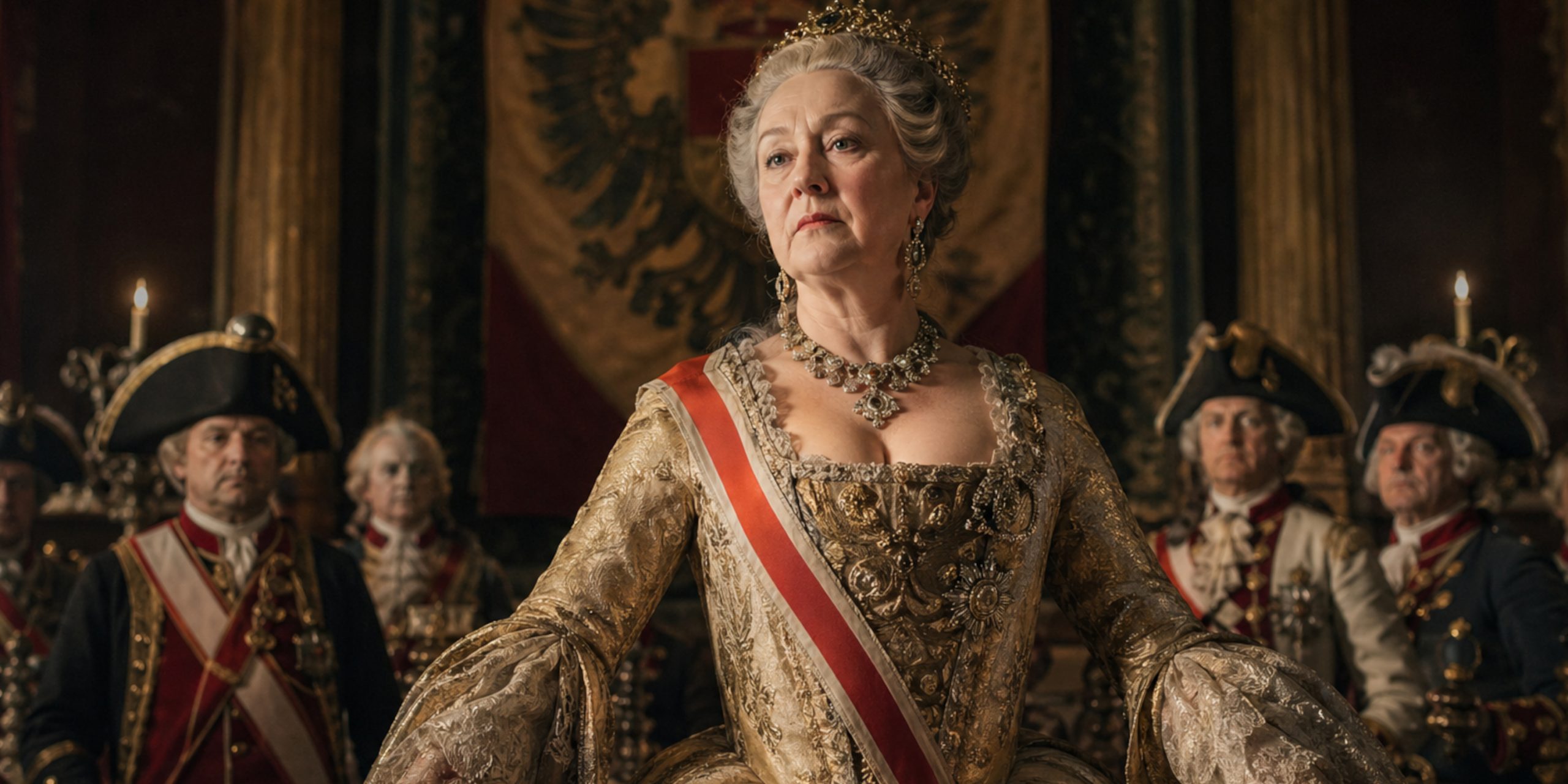
Maria Theresa is often introduced as the formidable matriarch of the Habsburg dynasty, yet that phrase only scratches the surface. She inherited a fragile inheritance and spent much of her reign fighting to keep it intact. Unlike many rulers of her time, she did not seek war out of ambition. War came to her doorstep, and she proved stubborn enough, and capable enough, to survive it.
As a historian, I find her particularly compelling because she was not shaped for rule in the traditional sense. She was not trained as a military commander, nor expected to lead armies. Yet she became one of the most consequential rulers of the eighteenth century, holding together a multinational empire that seemed on the brink of collapse.
Early Life and Accession
Maria Theresa was born in 1717, the eldest surviving daughter of Emperor Charles VI. The problem was clear from the start. The Habsburg lands had long preferred male succession.
To secure her inheritance, Charles issued the Pragmatic Sanction, which declared that his daughter could inherit his territories. European powers agreed to it in theory. In practice, they ignored it the moment he died in 1740.
At twenty three, Maria Theresa found herself ruler of a sprawling empire under immediate threat. Prussia, Bavaria, France and others moved quickly, sensing weakness. What followed would define her reign.
Arms and Armour
Maria Theresa did not personally fight in battle, yet her reign reshaped the military structure of the Habsburg forces. The army she inherited was uneven, poorly coordinated, and often reliant on regional loyalties rather than central command.
Weapons and Equipment
The Austrian army during her reign used a mix of traditional and modernised arms:
- Infantry weapons
- Flintlock muskets, particularly the Model 1745 variants
- Socket bayonets for close combat
- Cavalry arms
- Sabres for light cavalry, especially hussars
- Straight swords for cuirassiers
- Artillery
- Field cannons standardised during reforms
- Improved mobility through better carriage design
Armour and Uniform
Armour had largely fallen out of use, though elite cavalry retained elements:
- Cuirassiers wore breastplates and helmets
- Infantry relied on uniform and discipline rather than protection
- Distinctive regimental uniforms improved identification and cohesion
Her real contribution was not the equipment itself, but the system behind it. She pushed for centralisation, standardisation, and training, which made the army far more reliable over time.
Battles and Military Acumen
Maria Theresa’s reign is inseparable from conflict. She spent much of it defending her inheritance, often against better prepared enemies.
War of the Austrian Succession
This was her trial by fire. Prussia, under Frederick II, seized Silesia almost immediately.
Key moments include:
- The loss of Silesia, a major economic and industrial region
- Austrian resilience despite early defeats
- Diplomatic manoeuvring that kept the empire intact
She did not win clean victories, but she refused to collapse. That alone mattered.
Seven Years’ War
Maria Theresa sought to reclaim Silesia, aligning with former rivals such as France in what became known as the Diplomatic Revolution.
- Austria fought alongside France and Russia
- Initial successes raised hopes of reclaiming Silesia
- Ultimately, the war ended without regaining the territory
Her persistence is striking. She accepted losses when necessary, but never abandoned the larger strategic picture.
Military Strengths
- Strong administrative control over military reform
- Ability to sustain long conflicts without internal collapse
- Effective use of alliances, even unlikely ones
Limitations
- Reliance on generals for battlefield command
- Difficulty matching Prussian military efficiency
- Occasional overextension in prolonged wars
She was not a battlefield tactician, but she understood endurance, and in eighteenth century warfare that often mattered more.
Governance and Reform
Away from the battlefield, Maria Theresa proved a formidable reformer.
She centralised administration across her territories, reducing the autonomy of regional elites. Taxation was made more consistent, which increased state revenue. Education reforms laid the groundwork for a more literate population, something often overlooked in discussions of her reign.
There is a certain irony here. The wars that threatened her rule forced her to modernise the state, and those reforms became her lasting achievement.
Court, Culture and Personality
Maria Theresa’s court in Vienna was both traditional and evolving. She was deeply religious, conservative in many respects, and yet pragmatic when required.
She had sixteen children, which sounds excessive until one remembers that dynastic politics relied heavily on marriage alliances. Her daughter Marie Antoinette would later become Queen of France, with consequences that echo far beyond Austria.
Personally, she comes across in sources as determined, occasionally stubborn, and fiercely protective of her authority. There is little sense of hesitation once she had settled on a course of action.
Where to See Artefacts from Her Reign
For those interested in physical traces of her world, several locations preserve material from her reign:
- Vienna
- Hofburg Palace, imperial apartments and regalia
- Schönbrunn Palace, her primary residence
- Austrian Museum Collections
- Military equipment and uniforms from her army reforms
- Portraits and court objects
- Central European archives
- Administrative documents reflecting her reforms
Standing in these spaces, one gets a clearer sense of scale. This was not a small kingdom, but a vast and complex empire held together with effort.
Archaeology and Recent Findings
Archaeology tied directly to Maria Theresa is less dramatic than ancient battlefields, yet it is no less revealing.
Recent work has focused on:
- Military sites from the War of the Austrian Succession
- Battlefield surveys identifying troop positions
- Artefacts such as musket balls and uniform fragments
- Urban archaeology in Vienna
- Structural remains from eighteenth century expansion
- Evidence of administrative and residential reforms
- Palace restoration projects
- Layered construction phases revealing changes during her reign
These findings reinforce what written sources suggest. Her rule was not static. It was a period of adjustment, adaptation, and gradual strengthening.
Legacy
Maria Theresa left behind an empire that was far more stable than the one she inherited. She did not recover Silesia, and that loss often overshadows her achievements, perhaps unfairly.
She strengthened the state, improved its institutions, and ensured that the Habsburg monarchy remained a major European power. Her son Joseph II would push reforms further, but the foundation was hers.
From a historian’s perspective, she represents a particular kind of ruler. Not a conqueror, not a visionary in the abstract sense, but a survivor who turned crisis into consolidation. There is something quietly impressive about that.
Takeaway
It is tempting to measure rulers by victories and losses, neat outcomes that fit easily into textbooks. Maria Theresa resists that simplicity.
She lost key territory, yet preserved an empire. She faced repeated threats, yet emerged stronger. She was not supposed to rule, yet ruled for forty years.
That, in itself, tells you almost everything worth knowing.