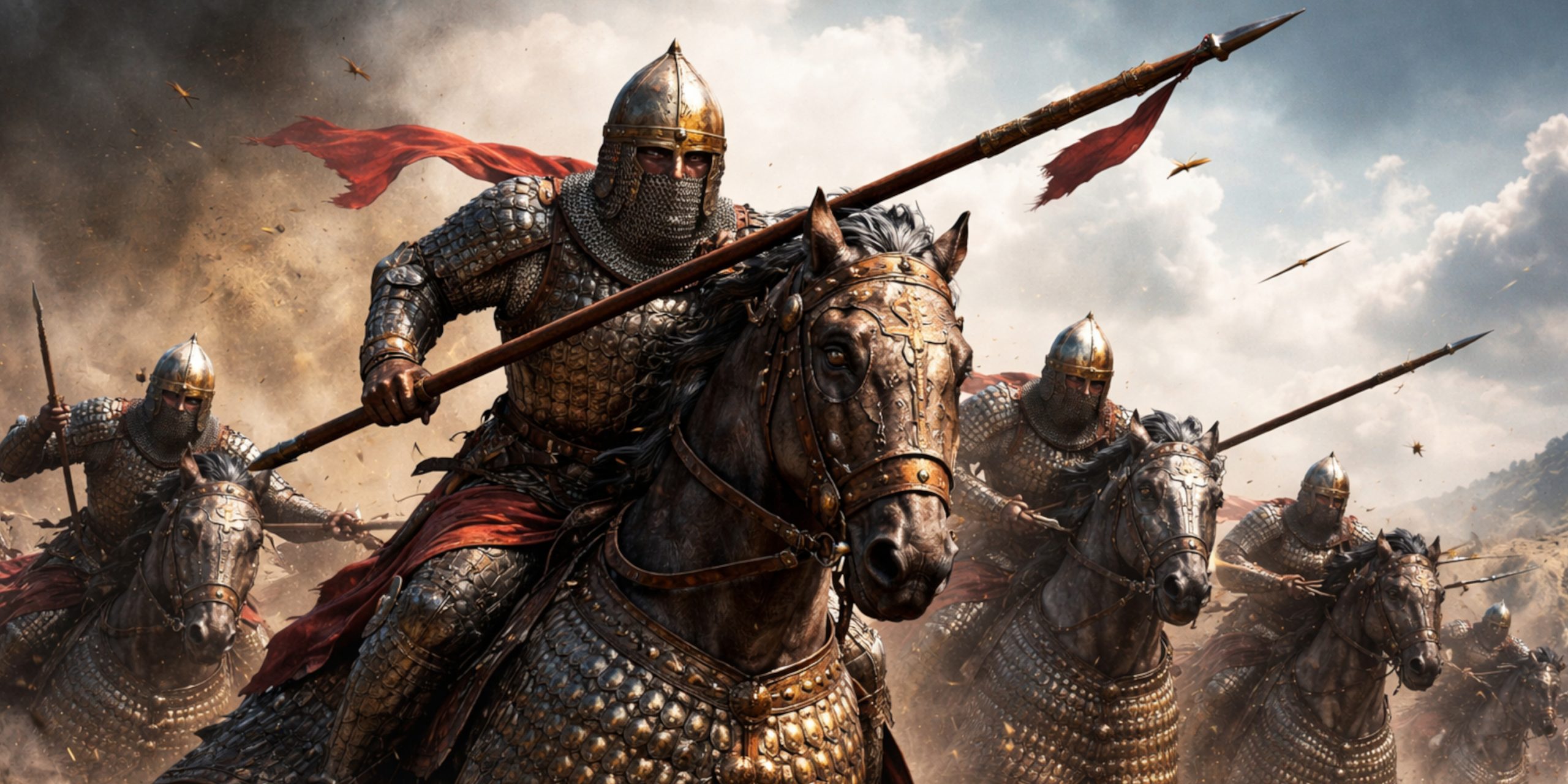
To a medieval infantryman standing in a shield wall, Byzantine Kataphraktoi must have looked less like men and horses and more like a particularly bad day sent by God.
The Kataphraktoi were the elite armoured cavalry of the Byzantine Empire. They combined the traditions of late Roman cavalry, Persian cataphracts and the practical military instincts of an empire that spent a thousand years fighting everybody from Arabs and Bulgars to Normans and Turks. They were expensive, difficult to maintain and gloriously impractical in peacetime, which is usually how one recognises an elite military formation.
At their best, the Kataphraktoi were among the finest cavalry in the medieval world. At their worst, they were a ruinously expensive answer to problems that had already moved elsewhere. Such is the fate of most military elites.
Who Were the Kataphraktoi?
The word “Kataphraktoi” comes from the Greek kataphraktos, meaning “completely enclosed” or “covered over”. The name referred to the heavy armour worn by both rider and horse.
The Byzantines inherited the concept from the late Roman Empire, which had itself borrowed heavily from the armoured horsemen of Parthia and Sassanian Persia. By the middle Byzantine period, especially between the 9th and 11th centuries, the Kataphraktoi had become one of the most distinctive features of Byzantine warfare.
Unlike the western European knight, who often fought as an individual noble in search of glory, the Kataphraktos was intended to fight as part of a disciplined formation. Byzantine military manuals describe them advancing in ordered ranks, supporting one another and combining missile fire with shock action. This was not the sort of cavalry charge that depended on enthusiasm and a large horse. It depended on timing, drill and, ideally, everyone doing exactly what they had been told.
The most famous descriptions come from the reigns of emperors such as Nikephoros II Phokas and John I Tzimiskes, both of whom relied heavily on elite cavalry during their campaigns against Arab states and steppe peoples.
Origins and Development
The roots of the Kataphraktoi stretch back to the late Roman cavalry formations of the 3rd and 4th centuries. Roman writers such as Ammianus Marcellinus described armoured horsemen who appeared “like statues polished by the hand of Praxiteles”, which is perhaps the most elegant way ever devised to say that someone was very shiny.
By the 7th century, the Byzantine Empire had lost much of the eastern provinces where this tradition had flourished. Yet the need for armoured cavalry remained. During the empire’s military revival in the 9th and 10th centuries, emperors invested heavily in cavalry reforms.
Military treatises such as the Praecepta Militaria of Nikephoros II Phokas and the Tactica of Emperor Leo VI the Wise provide detailed instructions for the organisation and use of the Kataphraktoi.
These manuals describe units arranged in wedge-shaped formations, sometimes with lighter cavalry and horse archers supporting the main body. The heavily armoured cavalry would weaken the enemy with arrows before closing for the decisive charge. Byzantine commanders had little patience for charging headlong without preparation. That sort of thing was left to other peoples, who were then written about rather smugly in Byzantine histories.
Arms and Armour
The Kataphraktoi were defined by their armour. Both rider and horse were protected, creating a formidable battlefield presence.
Rider Armour
The rider usually wore:
- A mail shirt or scale cuirass
- Lamellar armour made from overlapping metal plates
- Armoured sleeves and leggings
- A conical or rounded helmet, often with a mail aventail protecting the neck and face
- Sometimes a face mask or partial facial protection
By the 10th century, Byzantine military manuals describe elite cavalry wearing multiple layers of protection. A padded garment could be worn beneath lamellar or mail, while additional arm and leg guards provided yet more defence. It was effective, though one suspects the wearer was grateful whenever somebody invented winter.
Horse Armour
The horse was often protected by barding, usually made from quilted cloth, leather, scale or lamellar plates. Manuals describe armour covering:
- The horse’s neck
- Chest
- Flanks
- Head
A fully armoured horse was rare because of cost, but the wealthiest and best-equipped units certainly used them.
Weapons
The primary weapon of the Kataphraktos was the kontarion, a long thrusting lance used in the charge.
Secondary weapons included:
- Composite bow
- Mace
- Axe
- Dagger
Specific sword types used by Byzantine Kataphraktoi included:
- The straight, double-edged spathion, descended from the Roman spatha
- The longer paramerion, a slightly curved sabre-like sword worn at the waist
- Heavier cavalry swords influenced by eastern steppe and Persian designs
The spathion remained common through much of the middle Byzantine period. It was effective from horseback and capable of both thrusting and cutting. The paramerion became increasingly popular from the 10th century onwards, especially among cavalry influenced by warfare against steppe peoples. A curved sword had obvious advantages when swinging from horseback, though Byzantine officers continued to regard the straight sword with a certain stubborn affection.
Battlefield Tactics
The Kataphraktoi were not simply battering rams on horseback. Byzantine commanders used them with a degree of tactical sophistication that western observers often underestimated.
A common tactic involved three stages:
- Horse archers and light cavalry harassed the enemy
- The Kataphraktoi advanced in close formation
- The charge struck the enemy at the moment their line began to weaken
The preferred formation was often a wedge. Byzantine manuals suggest that heavily armoured cavalry should strike in a concentrated mass at a vulnerable point in the enemy line.
The most famous battlefield use of the Kataphraktoi came during the Byzantine reconquests of the 10th century. Under commanders such as Nikephoros II Phokas and John Tzimiskes, Byzantine cavalry achieved major victories in Syria, Anatolia and the Balkans.
At the Battle of Andrassos, Byzantine cavalry trapped and destroyed an Arab army in a mountain pass. At the Battle of Arcadiopolis, armoured cavalry helped defeat the invading forces of the Kievan Rus.
The Kataphraktoi also fought against the Bulgars, Normans and Seljuk Turks. Against heavily armoured western knights they could hold their own. Against fast-moving steppe horse archers they sometimes struggled, particularly when drawn into long pursuits or exposed ground.
There is a certain irony here. The Byzantine army had spent centuries learning how to defeat heavy cavalry and horse archers. Then, in the 11th century, it began losing to both.
Organisation and Recruitment
Kataphraktoi were usually drawn from the military aristocracy and from wealthy provincial soldiers who could afford the necessary equipment.
The cost of maintaining a Kataphraktos was immense. Armour, horse, barding and weapons required significant wealth. Because of this, they were often associated with the landed military class of Anatolia.
By the 10th century, elite cavalry units were organised into formations attached to the thematic armies and the imperial field army. The emperor also maintained professional regiments in Constantinople.
Some of the best-known elite units included:
- The Scholai
- The Excubitors
- The Hikanatoi
- The Athanatoi, or “Immortals”, revived under Michael VII Doukas
These formations often included heavily armoured cavalry and served as the core of Byzantine field armies.
Contemporary Descriptions
Byzantine and foreign writers left striking descriptions of the Kataphraktoi.
The 10th-century historian Leo the Deacon wrote of Byzantine cavalry:
“Their iron-clad riders shone in the sun, and their horses too were covered in armour.”
The military writer Nikephoros Ouranos advised commanders:
“The cavalry must advance in close order and break the enemy by the weight of their charge.”
Arab chroniclers also commented on the formidable appearance of Byzantine cavalry. One described them as:
“Mounted fortresses.”
A fair description, though perhaps not one calculated to improve a horse’s self-esteem.
Archaeology and Surviving Evidence
Direct archaeological evidence for the Kataphraktoi is relatively rare, largely because iron armour corrodes and cavalry equipment was often reused.
However, important finds include:
- Lamellar armour plates from Byzantine military sites in Anatolia and the Balkans
- Helmets and mail fragments from sites associated with the 10th and 11th centuries
- Depictions of armoured cavalry in manuscripts, ivory carvings and church art
- Coins and seals showing emperors dressed as armoured horsemen
Among the most important visual sources are the illuminated manuscripts of the Madrid Skylitzes, a Byzantine chronicle that includes detailed scenes of cavalry in battle.
Excavations at sites in modern-day Türkiye, Bulgaria and Greece have uncovered lamellar plates and horse fittings that match the descriptions in Byzantine military manuals. Finds from the region around ancient Constantinople also suggest the continued use of elite cavalry equipment into the 11th century.
Several museums today hold artefacts associated with Byzantine cavalry:
- Istanbul Archaeological Museums
- Byzantine and Christian Museum
- Metropolitan Museum of Art
- Dumbarton Oaks Museum
These collections contain helmets, sword fragments, lamellar plates and surviving Byzantine military art.
Decline of the Kataphraktoi
The Kataphraktoi declined during the 11th century. Several factors contributed:
- The weakening of the Anatolian military aristocracy
- Economic problems
- The loss of territory after the Battle of Manzikert
- Increasing reliance on foreign mercenaries
After Manzikert, the Byzantine Empire lost much of the land and wealth that had sustained its heavy cavalry. The empire increasingly relied on western knights, Turkic horsemen and mercenary forces.
By the time of the later Byzantine Empire, the classic Kataphraktos had largely disappeared. Yet the idea endured. Byzantine military traditions influenced the cavalry of eastern Europe, the Islamic world and even western chivalry.
The Kataphraktoi had been one of the most disciplined and formidable cavalry forces of the medieval world. They represented the Byzantine talent for taking old ideas, borrowing shamelessly from their enemies, refining them with bureaucracy and producing something uniquely effective. The empire did many things well. Turning warfare into an administrative science was one of them.