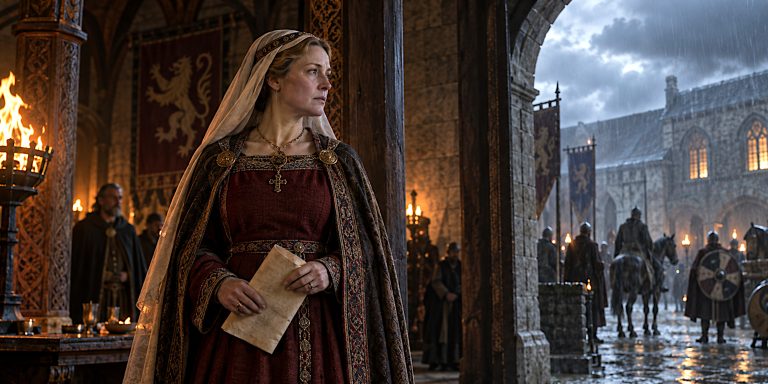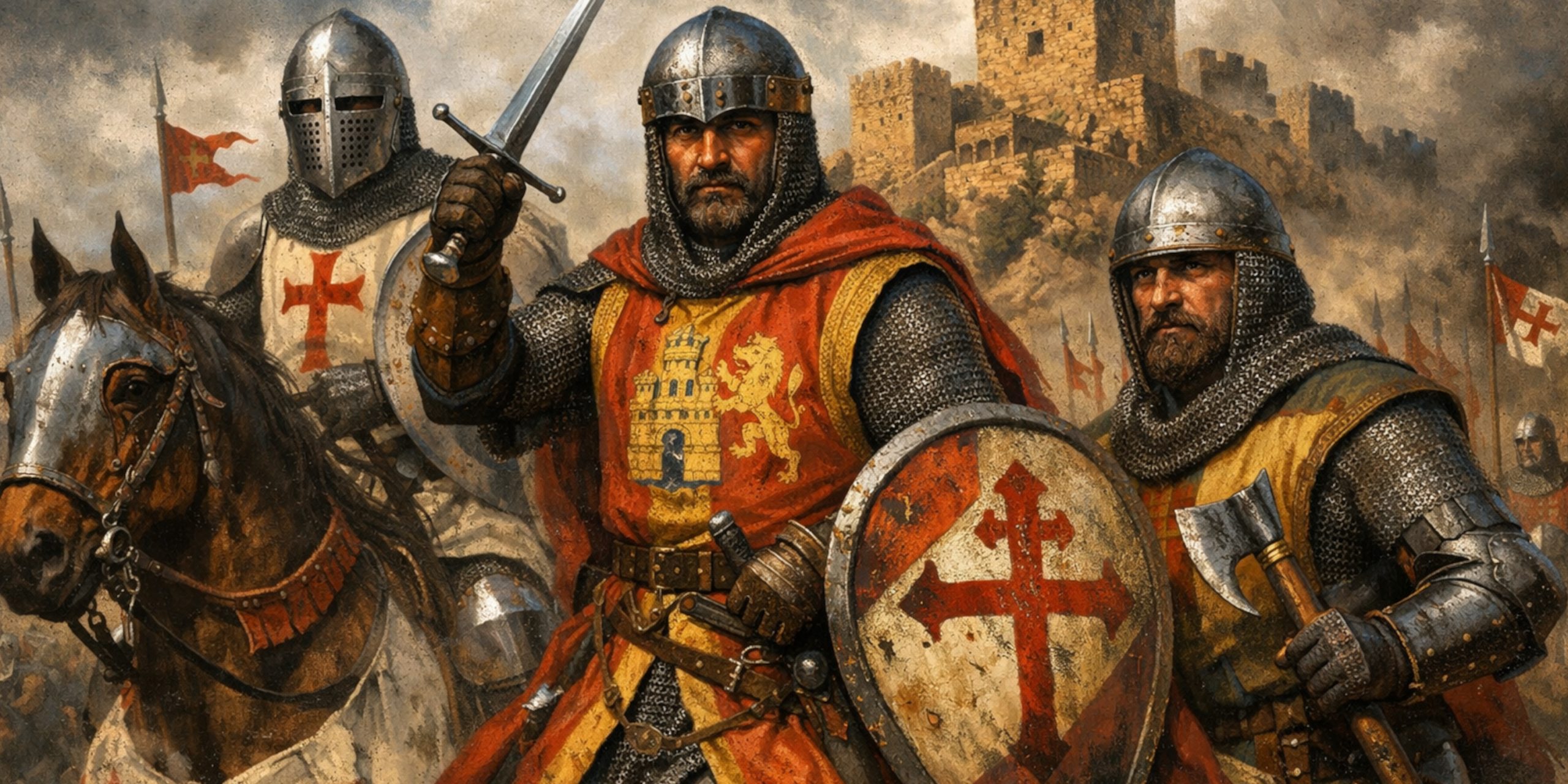
The Spanish caballero occupies a curious place in medieval history. He was a knight, certainly, but not quite the same as his counterparts in France or England. He rode into battle with lance and sword like any aristocratic warrior of the age, yet he was shaped by centuries of warfare on the Iberian frontier. The long struggle between Christian kingdoms and Muslim states gave Spanish knighthood a harder, leaner edge. French knights tended to dream of tournaments and courtly romances. The Spanish caballero spent rather more time worrying about raids, sieges and whether his horse would survive another campaign in the dry hills of Castile.
From the 12th to the 15th century, caballeros became one of the defining military and social classes of medieval Spain. They fought at Las Navas de Tolosa, the sieges of Seville and Granada, and in the bitter civil wars of Castile and Aragon. They were noblemen, military leaders and often landowners, though not always grand aristocrats. Some were wealthy magnates with retinues of armed men. Others were modest frontier horsemen with a mail shirt, a decent sword and just enough money to keep a horse fed. In medieval Spain, that alone could qualify a man for knighthood. Barely.
Who Were the Caballeros?
The word caballero comes from the Spanish word caballo, meaning horse. A caballero was therefore, quite literally, a horseman. In practice, it referred to a mounted warrior of noble or semi-noble status.
By the 12th century, the kingdoms of Castile, León, Aragon, Navarre and Portugal had developed their own traditions of knighthood. These were influenced by wider European chivalry, particularly through contact with France during the Crusades and the pilgrimage route to Santiago de Compostela. Yet the Spanish caballero remained distinct.
Unlike the heavily ritualised knightly culture of northern Europe, Spanish knighthood was often more practical. Men could become caballeros through military service rather than birth alone. On the frontier, a capable mounted warrior was too useful to ignore simply because his grandfather had been a merchant rather than a count.
Several categories of caballeros existed:
- Caballeros hidalgos: lesser nobles who served as mounted warriors.
- Caballeros villanos: wealthy commoners granted privileges in return for military service.
- Caballeros de las órdenes militares: knights of military orders such as Santiago, Calatrava and Alcántara.
- Grand noble caballeros: aristocrats with extensive lands and private armies.
The caballero therefore sat somewhere between nobleman and professional soldier. In Spain, those two things often blurred into one another.
The Reconquista and the Making of the Caballero
The rise of the caballero cannot be separated from the Reconquista. For centuries the Christian kingdoms of Iberia fought to expand southwards against Muslim states. This was not one continuous war, despite what old-fashioned history books sometimes suggest. It was a complicated mixture of battles, alliances, betrayals and occasional periods in which everyone stopped fighting long enough to argue over taxes instead.
For caballeros, frontier warfare shaped every aspect of life.
Spanish knights needed to:
- Ride long distances quickly.
- Fight in open country and rough terrain.
- Conduct raids and counter-raids.
- Serve in sieges.
- Operate in small, flexible groups rather than only in mass cavalry charges.
As a result, Spanish cavalry was often lighter and more mobile than the classic French knight. A Castilian caballero of the 13th century might wear mail and carry a lance, but he was also expected to skirmish, scout and survive harsh campaigning.
The great turning point came at the Battle of Las Navas de Tolosa in 1212, where the combined armies of Castile, Aragon and Navarre defeated the Almohads. Caballeros formed the striking force of the Christian armies. Their charge helped break the Muslim centre and opened the way for later conquests such as Córdoba, Valencia and Seville.
Social Status and Daily Life
Caballeros were not merely soldiers. They formed part of the ruling class of medieval Spain.
In return for military service they often received:
- Land grants
- Tax exemptions
- Legal privileges
- Rights over villages or estates
- A share of plunder and captured property
Many lived in fortified manor houses or small castles near the frontier. Life could be uncomfortable and often dangerous. A caballero might spend one month overseeing harvests and the next riding off to defend a border town from a raid.
The ideal caballero was expected to display:
- Courage
- Loyalty
- Generosity
- Piety
- Martial skill
Naturally, many failed at one or more of these. Medieval chroniclers contain an astonishing number of complaints about greedy nobles, cowardly commanders and knights who appeared more interested in collecting taxes than fighting. Human nature has always been remarkably consistent.
Arms and Armour
The arms and armour of the Spanish caballero changed significantly between the 12th and 15th centuries. Earlier caballeros looked much like other European knights in mail armour. By the 15th century they wore sophisticated plate armour influenced by Italian and German fashions.
Armour of the 12th and 13th Centuries
A typical 12th-century caballero might wear:
- A long mail hauberk reaching to the knees
- A padded gambeson underneath
- A conical or rounded iron helmet
- A nasal helmet or early great helm
- Mail chausses protecting the legs
- A kite-shaped shield
By the 13th century, great helms became more common, along with surcoats worn over armour. Shields gradually became smaller as armour improved.
Armour of the 14th and 15th Centuries
By the late 14th century, Spanish caballeros increasingly adopted plate armour:
- Breastplates and backplates
- Arm and leg harnesses
- Visored bascinets
- Sallets and armet helmets
- Reinforced gauntlets and sabatons
The richest caballeros of the 15th century wore full plate armour comparable to that of Burgundy or Italy. Spanish armourers, especially in Toledo, gained a formidable reputation.
The armour of Spanish knights often reflected the practical needs of Iberian warfare. Full tournament armour existed, but field armour tended to remain slightly lighter and more flexible. There is little point in wearing a magnificent steel shell if you then expire of heat somewhere outside Granada.
Specific Sword Types Used by Spanish Caballeros
The sword remained the defining weapon of the caballero, both in battle and as a symbol of status.
Common sword types included:
| Period | Sword Type | Description |
|---|---|---|
| 12th century | Early knightly sword | Broad, straight double-edged sword, often corresponding to Oakeshott Types X and XI. Good for cutting from horseback. |
| 12th-13th centuries | Arming sword | One-handed sword used with shield. Often carried by Castilian and Aragonese knights. |
| 13th century | Oakeshott Type XII sword | A versatile cavalry sword with a broad blade and improved thrusting point. Widely used during the Reconquista. |
| 14th century | Long arming sword | Slightly longer one-handed swords with narrower blades. Suitable against improving armour. |
| 14th-15th centuries | Hand-and-a-half sword | Used by wealthier caballeros. Allowed greater power and flexibility in combat. |
| 15th century | Early estoc | A rigid thrusting sword designed to penetrate gaps in plate armour. |
| Throughout period | Jineta sword | A lighter Iberian cavalry sword influenced by Andalusi and Moorish styles, especially popular in southern Spain. |
Spanish knights were also strongly associated with the famous swords of Toledo. Toledo steel had been renowned since Roman times, and by the late Middle Ages its blades were prized across Europe.
Other weapons carried by caballeros included:
- Lance
- Spear
- Mace
- War hammer
- Dagger
- Crossbow
The dagger was especially important in close combat. The misericorde, used to thrust into the gaps of armour, had an unfortunate but accurate name.
Horses and Cavalry Tactics
No caballero existed without his horse. A mounted knight without a horse was simply a very heavily dressed pedestrian.
Spanish caballeros generally used two styles of riding:
- A la brida: the heavier European style, suitable for lance charges.
- A la jineta: a lighter, faster style influenced by Moorish cavalry.
The jineta style became increasingly important in the later Middle Ages. Riders used shorter stirrups and more agile horses, allowing rapid manoeuvres and hit-and-run tactics.
This influence from Muslim Spain gave Spanish cavalry a distinct character. In the 15th century, Castilian knights fighting in Granada often combined the heavy lance charge with lighter cavalry tactics borrowed from their opponents.
Caballeros and the Military Orders
Some of the most famous Spanish caballeros belonged to military orders.
These included:
- The Order of Santiago
- The Order of Calatrava
- The Order of Alcántara n- The Order of Montesa
These organisations combined the ideals of monk and knight. Members took religious vows while also fighting on the frontier.
The military orders controlled vast estates and castles across Spain. Their knights often played major roles in campaigns against Muslim kingdoms.
The Order of Santiago in particular became enormously powerful. By the 15th century it possessed huge wealth and influence, to the point where the Crown began to worry. Medieval kings tended to become nervous whenever someone else had too many castles and armed men. One can understand why.
Famous Caballeros
Several Spanish knights became legendary figures.
Rodrigo Díaz de Vivar, El Cid
Although he lived slightly before the 12th century, El Cid remained the model of the Spanish caballero for centuries. Soldier, exile, warlord and sometime mercenary, he fought for both Christian and Muslim rulers.
His sword, Tizona, became one of the great symbols of Spanish knighthood.
Álvar Fáñez
A companion of El Cid, Álvar Fáñez became celebrated in Castilian tradition as a capable and loyal frontier commander.
Gonzalo Fernández de Córdoba
At the very end of the 15th century, Gonzalo Fernández de Córdoba represented the transition from the medieval caballero to the Renaissance commander. Known as “The Great Captain”, he modernised Spanish warfare and helped create the armies that would dominate Europe in the 16th century.
Archaeology and Surviving Evidence
Archaeology has revealed a great deal about Spanish caballeros and their equipment.
Excavations at castles, battlefields and burial sites across Spain have uncovered:
- Mail fragments
- Spurs
- Sword blades
- Lance heads
- Horse fittings
- Helmets
- Decorative belt mounts
Finds from Las Navas de Tolosa, Alarcos and other battlefields have shown the mixture of Christian and Muslim equipment used in Iberian warfare.
Archaeologists have discovered evidence that Spanish knights often reused and adapted captured arms and armour. A caballero on campaign was unlikely to reject a perfectly good helmet simply because it had once belonged to the other side.
Excavations at medieval castles such as Calatrava la Nueva and Loarre have also revealed the living conditions of knightly households. Weapons were found alongside pottery, cooking tools and religious objects, which is a useful reminder that even the most fearsome caballero still had to eat dinner and occasionally mend his boots.
Several notable surviving artefacts remain:
- The sword Tizona, traditionally associated with El Cid
- Knightly tomb effigies in Burgos, Toledo and León
- Armour fragments from the Alcázar of Segovia
- Spurs and swords recovered from frontier fortresses in Andalusia
Contemporary Quotes
Medieval chroniclers left vivid descriptions of Spanish caballeros.
The Poema de Mio Cid praised the mounted warriors of Castile:
“They rode out with shining shields and bright swords, their banners fluttering in the wind.”
The chronicler Rodrigo Jiménez de Rada described the Christian charge at Las Navas de Tolosa:
“The knights advanced with such force that no enemy could withstand them.”
A later 15th-century observer, Hernando del Pulgar, wrote of Castilian nobles:
“They were men more eager for honour in war than for peace at home.”
That may be slightly flattering. Some noblemen were indeed eager for honour. Others were simply eager for the next opportunity to argue with their neighbours while armed.
The Decline of the Caballero
By the late 15th century, the traditional caballero was beginning to disappear.
Several factors contributed:
- The rise of gunpowder weapons
- Professional infantry armies
- Centralised royal power
- The decline of feudal obligations
The conquest of Granada in 1492 marked the end of the Reconquista and the world that had created the caballero. Spain still produced noble cavalrymen, but they increasingly served as officers in royal armies rather than as independent frontier knights.
The romantic image of the Spanish caballero survived long after the reality had faded. Later generations imagined him as the perfect knight: brave, honourable and splendidly mounted. The truth was rather more interesting. Real caballeros were ambitious, practical, often ruthless and shaped by centuries of hard warfare on one of medieval Europe’s most dangerous frontiers.
Legacy
The Spanish caballero left a profound mark on Spanish culture and identity.
His influence can still be seen in:
- Spanish literature and epic poetry
- Heraldry and noble traditions
- The military orders that survive today
- The image of the mounted hidalgo in later Spanish history
- The enduring reputation of Toledo steel
Without the caballeros, the history of medieval Spain would have been entirely different. They helped build kingdoms, win battles and shape the culture of Iberia. They also left behind some excellent swords, which from a historian’s point of view is always a welcome contribution.
Further Reading
- The World of El Cid by Simon Barton and Richard Fletcher
- Reconquest and Crusade in Medieval Spain by Joseph F. O’Callaghan
- The Knight in Spain by Angus MacKay
- The Art of Medieval Spain by Jerrilynn Dodds
- Arms and Armour of the Medieval Knight by David Edge and John Miles Paddock