There are few devices from the medieval and early modern world that feel as grimly theatrical as the breaking wheel. It sits somewhere between punishment and performance, a tool of execution that was designed not only to end a life, but to make a point while doing it.
As a historian, one quickly learns that the wheel was not an outlier. It was part of a wider system of justice that leaned heavily on visibility, symbolism, and deterrence. Still, even within that context, it has a reputation that lingers. You do not forget it once you understand how it worked.
Origins and Spread
The breaking wheel appears in European records from at least the High Middle Ages, though its roots likely stretch back further into Roman practices of corporal punishment. By the thirteenth century it was firmly embedded in the judicial systems of regions such as the Holy Roman Empire and France.
Its use spread unevenly. In parts of Germany it became a standard punishment for severe crimes such as murder, robbery, and aggravated theft. In France it was known as the roue, and its application could be as much about public order as legal retribution. England, rather notably, did not adopt it in any sustained way, favouring hanging and drawing instead. One might say the English preferred efficiency, or at least a different flavour of brutality.
How the Breaking Wheel Worked
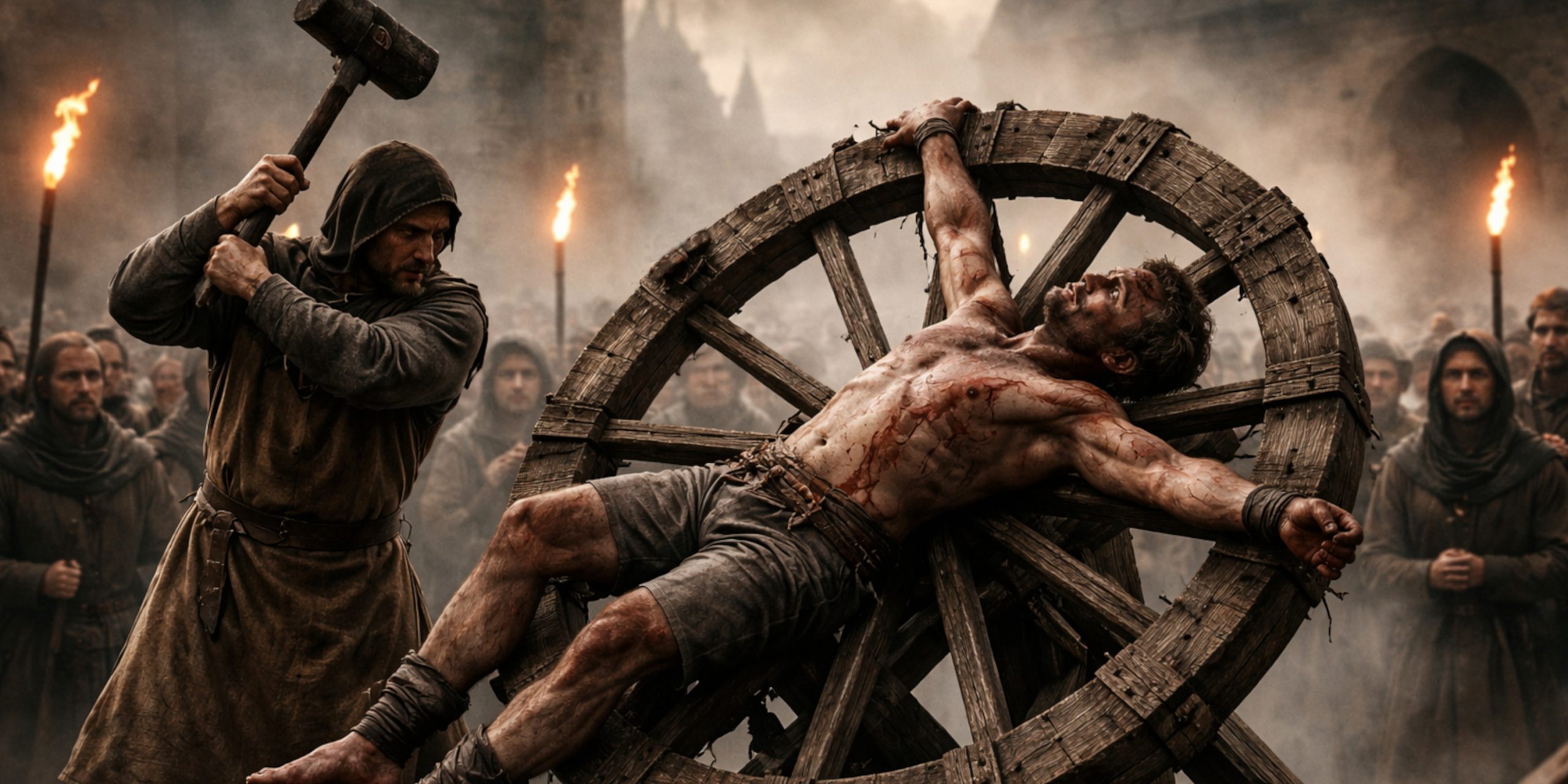
At its simplest, the process involved the systematic shattering of a condemned person’s limbs using an iron bar or hammer. The executioner followed a prescribed sequence, often dictated by the sentence itself.
There were two main approaches:
- Breaking from below upwards, considered the harsher method, prolonging suffering
- Breaking from above downwards, sometimes seen as more merciful, though that word feels misplaced here
Once the limbs were broken, the victim was either:
- Woven into the spokes of a large wooden wheel
- Tied atop it and raised on a pole for public display
Death did not always come quickly. In some cases, the condemned lingered for hours, even days. It is at this point that modern readers tend to look away. Medieval audiences did not.
Legal Framework and Sentencing
The breaking wheel was not an arbitrary act of cruelty. It was codified within legal systems, particularly under the Carolina Code of Constitutio Criminalis Carolina, issued by Charles V in 1532.
This code standardised criminal procedure and punishments across much of the Holy Roman Empire. The wheel was reserved for crimes considered especially destructive to social order.
Sentences could be highly specific. A judge might decree the exact number of blows, the sequence of limbs to be struck, and whether the executioner should deliver a final mercy stroke to the chest or neck. That last detail, unsurprisingly, mattered a great deal.
Public Spectacle and Social Function
Executions by wheel were public events, staged in marketplaces or just outside city walls. Crowds gathered, not merely out of curiosity, but because attendance was part of civic life.
The intention was clear:
- Reinforce the authority of the law
- Demonstrate the consequences of crime
- Offer a form of moral instruction
Contemporary accounts suggest a mixture of reactions. Some spectators prayed. Others treated it with a certain grim fascination. There are records of vendors selling food nearby, which tells you something about how normalised these events could become.
Contemporary Accounts
Primary sources are never short of detail, though they often require a strong stomach.
The chronicler Sebastian Franck described executions by wheel with unsettling clarity:
“They strike him upon the limbs with heavy blows, until bone and flesh give way, and he is set upon the wheel to die in torment.”
Similarly, legal records from France note the deliberate pacing of the act:
“The executioner shall break the arms and legs in such order as decreed, and the body shall be exposed upon the wheel until life departs.”
There is little ambiguity in these descriptions. Nor much mercy.
Variations and Regional Practices
Despite a shared concept, the breaking wheel varied by region.
In German territories:
- Greater emphasis on precise legal procedure
- Frequent use of the mercy blow
In France:
- More elaborate public staging
- Occasional delays in delivering death
In Eastern Europe:
- Continued use into later periods
- Sometimes combined with other forms of punishment
These differences remind us that even brutality has local customs.
Archaeology and Evidence
Unlike swords or armour, the breaking wheel leaves little in the way of physical artefacts. Wood decays, iron bars are reused, and execution sites are often repurposed.
What remains comes from:
- Court records and legal documents
- Illustrated manuscripts and engravings
- Skeletal remains showing patterns of trauma
Archaeological studies of human remains have occasionally revealed multiple fractures consistent with judicial execution. While it is rarely possible to say with certainty that a victim died on the wheel, the evidence aligns closely with written accounts.
Decline and Abolition
By the eighteenth century, attitudes towards punishment began to shift. Enlightenment thinkers questioned the morality and effectiveness of such spectacles.
The breaking wheel gradually fell out of use:
- Abolished in many regions during the late eighteenth and early nineteenth centuries
- Replaced by methods considered more humane, such as beheading or later the guillotine
The irony, of course, is that each generation tends to believe it has found a cleaner way to administer death.
Cultural Legacy
The breaking wheel has endured in literature, art, and collective memory. It appears in medieval illustrations with unsettling regularity, often as a symbol of divine or judicial wrath.
It also serves as a reminder that justice has not always meant restraint. In many ways, the wheel represents a period when punishment was meant to be seen, remembered, and feared.
Final Thoughts
It is tempting to view the breaking wheel as an aberration, something distant and disconnected from modern society. That would be a mistake.
What it really reveals is a different set of priorities. Justice, in this context, was not only about punishment but about communication. The message was carved into bone, quite literally.
And while we may congratulate ourselves on having moved beyond such practices, the underlying question remains uncomfortably familiar. How far should a society go to enforce order, and who decides where that line is drawn?
History rarely answers that neatly.