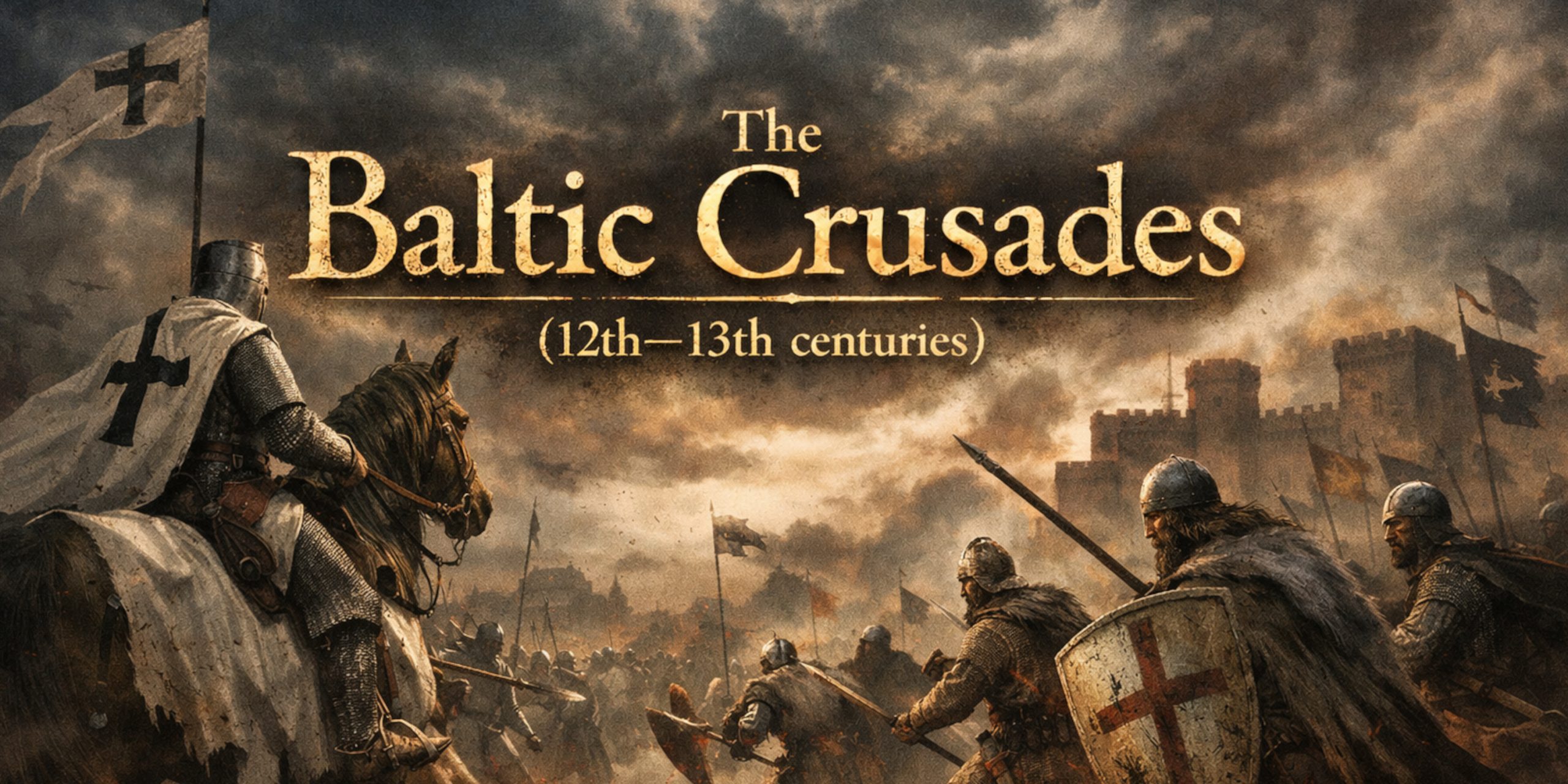
The Baltic Crusades feel different from the better-known expeditions to the Holy Land. They are colder, slower, and in many ways more relentless. Fought across forests, marshes, and frozen rivers, these campaigns pushed into one of the last regions of Europe still practising pre-Christian religions.
From the late 12th century into the 13th, a mix of German knights, Danish kings, Swedish expeditions, and missionary bishops set their sights on Livonia, Prussia, and beyond. What followed was not a single war but a series of grinding campaigns. Conversion and conquest walked hand in hand, and one rarely arrived without the other.
Background and Causes
By the late 1100s, most of Europe had been drawn into Latin Christianity. The Baltic, however, remained a stubborn holdout. The Prussians, Livonians, Letts, Curonians, and Lithuanians followed complex local belief systems tied to land, ancestors, and seasonal rites.
The Papacy framed the region as a legitimate theatre for crusade. The logic was clear, at least on parchment. If Jerusalem could be fought over, then so too could the pagan north.
There were less spiritual motivations at work:
- Control of trade routes along the Baltic Sea
- Expansion of German settlement eastward
- Political ambition among Scandinavian rulers
- The chance for military orders to carve out territories of their own
It is difficult to separate faith from opportunity here. Many participants likely did not bother trying.
The Military Orders and Key Powers
Several groups drove the campaigns forward, often with uneasy cooperation.
- Originally founded in the Holy Land
- Shifted focus to Prussia and later Lithuania
- Developed into a powerful, state-building military force
The Livonian Brothers of the Sword
- Founded to convert and control Livonia
- Eventually absorbed into the Teutonic Order after heavy losses
The Kingdom of Denmark
- Played a major role in Estonia
- Established strongholds along the northern Baltic coast
The Kingdom of Sweden
- Conducted expeditions into Finland
- Aimed to secure influence and expand Christianity eastward
What emerges is not a neat alliance but a loose collection of overlapping ambitions. Even among crusaders, cooperation could be fleeting.
Arms and Armour
The warfare of the Baltic Crusades closely resembled that of contemporary northern Europe, though adapted to harsh terrain.
Crusader Forces
- Mail hauberks with coifs, later reinforced with early plate elements
- Kite and heater shields bearing heraldic devices
- Helmets evolving from nasal helms to enclosed great helms
- Swords typically of Oakeshott Types X to XIII, broad blades suited to cutting
- Lances for cavalry charges, though less effective in forested terrain
Baltic Tribes
- Mixed equipment depending on wealth and region
- Spears, axes, and shorter swords or seaxes
- Round shields, often wooden with iron bosses
- Limited use of armour, though elite warriors could be well equipped
Fighting here was rarely the open-field clash that western knights preferred. Forest ambushes and sudden raids were far more common. A heavily armoured knight is impressive on a field. In a swamp, less so.
Key Battles
The Battle of Saule (1236)
A turning point that still carries a sense of shock. The Livonian Brothers of the Sword marched into Samogitia and found themselves outmanoeuvred.
- Crusader forces were drawn into unfavourable terrain
- Local forces used mobility and knowledge of the land
- The order suffered catastrophic losses
The defeat was so severe that the order effectively ceased to exist as an independent force.
The Battle of the Ice (1242)
Fought on the frozen surface of Lake Peipus, this engagement has gathered a certain mythic quality over time.
- Led by Alexander Nevsky against Teutonic forces
- The crusaders were pushed back across the ice
- Later tradition suggests dramatic collapses, though this is debated
Even without embellishment, it halted further eastward expansion for a time.
The Prussian Uprisings (1242–1274)
Not a single battle but a prolonged resistance.
- Coordinated revolts across Prussian territories
- Destruction of castles and settlements
- Gradual suppression by the Teutonic Order
These uprisings underline a simple point. Conquest did not equal control.
The Battle of Durbe (1260)
Another sharp blow to crusader confidence.
- Samogitian forces defeated the Teutonic Order
- Triggered widespread rebellions in Prussia
- Demonstrated that the order was far from invincible
At this stage, any illusion of easy victory had long since disappeared.
Campaign Life and Strategy
Campaigning in the Baltic demanded a different rhythm.
- Winter warfare was common due to frozen rivers enabling movement
- Castles became essential, acting as anchors of control
- Raiding and counter-raiding dominated much of the conflict
The crusaders built a network of fortifications. Brick by brick, quite literally, they reshaped the landscape. The Teutonic castles still standing today speak to that ambition.
Archaeology and Material Evidence
Archaeology has done much to ground these campaigns in reality.
Excavations across Poland, Latvia, and Estonia have revealed:
- Remains of Teutonic castles such as Malbork, a vast brick fortress complex
- Burn layers in settlement sites, evidence of repeated destruction
- Weapon finds including swords, spearheads, and crossbow bolts
- Burial sites showing both Christian and pre-Christian practices
One of the more telling patterns is continuity. Even after conversion, older traditions linger in burial customs and material culture. Conversion on paper did not always translate to immediate cultural change.
Recent work has also focused on landscape archaeology, mapping how crusader fortifications altered trade routes and settlement patterns. The effect was long-term and structural.
Contemporary Voices
The written record comes largely from the victors, which always requires a careful reading.
From the Chronicle of Henry of Livonia:
“The pagans fled into the forests, as was their custom, and there prepared their resistance.”
A line that captures both frustration and a grudging respect.
From Peter of Dusburg, writing on the Prussian campaigns:
“They fought with great courage, preferring death to submission.”
Even in a text designed to justify conquest, admiration slips through.
These accounts are not neutral. They are shaped by purpose and audience. Still, they offer glimpses of how both sides were perceived.
Religion and Conversion
Conversion was often presented as the central goal. In practice, it unfolded unevenly.
- Some communities accepted baptism quickly, often under pressure
- Others resisted for decades, even generations
- Missionary work continued alongside military campaigns
The line between conversion and coercion could be thin. A newly baptised village might still quietly observe older rites, particularly in rural areas.
Lithuania stands out for its prolonged resistance, only officially converting in the late 14th century. Even then, the process was gradual.
Legacy and Long-Term Impact
The Baltic Crusades reshaped northern Europe in lasting ways.
- Establishment of the Teutonic State in Prussia
- Integration of Baltic regions into the Christian world
- Expansion of German-speaking populations eastward
- Foundation of cities that still exist today
There is also a harder edge to that legacy. Indigenous cultures were altered, sometimes erased. Languages faded, traditions shifted, and identities were redefined under new political and religious systems.
It is not a story of simple victory. It is a story of transformation, often uncomfortable to trace.
A Historian’s Reflection
There is a tendency to treat crusades as distant, almost abstract events. The Baltic campaigns resist that. They feel closer to the ground.
You can walk through the remains of a Teutonic castle or stand in a forest that once hid a retreating war band. The landscape has not forgotten, even if the details blur.
What strikes me most is the persistence on both sides. The crusaders kept coming, year after year. The local populations kept resisting, often against grim odds. Neither side behaved as if the outcome was inevitable.
History rarely feels inevitable when you are in the middle of it.
Takeaway
The Baltic Crusades were not a single campaign but a long, uneven push into Europe’s final pagan regions. They combined faith, ambition, violence, and endurance in equal measure.
Their outcome shaped borders, cultures, and identities that still define the region today. Yet beneath that broad transformation lies a quieter truth. Change here was contested at every step, and never as straightforward as the chronicles suggest.